

Movies
Why ‘Dumplings’ (2004) Is the Crown Jewel of Gastronomic Horror
In the small subgenre that is gastronomic horror, horror focused primarily on food, only a few films in recent memory have managed to make an impact. Flesh was wet spaghetti slapping you in the face, while The Menu was a surface-to-air rocket that blew up the pop culture landscape on release. Dumplings predates both of them and, in my humble opinion, surpasses them on a filmmaking and narrative level completely.


If there’s one thing my friends have heard time and time again, it’s that I’m always ready for some dumplings. They are one of my favorite things; not just my favorite things to eat, my favorite things bar none. If you steam them or fry them, I will come.
Now, I say this because the 2004 film Dumplings by director Fruit Chan made me fall out of love with dumplings for months after I had watched it. It is a film that I will never forget and utilizes food on film to tell a bizarre, tragic story in a way very few have.
Exploring the Gastronomic Horror Genre
In the small subgenre that is gastronomic horror, horror focused primarily on food, only a few films in recent memory have managed to make an impact. Flesh was wet spaghetti slapping you in the face, while The Menu was a surface-to-air rocket that blew up the pop culture landscape on release. Dumplings predates both of them and, in my humble opinion, surpasses them on a filmmaking and narrative level completely.
I remember first encountering Dumplings during a time in high school when I had gotten into that genre of YouTube video that talked about “disturbing films”, something I’ve derided in previous articles on Horror Press; I stand by the opinion that 9 times out of 10, you will be disappointed when you see a film on those lists. And Dumplings, ultimately, is a very grotesque film that is undoubtedly disturbing, but it’d be a reductive descriptor. Because it’s freaky, bloody, and sometimes psychosexual expression is not so secretly a piece of political counterculture created by a Hong Kong visionary: Fruit Chan.

Fruit Chan, The Man And The Myth
Cinema savant Fruit Chan is a one-man show of film talents: he’s an editor, a writer, but foremost a director. He cemented himself as a legend of the independent film scene in Hong Kong following a slow decade-long crawl to the top and is seen by many as the man who resurrected indie filmmaking during a time of great uncertainty.
The Handover of Hong Kong in ’97, in which Britain relinquished control of the country to mainland China, threatened the country’s economic stability due to speculation of a harsher and more restrictive regime than the United Kingdom’s. This meant a risk to all sectors, including film, and in turn, spurred a new generation of indie filmmakers to take center stage from their mainstream counterparts.
Alongside cinema legendary Wong Kar Wai and terribly underrated master Mabel Cheung, Fruit Chan became a hero of the Hong Kong New Wave era with his crime thrillers Made in Hong Kong and The Longest Summer which tackled the motif of change and Hong Kong’s evolution. And eventually, he brought those same ideas to the horror of Dumplings.
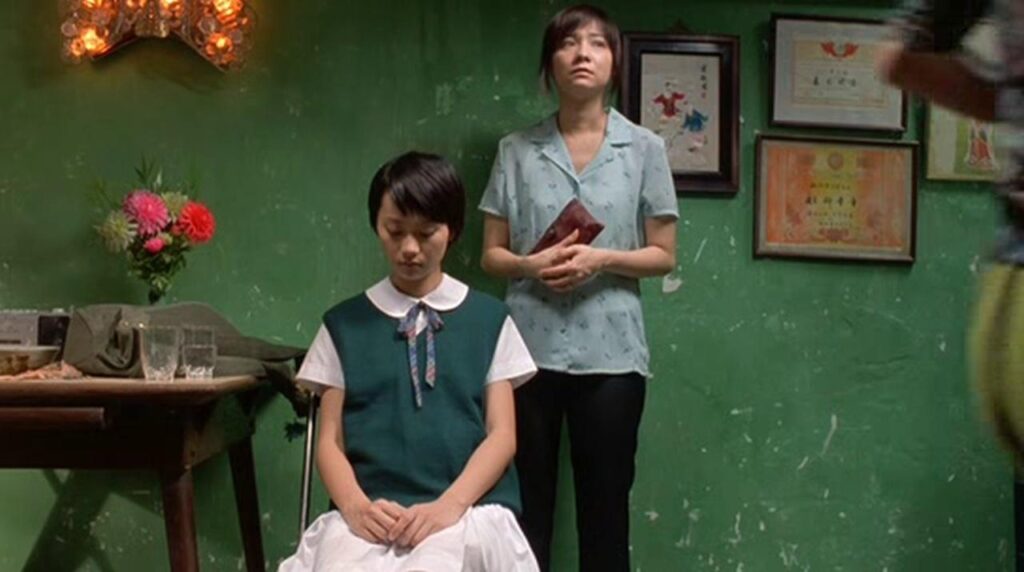
A Story of Tasting Beauty And It’s Ugliest Parts
SPOILERS FOR DUMPLINGS BEGIN HERE.
Released in October of 2004, Dumplings was adapted from the Lilian Lee book of the same name, and later cut into a short film collected in the anthology Three…Extremes. The star of the show is Mrs. Li, an aging starlet whose marriage is slowly dying due to her husband’s infidelity. Blaming her appearance and infertility, Mrs. Li begins paying lump sums of cash to a medicine woman named “Aunt” Mei for miracle dumplings: with a bit of ginger, cabbage, pork, and a potent secret ingredient minced extra fine, Mei cooks up dumplings that restore the youth of the eater. Just one problem…the secret ingredient is fetuses.
The Tragic Descent of Mrs. Li
As Mrs. Li and Mei’s relationship progresses, the duo becomes more entangled as the actress wrestles with the creation and side effects of the “magical” cure to all her problems, which may or may not actually be working at all. The story is equal parts modern fairy tale, drama, and horror show as we watch Mrs. Li’s mind deteriorate and see her slowly become more and more unstable as she’s entrenched in the craving for youth and beauty.
Miriam Yeung as Mrs. Li, captures a depressing sight with elegance, as you watch a figure of beauty and grace be swallowed up by the delusion of becoming “beautiful enough” for a man who doesn’t love her, all the while being acutely aware of her husband’s emotional abuse and infidelity.
Aunt Mei: The Sinister Medicine Woman
Bai Ling’s performance as Aunt Mei is especially memorable and the part of the film that brought it back to the forefront of my mind. Ling embodies the quirks and mannerisms of a witch who has her client by the throat with this underlying sinister mood. There’s a subtle malicious tint to all she says and sings as she tries to sell a ghastly cure to a desperate woman.
And by the end, you’re not particularly rooting for either of them. Still, their chemistry on screen has you craving some resolution as their relationship gets messier and messier. Fruit Chan gives you just that, and a side of cruelty to go with it.
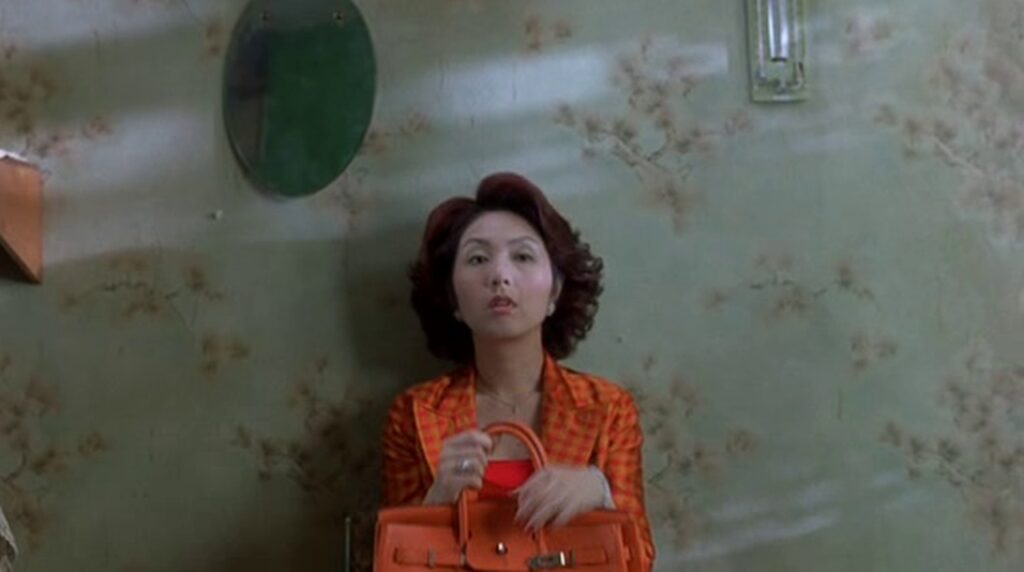
Unsettling Atmospheres and Claustrophobic Spaces
When it comes to the film’s look, Dumplings has a very specific inhospitable vibe that clashes with the small, would-be-comfortable interiors you’re forced to sit in. Mei’s apartment is a tight space, with a wall often being the central feature dividing her and Mrs. Li. The walls are adorned with photos, knick-knacks, and kitschy paintings of children that take on a sinister new meaning watching over the duo as Mrs. Li eats. Shot in Shek Kip Mei Estate, the first public housing estate in all of Hong Kong, it’s filled with people living their lives quietly in the background, but still feels lonely because of how everyone is spaced and placed.
When you get to Mrs. Li’s unfinished mansion, the interiors are framed, often blocking off her guests, shooting around corners and in close-ups being a crucial part of Fruit Chan’s camerawork that communicates the isolation of his subjects. The pristine white walls are more sanitary than classy, and the space as a whole feels like an eternal spec house, never meant to be inhabited.
Cold Lighting and Disgusting Delicacies
Lighting is the key element to making these spaces as uncomfortable as possible, and it’s also the driving force behind making the food in the film unbelievably unappetizing. Because Fruit Chan commits the cardinal sin of food photography, he uses cold lighting. Nothing makes food more unappetizing than cold lighting, and if you’ve ever been in a takeout restaurant late at night with fluorescent bulbs beaming down on whatever combination plate you ordered, you know how bad food can look in the wrong context. This might seem obvious, but this simple cinematic choice amplifies the already disturbing nature of Mrs. Li’s story by taking comfort food and making it feel like something being forced down your throat rather than willingly eaten (a recurring motif of Yeung’s performance while eating in the film).
And none of that is to discount the incredible foley work that gives you every agonizing sound of consumption; every chew, lick, and swallow is audible, and if you’re like me, you’ll want to squirm out of your headphones when you hear it. In a way, Fruit Chan invented a proto-ASMR.
If the goal of ASMR was to be as disgusting as humanly possible.
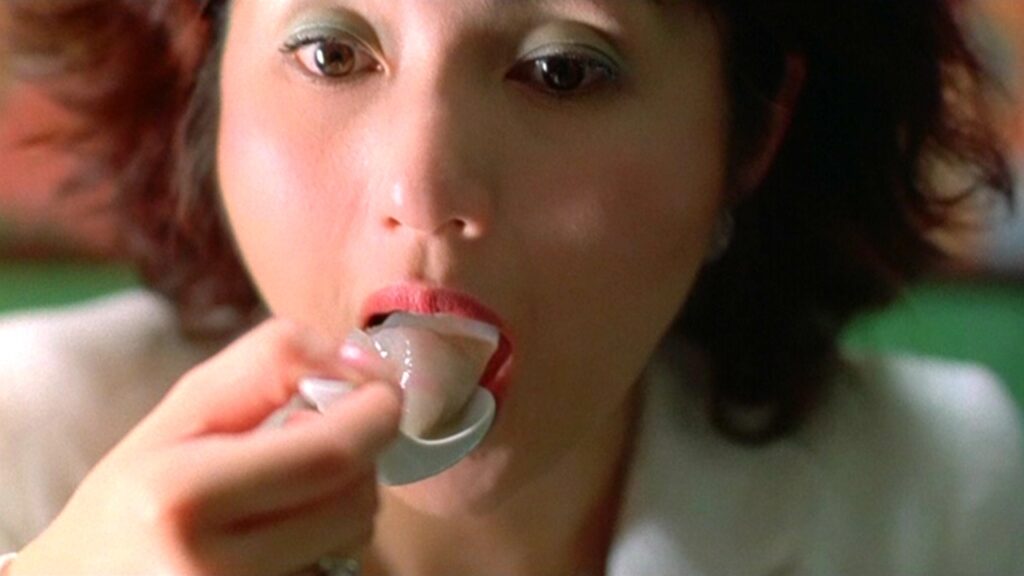
Deeper Themes: Misogyny, Consumption, and Cultural Anxiety
The script itself? That’s a whole other philosophical feast on its own.
The film’s writer and acclaimed author, Lilian Lee, weaves a story that delves into internalized misogyny, sexual violence, and the commodification of young women by the industries and men that use them. Lee makes a contrast early on between Mrs. Li’s consumption of the dumplings and her husband Mr. Li’s taste for balut (fertilized eggs with unhatched chicks in them); there is a clear mirroring between Mr. Li’s appetite for younger women and Mrs. Li’s appetite for his love, one that makes her story all the more futile and tragic as she decays both literally and morally to “better match” her husband.
Betrayal and Structural Violence
Mei’s eventual betrayal of Mrs. Li to sleep with her husband becomes a multiplying factor in that tragedy, as she becomes just one more person to act on the misogyny torturing Mrs. Li. Dumplings has a Cronenberg-esque relationship with sexuality, reminiscent of Videodrome and Crimes of the Future (2022) where sex is often correlated with violence; more on the Crimes end of the spectrum, Dumplings shows sex as a metaphor for structural violence, and how that violence often gets people to act against their own best interest.
Political and Cultural Reflections
What is a messed-up folk tale of misogyny and lost love on the surface also becomes a historically and politically charged film. The illegality of abortion in Hong Kong is brought up several times during the film by Mei, a doctor working in abortion clinics in China during the 1960s and whose marriage dissolved because of it. She travels back and forth from China to Hong Kong in the film, and a great emphasis is put on not only the physical and legal divide, but the cultural divide between the two countries: they’re so close, but so far apart.
The film’s most memorable song is Mei’s renditions of “Wave after Wave in Honghu Lake”, a CCP folk song whose tune changes throughout the film as she sings it to Mrs. Li. It is ultimately completely changed in meaning and tone by the time it is played through the film’s final moments, reflecting the shift in the cultural and political landscape of Hong Kong since the handover.
Cannibalism as Cultural Critique
Yun-Chu Tsai, a doctorate in East Asian languages and literature, posits that the film is a modern analysis of Chinese society and the act of consumption on both the personal and national scale. In her dissertation, “You Are Whom You Eat: Cannibalism in Contemporary Chinese Fiction and Film”, Tsai sees Dumplings as one of the late-stage pieces of media that take cannibalism and uses it to tell the story of a particular cultural anxiety: “both the anxiety of being marginalized and consumed others and the desire for consumption in a post-socialist, neoliberal Chinese society”.
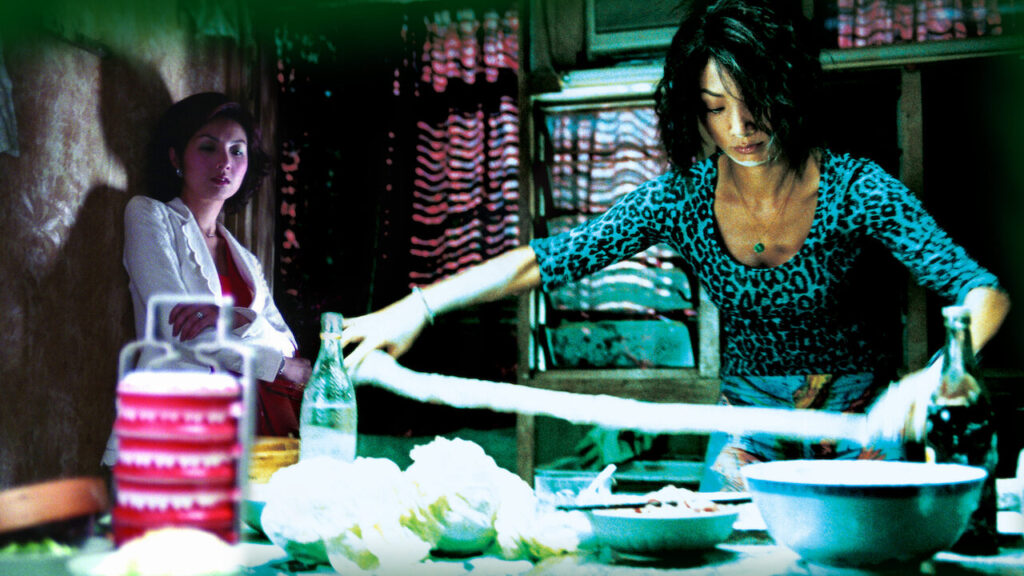
Why Dumplings Remains Unforgettable
In all that I’ve said here today, I have yet to begin to scratch past the surface of Dumplings. To capture all the intricacies and finer details of this film, let alone the numerous readings you can make of it would be borderline impossible.
Dumplings takes a simple staple food and turns it into a conversation that, as any good one shared over a meal, can branch out in a hundred different directions with a thousand different trains of thought wrestling for control. And that conversation will keep the movie in your mind for much, much longer.
So, get out there and get to watching.



I was late to the Radio Silence party. However, I do not let that stop me from being one of the loudest people at the function now. I randomly decided to see Ready or Not in theaters one afternoon in 2019 and walked out a better person for it. The movie introduced me to the work of a team that would become some of my favorite current filmmakers. It also confirmed that getting married is the worst thing one can do. That felt very validating as someone who doesn’t buy into the needing to be married to be complete narrative.
Ready or Not is about a fucked up family with a fucked up tradition. The unassuming Grace (Samara Weaving) thinks her new in-laws are a bit weird. However, she’s blinded by love on her wedding day. She would never suspect that her groom, Alex (Mark O’Brien), would lead her into a deadly wedding night. So, she heads downstairs to play a game with the family, not knowing that they will be hunting her this evening. This is one of the many ways I am different from Grace. I watch enough of the news to know the husband should be the prime suspect, and I have been around long enough to know men are the worst. I also have a commitment phobia, so the idea of walking down the aisle gives me anxiety.

Grace Under Fire
Ready or Not is a horror comedy set on a wealthy family’s estate that got overshadowed by Knives Out. I have gone on record multiple times saying it’s the better movie. Sadly, because it has fewer actors who are household names, people are not ready to have that conversation. However, I’m taking up space this month to talk about catharsis, so let me get back on track. One of the many ways this movie is better than the latter is because of that sweet catharsis awaiting us at the end.
This movie puts Grace through it and then some. Weaving easily makes her one of the easiest final girls to root for over a decade too. From finding out the man she loves has betrayed her, to having to fight off the in-laws trying to kill her, as she is suddenly forced to fight to survive her wedding night. No one can say that Grace doesn’t earn that cigarette at the end of the film. As she sits on the stairs covered in the blood of what was supposed to be her new family, she is a relatable icon. As the unseen cop asks what happened to her, she simply says, “In-laws.” It’s a quick laugh before the credits roll, and “Love Me Tender” by Stereo Jane makes us dance and giggle in our seats.

Ready or Not Proves That Maybe She’s Better Off Alone
It is also a moment in which Grace is one of many women who survives marriage. She comes out of the other side beaten but not broken. Grace finally put herself, and her needs first, and can breathe again in a way she hasn’t since saying I do. She fought kids, her parents-in-law, and even her husband to escape with her life. She refused to be a victim, and with that cigarette, she is finally free and safe. Grace is back to being single, and that’s clearly for the best.
This Guy Busick and R. Christopher Murphy script is funny on the surface, even before you start digging into the subtext. The fact that Ready or Not is a movie where the happy ending is a woman being left alone is not wasted on me, though. While Grace thought being married would make her happy, she now has physical and emotional wounds to remind her that it’s okay to be alone.
One of the things I love about this current era of Radio Silence films is that the women in these projects are not the perfect victims. Whether it’s Ready or Not, Abigail, or Scream (2022), or Scream VI, the girls are fighting. They want to live, they are smart and resourceful, and they know that no one is coming to help them. That’s why I get excited whenever I see Matt Bettinelli-Olpin and Tyler Gillett’s names appear next to a Guy Busick co-written script. Those three have cracked the code to give us women protagonists that are badasses, and often more dangerous than their would-be killers when push comes to shove.

Ready or Not Proves That Commitment is Scarier Than Death
So, watching Grace run around this creepy family’s estate in her wedding dress is a vision. It’s also very much the opposite of what we expect when we see a bride. Wedding days are supposed to be champagne, friends, family, and trying to buy into the societal notion that being married is what we’re supposed to aspire to as AFABs. They start programming us pretty early that we have to learn to cook to feed future husbands and children.
The traditions of being given away by our fathers, and taking our husbands’ last name, are outdated patriarchal nonsense. Let’s not even get started on how some guys still ask for a woman’s father’s permission to propose. These practices tell us that we are not real people so much as pawns men pass off to each other. These are things that cause me to hyperventilate a little when people try to talk to me about settling down.
Marriage Ain’t For Everybody
I have a lot of beef with marriage propaganda. That’s why Ready or Not speaks to me on a bunch of levels that I find surprising and fresh. Most movies would have forced Grace and Alex to make up at the end to continue selling the idea that heterosexual romance is always the answer. Even in horror, the concept that “love will save the day” is shoved at us (glares at The Conjuring Universe). So, it’s cool to see a movie that understands women can be enough on their own. We don’t need a man to complete us, and most of the time, men do lead to more problems. While I am no longer a part-time smoker, I find myself inhaling and exhaling as Grace takes that puff at the end of the film. As a woman who loves being alone, it’s awesome to be seen this way.

The Cigarette of Singledom
We don’t need movies to validate our life choices. However, it’s nice to be acknowledged every so often. If for no other reason than to break up the routine. I’m so tired of seeing movies that feel like a guy and a girl making it work, no matter the odds, is admirable. Sometimes people are better when they separate, and sometimes divorce saves lives. So, I salute Grace and her cathartic cigarette at the end of her bloody ordeal.
I cannot wait to see what single shenanigans she gets into in Ready or Not 2: Here I Come. I personally hope she inherited that money from the dead in-laws who tried her. She deserves to live her best single girl life on a beach somewhere. Grace’s marriage was a short one, but she learned a lot. She survived it, came out the other side stronger, richer, and knowing that marriage isn’t for everybody.

My New Year’s resolution is to spend more time watching my favorite app. Luckily, Shudder is not taking it easy on us this holiday season, so I may meet my quota this January. The streamer is bringing in the new year with quite a few bangers. We have classics from icons, a new title from the first family of indie horror, and a couple of lesser-known films that have finally found a home. So, I am obviously living for this month’s programming and think most of you will too. I have picked the five films that I believe deserve our collective attention the most. Get into each of them and start your 2026 off on the right foot.
The Best Movies to Stream on Shudder This Month
Carrie (1976)
A sheltered teen finally unleashes her telekinetic powers after being humiliated for the last time. Carrie is the reason I thought proms might be cool when I was a kid. This Brian De Palma adaptation is one of my favorite Stephen King adaptations. It is also an important title in the good-for-her subgenre. I cannot help rooting for Carrie White (Sissy Spacek) when I watch her snap at this prom and then head home to accidentally deal with her mom. The only tragedy of this evening is that Carrie had to die, too. I said what I said, and I will be hitting play again while it is on Shudder. This recommendation goes out to the other recovering sheltered girls who would be the problem if they had powers. I see you because I am you.
You can watch Carrie on January 1st.
Marshmallow (2025)
A shy 12-year-old gets sent to summer camp and finds himself in a living nightmare. While Marshmallow did not land for me, I know plenty of people who love it. Which makes this the perfect addition to the Shudder catalogue. I am actually excited to see more folks fall in love with this movie when it hits the streamer. If nothing else, it will help a few folks cross off another 2025 title if they are still playing catch-up with last year’s movies. It also gets cool points from me for not taking the easy route with the mystery it built. I hope you all dig it more than I did, and tell your friends about it. Perhaps you could even encourage them to sign up for the app.
You can watch Marshmallow on January 1st.
Chain Reactions (2024)
Tobe Hooper’s The Texas Chain Saw Massacre cemented his horror legacy over fifty years ago. So, it is long overdue for a documentary where horror royalty can discuss its impact on them and their careers. I have been waiting for a couple of years to hear Karyn Kusama and Takashi Miike talk about Hooper’s work and how he inspired them. So, I am super geeked that Shudder is finally giving me the chance to see this film. The streamer is also helping the nerds out by adding The Texas Chain Saw Massacre (1974) and The Texas Chain Saw Massacre 2 (1986) this month. If you are also an overachieving couch potato, I will see you at the finish line next week.
You can watch Chain Reactions on January 9th.
In the Mouth of Madness (1994)
An insurance investigator discovers the impact a horror writer’s books have on people. I love chaos, and John Carpenter chaos happens to be one of my favorite kinds of chaos. While we talk about The Thing and Halloween all the time, this maestro has given us plenty of horror to celebrate. In the Mouth of Madness is very much one of those titles vying for a top spot among the best of his filmography. To sweeten the batshit pot, this movie features Sam Neill. You know that he only shows up in our genre if the movie is going to be legendary. You cannot tell me this is not a Shudder priority this month.
You can watch In the Mouth of Madness on January 10th.
Mother of Flies (2025)
A terminally ill young woman and her dad head to the woods to seek out a recluse who claims she can cure her cancer. The Adams Family has been holding court on Shudder for years, so it feels right that Mother of Flies is a Shudder Original. More importantly, this fest favorite has one of the best performances of 2025. Which makes it a great time for people to finally get to see it and get in line to give Toby Poser her flowers. Whatever you think your favorite Poser role is, it is about to change when you see her as Solveig. I am being serious when I say that this movie might be the first family of indie horror at their best.
You can watch Mother of Flies on January 23rd.
New year, but same Shudder. I would not want to go into 2026 any other way, personally. I hope these horrific recommendations bring you the good kind of anxiety. Or at least distract you from the state of the world for a bit.


‘Night Patrol’ Review: Vampiric Cop Horror Undone by Messy Execution

The 10 Most Satisfying Deaths in Horror Movies

‘28 Years Later: The Bone Temple’ Review: Nia DaCosta Has the Cure

The Horror Press Podcast Episode 54: Heated Rivalry & Yahtzee

‘Sleepy Hollow’ Review: Seeing Really Is Believing

‘Ready or Not’ and the Cathartic Cigarette of a Relatable Final Girl

‘Carrie’ Review: A Look At Two Adaptations

The Best Horror You Can Stream on Shudder in January 2026

The Best Horror You Can Stream on Netflix in January 2026

‘The Taking of Deborah Logan’ Review: An Overlooked Gem

‘The People Under the Stairs’ Review: A Brilliantly Bizarre Horror Classic

Slappy Was the Blueprint: How the Dummy from Goosebumps Became A Horror Icon

‘Five Nights at Freddy’s’ and The Story of William Afton Explained

Glen and Glenda: Don Mancini’s Reverence for Queerness in ‘Seed of Chucky’ (2004)

‘Truth or Dare’: Who Did it Best?

V/H/S Franchise Ranked, Best to Worst

Everything You Need to Know About Jason Voorhees

The 11 Most Disturbing Horror Movies Ever, According to an Actual Horror Fan

[REVIEW] ‘Cherry Falls’ (1999) Brittany Murphy Shines in This Cult Classic Slasher
