

Misc
Aimee Kuge on Creating ‘Cannibal Mukbang’, Disastrous Dinner Dates, and Timeless Horror
I covered Cannibal Mukbang as part of our Brooklyn Horror Film Festival series, where it came out as a fan favorite for a theatre packed to the gills. Since then, writer-director-to-watch Aimee Kuge has been on a film festival victory lap as the movie is received warmly all over the world, from Austin, to New Orleans, to Italy and back. Luckily, she could carve out some time to talk to us here at Horror Press about the movie and how it was made before things kicked back into high gear. Join us for an interview with director Aimee Kuge!


The holiday season is a tumultuous time. The delicate balancing of relationships, the delicate balancing of food crammed on your Thanksgiving dinner plate. The indulgent nature of two incoming months of holiday parties, baked goods, and finding random candy in your pockets. And most of all, the love and heartbreak that can permeate all around it.
So, is there any better time to talk about the romantic horror comedy Cannibal Mukbang again than now?
I covered Cannibal Mukbang as part of our Brooklyn Horror Film Festival series, where it came out as a fan favorite for a theatre packed to the gills. Since then, writer-director-to-watch Aimee Kuge has been on a film festival victory lap as the movie is received warmly all over the world, from Austin, to New Orleans, to Italy and back. Luckily, she could carve out some time to talk to us here at Horror Press about the movie and how it was made before things kicked back into high gear.
***
First of all, congrats are in order for you and the Cannibal Mukbang crew, given the movie has been getting a lot of love. How does it feel seeing the film realized and getting eyes on it after all this time?
Aimee Kuge: It feels surreal, really magical, and wonderful. I’ve been working in film for a very long time and working on other people’s movies, so this is my first feature. Seeing it on the big screen is a really indescribable experience, so I’m very grateful.
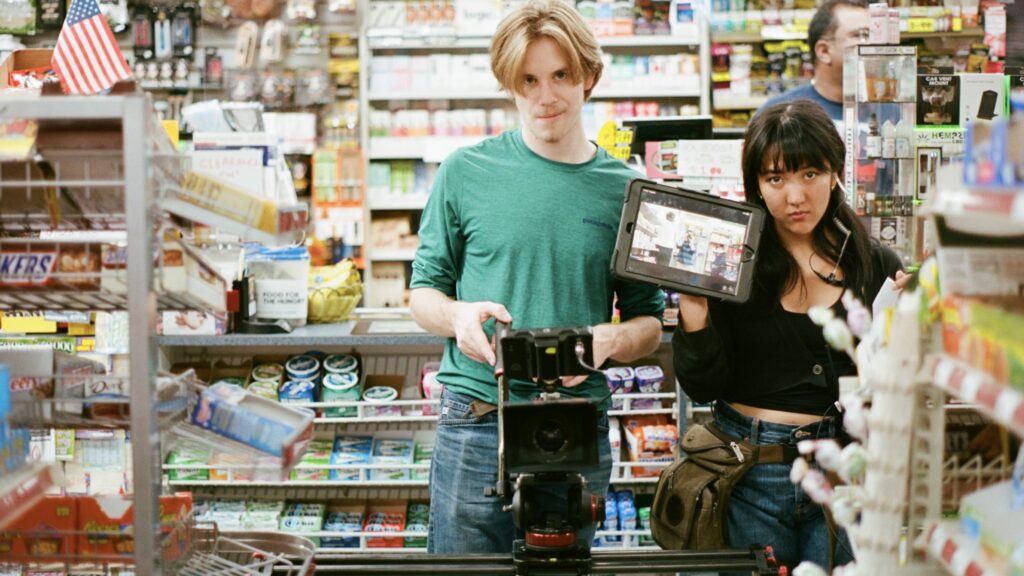
A lot of people ask for an elevator pitch of the movie, but I really want to know: if you had to present Cannibal Mukbang as if it were a dish, how would you describe it? What’s C.M.’s flavor profile?
I mean, it’s a rich, hard-to-capture taste. But it’s a sweet and savory, umami-heavy dish… and has a little bitterness at the end.
Do you remember what the earliest seeds of Cannibal Mukbang looked like? Where were you as a filmmaker and a creative when the idea first came to mind?
A.K.: It actually came to me in 2020, I had been thinking about making something that had to do with food for a while. I was a food photographer for many years in New York when I first moved here, so its always been part of my filmmaking practice. I had been interested in mukbangs, and had some really bad experiences with my own body and with myself during that time. Mukbangs helped me get out of that funk.
But what really solidified the idea for Cannibal Mukbang was when I was at a random party and I met a friend of a friend, who told me about her friend. She had gone on a date with a guy she matched with on Tinder, they had amazing chemistry. He made them an incredible dinner for two, and she wanted to stay the night, but he said he wanted to hold off and see her again, so he sent her off. The next day, she’s excited about the date, but her stomach starts hurting horribly. She ends up going to the hospital, they do some tests on the contents of her stomach…and they find out she had eaten human meat. She tried to find him again, but he just vanished completely.
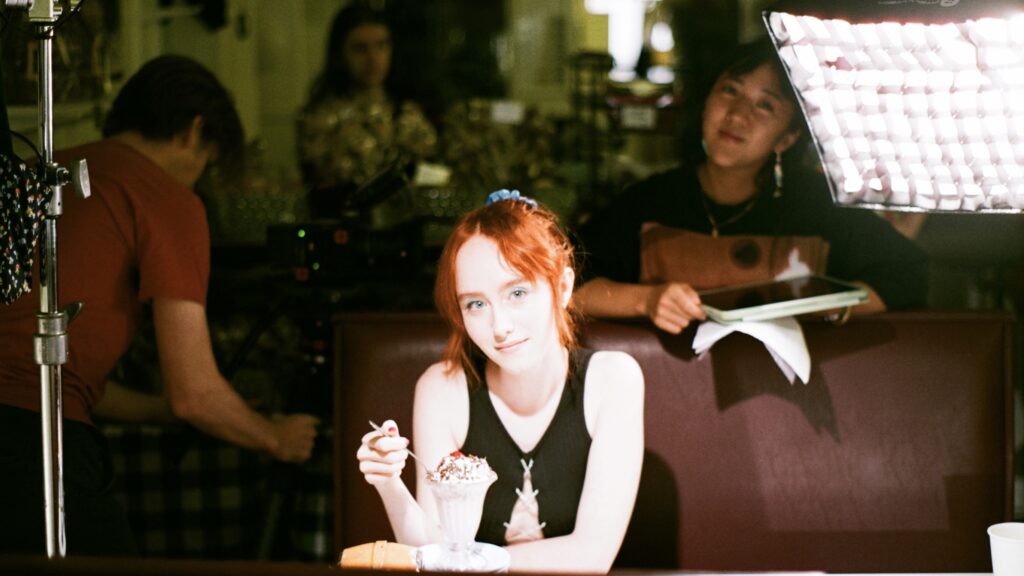
Pictured: April Consalo and Aimee Kuge
That’s a brutal dinner date, to be sure.
A.K.: It was a friend of a friend of a friend, so it might not be a real story. But it connected all the dots for me. Like, “What if I made a movie about a mukbanging cannibal?”! I feel bad for the person if it’s true, but I am grateful for that conversation, and grateful that in my life as an artist, these are the conversations I get to hear and write down. I’m thankful for how these stories transform and morph in different ways.
Cannibalism aside for a moment. As a mukbang fan, were there more conventional food stylists, or particular content creators that you looked to for inspiration while shooting food for the movie?
There are some big mukbangers that were very inspirational to me, definitely Nikocado Avocado; he’s the face of it all. Trisha Paytas was too. I sent her a cold email years ago asking if she wanted to help me with this movie, and she never got back to me! Oh, and also Hunger Diaries. Those were the main three that inspired me the most.
I guess that also begs the question: hours-wise, how much footage of people eating crazy amounts of food did you watch for this film?
Hundreds, if not thousands! It started because I watched Food Network a lot while on the treadmill in college, and it took off from there. I found mukbangs, and now sometimes I watch mukbangs even while I’m working. I love the culture, and I think that the part of me that likes seeing it is disgusting, but it’s worth exploring clearly. These people are making millions, and I’m one of the millions consuming and enjoying it, so they’re onto something. But yeah, hundreds and hundreds of hours. A lot.
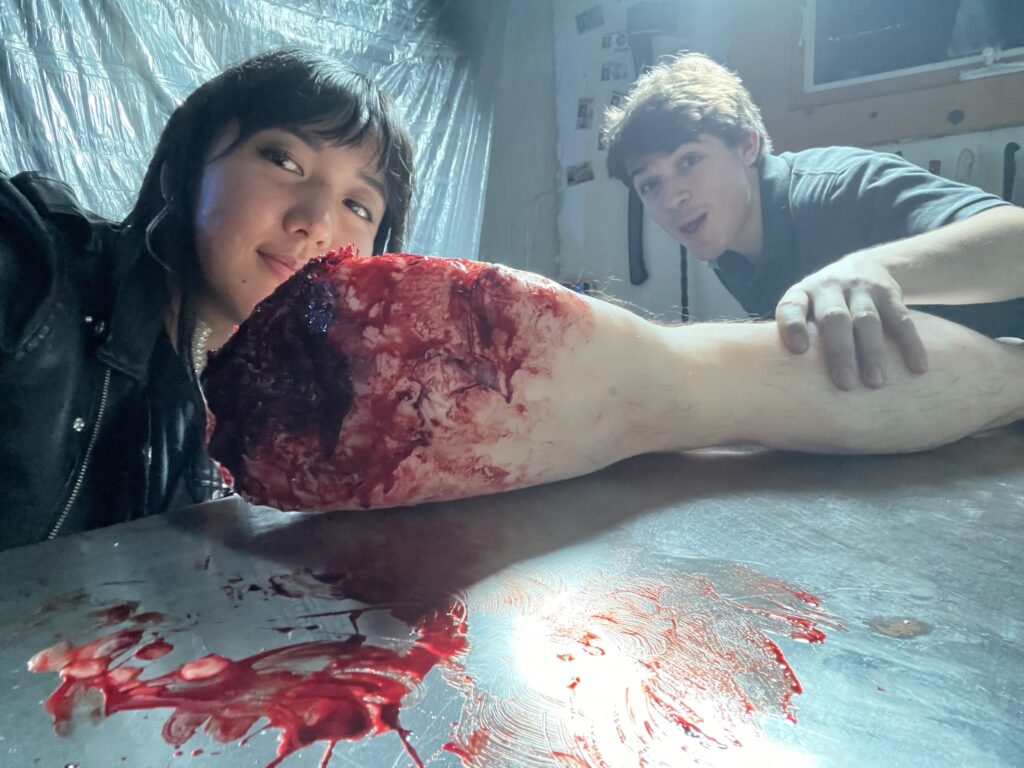
BTS with Aimee Kuge and Daniel Rinaldi
As difficult as shooting food is, shooting those wonderfully gooey practical effects you get to see throughout the film was a big highlight. Were there any effects that gave you particular trouble while shooting?
For the whole scene with Ash doing the “butchering” on the table, we were going to do a full-body cast, but we couldn’t make it work. We wanted Ash to be able to cut it open while she’s talking and see a lot more of that gore mid-conversation. We weren’t able to get the whole body, but luckily, Ashley and Alex from Yellow Moth Makeup F.X. made an amazing fake head, an amazing torso, an amazing arm, an amazing everything.
That was the trickiest scene since I could only shoot with their dialogue, and then I came in on a separate day with April and the effects and filmed her separately, cutting everything up and editing it all together.
That gnarly arm break was perfect, so I imagine it was a headache to get looking that good.
It was really hard to shoot that because we were using this hose to make the fake rain, and my production designer Matt Weir was holding it above the camera trying not to get us soaked. But we got the arm break in one take! It worked out because they had the blood rig perfectly set up, and we got it in one shot. We only had a little time to do those effects, and it was really important to have Yellow Moth’s professionalism and be able to do it quickly.
With a title like Cannibal Mukbang, you can make a lot of comparisons to the cannibal exploitation films of the 70s and early 80s. How did that era of filmmaking resonate with this film so heavily?
There’s been a big resurgence of 70’s horror as of late, Giallo in particular. The first dream sequence that happens I wanted it to feel like a Fulci movie, and I wanted it to feel like you were taken to that timeless space those movies create. The flashback sequence is the connective tissue that connects those films and this one the most, it brings the Cannibal Mukbang together. And that flashback sequence also gives Ash a sort of timeless quality and makes it hard to determine exactly what she is, so I felt it resonated there.
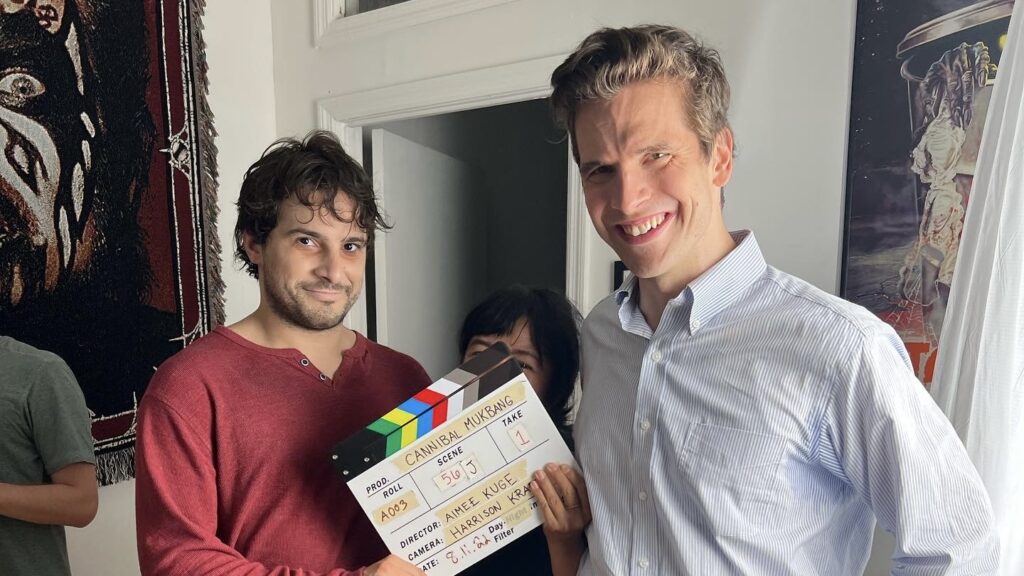
Pictured: Nate Wise on Left and Clay von Carlowitz on right.
Let’s talk about that flashback segment of the film, the one that shows us the origins of how Ash got a taste for human flesh. I enjoyed it because you don’t see it coming at all, it catches you off guard. What spurred you to insert such an aesthetically different sequence into the film?
It was a lot about going back to my roots. I went to film school at C.U. Boulder, and a huge emphasis was placed on shooting on film, super-8 and 16mm. We weren’t actually allowed to shoot on digital cameras until we were juniors, which was crazy, so I shot a lot on film. I had it in my head that we would shoot that sequence on super-8 because stylistically, it is a massive flashback choice. You see a lot of flashbacks in sepia, but I feel like on film it feels really nostalgic.
And what was the transition like between two different mediums, all while shooting out in nature?
I had a really small crew down in Florida, my DP Harrison Kraft and my gaffer Danny Rinaldi like, really…they ate. They did such a good job with very little lighting, they really pulled through with that sequence. And we actually shot it simultaneously on a Panasonic Lumix S5, just in case we missed something. We would do a digital rehearsal to get the movement down first, then we’d get it on film. And even if it didn’t pan out, I would have it on digital… but it panned out.
So thematically, how did that technical aspect factor into telling the story of who Ash was?
Most of the movie is from Mark’s perspective. His perspective is closed, and intimate, with not a lot of wides and not a lot of movement. He’s a very stationary, one-track mind kind of character. But when we go into Ash’s world in the flashback, we see the nature she grew up in, we see a lot of dynamic movement, which is so different. And it had to be completely different from the rest of the movie and really stand out to communicate who she was.
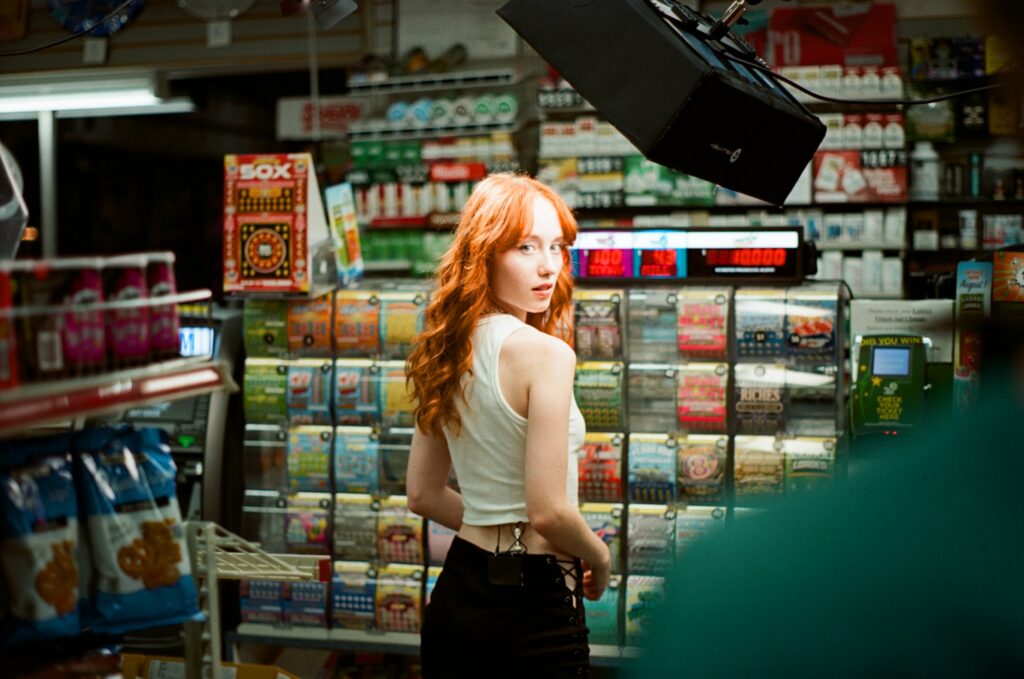
Photo Credit Nate Wise
On the topic of Ash, writing a character like her, getting that delicate nature of sympathetic but also quietly terrifying when you stop to think about it. Was she always written that way, or were there other plans for the character initially that evolved? Did April Consalo being cast change the character at all?
Well, she didn’t really change much from when I first wrote the script in 2020. She was always going to be this incredibly powerful, tense, sexy, multifaceted, funny, cool girl. But April definitely influenced how the character came out on screen just because of her intensity. She’s so beautiful, she looks like a Disney princess but also has this edge to her that looks like she could fuck you up. When I cast her, she just really got the character. She really brought herself as an actress into Ash and they became like one person to me for a bit.
She was dialed in completely.
Yeah, it was intense, but in a good way. We had a 14-day shooting schedule, the script is 110 pages, and we’re shooting a bunch of these pages every day. She was off the book immediately; she knew her lines and character in and out exactly, and we couldn’t have done it the way we did if she hadn’t.
14 days is an absolutely insane timetable for a shooting schedule.
I don’t know how we did it honestly. There was a lot of blood, sweat, and tears… fake blood, and not real tears, just to clarify.
Many people will sympathize with the relationship dynamic between Mark and Ash, for better and for worse, especially with how well the leads April Consalo and Nate Wise play off each other. Were there any challenges in trying to capture that energy?
I got very lucky. I had a feeling about both of them when I first cast them, and we had a joint meeting before I gave them the final offer. We met at a bar, and they had this chemistry between them where they didn’t exactly vibe right away, but they were already teasing each other and playfully flirting, and I just felt it. They had a genuine tension, they weren’t being fake with each other, so I knew we could make this work.
Later, we had another meeting with my intimacy coordinator, Kennedy Murray, and I said, “All right, we’re going to go through all the make-out and sex stuff right now” and see if we had any adjustments we needed to make. And I made them watch the scene in Twilight where Edward and Bella first kiss, and also the bus stop kiss in Spun before they went for it. And when they rehearsed their first kiss, I knew this would work. The core of the movie is their chemistry, and it just worked.
Cannibalism as a metaphor for love has been a very hot topic as of late in both film and literature. Do you feel that in the context of the film, the cannibalism shown is more about the love of self or the love of others?
I definitely think it’s about the love of others. If we do a sequel, we can tap into the idea of it as self-love, but I wanted the movie to be focused on this toxic romance. I know it’s a bit of an oversaturated trope at this point, but this is an eating show where one person is eating the other alive, so it makes sense. It’s about that love for others, not just romantic love but also familial love, a love for vengeance. I don’t think these characters love themselves at all, and that’s why they do what they do.

Photo Credit Nate Wise
We’ve covered that there are a lot of homages to great classic grimy horror in this movie. Are there any homages to great classic romantic films that might go over viewers’ heads? I felt a twinge of Eternal Sunshine of the Spotless Mind.
Absolutely! Eternal Sunshine was a major inspiration for me. The whole Before trilogy, especially Before Sunset. There are some cuts of She’s All That and 10 Things I Hate About You. Not romance, but there’s a touch of Superbad on the comedy side.
Are there any films you would consider a spiritual sibling or precursor to Cannibal Mukbang? One that you would pair it with for a double feature?
Definitely Jennifer’s Body. That’s like the big sister of Cannibal Mukbang, that’s what I aspire to make, to make something like that.
Honestly, same. We should all strive to be a little more like Diablo Cody.
Yes, Diablo Cody and Karyn Kusama, 100%.
Mukbanging is one of the biggest subcultures in a near-endless number of communities online that are ripe for taking in cinema. Are there any other internet subcultures that you would want to make a horror movie about?
I’m currently working on a new romantic horror script about emo kids and the emo music scene. I just pitched it at Austin Film Fest, and it did well there, so I am hoping to write the script and get it out within the next few years. Indie sleaze is really popular right now, and I want to make a movie about that early-2000’s scene. You know, everything happens in these 30-year cycles, and the early-2000’s are coming back with how fast trends move now. I want a movie all about the music.
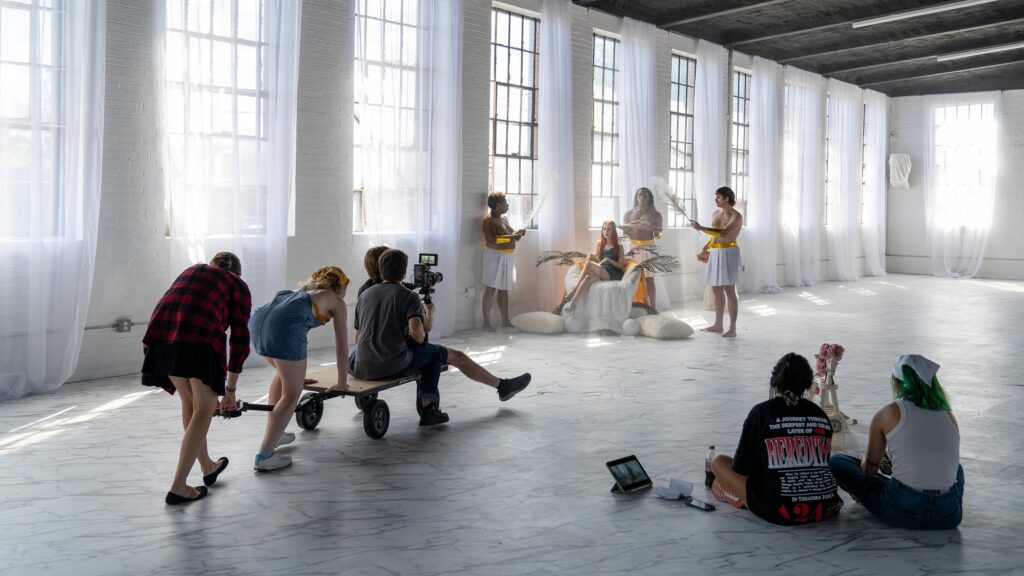
Photo Credit George Blandino-Ripley
Who would you put on the soundtrack for the movie? Yellowcard? Dashboard Confessional?
You know, My Chemical Romance is a given. There’s some really new, amazing emo that’s coming out now, like Saturdays at Your Place, Prince Daddy, and the Hyena. It’s having a huge comeback, especially with older bands like Blink-182 getting big again. I think the world is ready for it again.
Daydream with me a bit. No reins, no questions asked, just unlimited funding, whatever you need to make it. What kind of horror movie would you make in the wake of Cannibal Mukbang?
Can I say Cannibal Mukbang 2? It’s Cannibal Mukbang 2! We have the ideas down, April and I have begun writing the script for it. But I also really want to make my emo movie. Hopefully, we’ll make enough money, find investors who are interested, and be able to make them both. It’s going to happen. I want to make more romantic horror comedies, that’s where I want to live in. It’s the world I like to write in.
…So. If they’re having an eating competition, who’s winning: Nikocado Avocado, or Ash?
Ooh. I don’t know. He recently lost like 80 lbs. Back in 2021, Nikocado could beat her, at peak form. But Ash in 2023 could hold her own. This is the toughest question yet. If it were real food and not human food, Nikocado would win. But if it’s about eating humans, Ash wins.

Photo taken at Brooklyn Horror Film Festival
***
Thanks again to Aimee for all the great insights on the film! I also want to thank Nate Wise and George Blandino-Ripley for the images for this article. And if you want to read the review of Cannibal Mukbang that was so good lead actress April Consalo wanted to get a tattoo of it (Aimee’s words, not mine), you can check it out here!
And if you’re hungry for seconds and thirds of the best horror content out there, stay tuned to Horror Press!


From October 16 to 25, horror fans, filmmakers, writers, and artists gathered in Williamsburg, Brooklyn for ten days of film screenings, panels, live podcast recordings, Miskatonic Institute of Horror Studies lectures, an artisans’ market, networking opportunities, and parties. It was Brooklyn Horror Film Festival’s milestone 10-year anniversary. While there were, of course, first-timers in attendance, the majority, it seemed, have been going to the Festival for years—a testament to not only the expertise of the organizers and programmers, but to their dedication to the horror community as well.
How Brooklyn Horror Film Festival Began
Justin Timms, Founder and Festival Director, created Brooklyn Horror Film Festival in 2016. At the time, he had been working as an editor and post supervisor, bouncing back and forth between FilmRise and a video production company that made internal videos for major companies, like Pepsi. BHFF was initially intended to be a side project to satisfy his lifelong interest in the horror genre.
“I’ve always been into horror. They’ve always been the movies that I wanted to see,” he said. “The types of movies that I love weren’t playing festivals in New York, so I just had this crazy idea that I could start a film festival.”
So, that’s exactly what he did. One of the first people to join the team was Director of Programming Matt Barone. He and Timms followed each other on Twitter, and when Timms posted about the festival, Barone, whose love of horror began when his father showed him Abbott and Costello Meet Frankenstein when he was six or seven years old, reached out. Barone had been writing about music, reviewing horror films, and covering film festivals for a number of years, and was interested in pursuing a path in festival programming. Since this was BHFF’s debut on the scene, he took on the task of reaching out to filmmakers to create the festival lineup. That first year, BHFF opened with Dearest Sister by Laotian filmmaker Mattie Do, closed with Child Eater by Erlingur Thororddsen, and also featured We Are The Flesh by Emiliano Rocha Minter as the centerpiece film and Without Name by Lorcan Finnegan and Garret Shanley, which won the Festival’s award for Best Cinematography.

Pictured above, Tori Potenza and Joseph Hernandez. Photo courtesy of Brooklyn Horror Film Festival
A Decade of Growth and an Expanding Programming Vision
Ten years in, BHFF has grown exponentially, from a weekend-long stretch of screenings to a fully-formed film festival spread over ten days. It’s also established a reputation of excellence and receives hundreds of submissions each year, requiring a team of screeners in addition to programmers. Programming a film festival is a major responsibility—one that Senior Programmer and Director of Community Development Joseph Hernandez takes very seriously.
“You are a curator that has a huge influence on filmmakers that are seen or not seen, films that that are being recommended and placed in the public eye,” Hernandez said. “You have a true power in guiding trends, [including] which kinds of filmmakers are being represented in the overall landscape. [It’s a] huge, huge responsibility that I don’t take lightly.”
From Early Horror Fans to Key Festival Programmers
Like Barone, Hernandez has been with the Festival since the beginning. He had been working with the Tribeca Film Festival on the theater operation side of things and wanted to shift to a more film-focused role. A horror fan since his preteen years through Goosebumps books and Scooby Doo (with early childhood exposure to classics like A Nightmare on Elm Street and Friday the 13th that led to “a recurring Freddy Krueger nightmare”), reaching out to Timms to get involved with Brooklyn Horror Film Festival seemed like the perfect starting-off point. That first year, he was a screener and also introduced films, moderated Q&As, and helped with venue management. After that, he was promoted to programmer.
“As I learned what the role truly entailed, I was able to grow this whole [new] appreciation for what film festivals do and what their function truly is,” he said. “You get to see firsthand the difference that you’re making. You see how excited and happy [the filmmakers] are. You see all these audience members coming up to them and praising their work. I think a lot of filmmaking is behind closed doors, and it can be a very lonely experience. [For some, this is] their first opportunity of not just showing their work, but also being able to take that victory lap, when they get to finally put that movie in front of an audience. What we do is life changing for a lot of artists, and that makes a lot of the work and sleepless nights so much more worth it.”

Pictured above, NYC horror icon, Xero Gravity, and film critic/playwright Sharai Bohannon. Photo courtesy of Brooklyn Horror Film Festival
How Programming Shapes Filmmakers and the Genre
Hernandez is also an actor and filmmaker, and says that his experience as a programmer has helped him grow creatively.
“The best thing that any young filmmaker can do is watch as many films as possible. It could be bad films; it could be good films. You’re going to learn something from every viewing,” he said. “You’re developing those film analysis muscles that really help you to pick apart why something works in a film and why it doesn’t. It’s such a great classroom. I watch like, 1,000 movies a year for Brooklyn, and that just keeps me growing and sharpening those muscles and tools.”
Curating a Diverse and Audience Focused Horror Lineup
Of the actual process of programming, Hernandez stresses the importance of building a program for a wide audience.
“Each film you select doesn’t have to be something that is going to be unanimously liked, but there should be films in your program for every kind of viewer. This goes back to our responsibility as programmers. You have to be selfless. You can’t build a program just to your tastes.”
Hernandez notes that one of the Festival’s objectives is to demonstrate how vast the spectrum of horror is. If you ask him, it’s the key to bringing more people in.
“I think it’s very easy for someone to say, ‘Oh, I don’t like horror’, while their idea of horror is just a gory slasher film. That is a misperception that I blame on the marketing of the ’80s, when we had that huge slasher sequel boom, and that just became the mainstream definition of what a horror film was,” he said. He cites Silence of the Lambs as a case study on how this narrow definition of horror has led to mainstream audiences misunderstanding what horror is. “Horror doesn’t even have to be scary. Horror could be funny, it can be psychological, it could be so many things. We try to show that within our program, and that’s kind of what gave birth to our Head Trip section. These are films that are very much on the margins, but do fall into the Venn diagram. I think that’s another way that we can help the horror genre to survive and persevere: by showing that it encompasses so much more, and getting rid of that narrow stigma.”
Representation, Inclusivity, and Marginalized Voices in Horror
Beyond honoring the full scope of the genre, representation and inclusivity are always top priorities at BHFF. It’s reflected in not only the consistently diverse lineup, but in highlighted sections, like this year’s spotlight on Black horror and the annual “Slayed” block for LGBTQ+ short films. Nearly 50% of this year’s program was also woman-directed.
“There’s so much horror coming out nowadays because it’s having a big resurgence, which is awesome, but we’re getting so many prequels and reboots and requels,” writer, film critic, and programmer Tori Potenza said. “There are just so many great indie films out there coming from marginalized voices [so it’s] really important to highlight [them]. It feels like [the Festival has] always been ahead of the curve there.”
Championing Diversity, Queer Voices, and Inclusive Horror
It’s a sentiment shared by Hernandez, as well as by writer and emcee Xero Gravity, who is also deeply involved in BHFF:
“Everything else around us changes, and this is the little pocket that we have that stays consistent,” she said. “Something that I love about Brooklyn Horror is that we’re very adamant about queer liberation and giving queer voices their own spot, [and] there was also a slate specifically for Black horror. There’s a lot of pandering in the outside world, and [maybe] 5% of it is genuine. But this is something that’s very consistent with with Brooklyn Horror—these people just fucking get it, and that’s the great thing about having an intersectional community. When I’m up there introducing films or doing Q&As, I look into the audience and I see an array of people. I see white people, I see Black people, I see disabled people, I see queer people scattered amongst the audience. [BHFF] really recognizes the diversity of their audience and don’t use that as a pandering, but [instead] use that as ‘Okay, these are the people who we have in seats, and we should make sure that they feel welcome.’”

Photo courtesy of Brooklyn Horror Film Festival.
Filmmakers Share Their Incredible Experiences
Of course, BHFF isn’t just exciting for fans—it’s also thrilling for filmmakers, especially if they’re presenting work. Filmmakers Jasmine Osean Thomas and Ksusha Genenfeld came this year because their short film, Candy, was selected for the “Home Invasion” shorts block. This was the first time that Thomas, the writer and director, came to the Festival; it was the second time for Genenfeld, the cinematographer.
“I’d been following Brooklyn horror for a while because I know the quality of work that they support is unbelievable and very diverse,” Thomas said. “When I got in, it was like fireworks. I’m a die-hard horror fan. I’ve been since I was a little kid. So to get into something like this, where the genre is so celebrated, and to be amongst my people was so great. The work at this festival is just a different quality and caliber that should be celebrated forever. I’m just so honored to be part of this. And beyond that, the way that the festival supports filmmakers locally, but also brings in filmmakers, like to the Women In Horror networking event, sets it apart from any other film festival I’ve been to. It’s about community, it’s about horror, and it’s about celebrating not just your own film, but everyone else’s films.”
“I feel like it’s always the best time ever. I always meet new people and new filmmakers, so it’s always exciting to come back and be here,” Genenfeld added.
More Than Just Horror: Lectures, Parties, Markets, and Live Events Too
BHFF doesn’t only feature films, though. In addition to the scheduled screenings, there are also always additional events, like academic lectures held with Miskatonic Institute of Horror Studies, parties, live podcast recordings, and this year, an artisans’ market.
“It can’t just be all about the movies,” Hernandez said. “We need to provide a variety of events and activities to diversify our offerings. You can get burnt out if you’re just going from movie to movie to movie, but if you’re buffering in between, doing something completely different, that’s a lot of fun. Then you can catch your second wind and go see another movie. It really helps the whole festival experience. We never aspire to be a screening series. We want it to be a full-fledged festival.”
Creating Dedicated Spaces for Women and Queer Horror Fans
In recent years, one of the events has been a mixer for women in the horror community, spearheaded by Potenza and Caryn Coleman, the founder of the organization The Future of Film Is Female. Potenza recalls that the realization that a women-specific event came when she was in the middle of a conversation with another woman during a BHFF happy hour, and a man interrupted them to “explain” the monstrous feminine.
“That felt like a really big sign that we needed our own space—women and queer folk outside of the cis, straight, male-dominated space,” Potenza said. She teamed up with Coleman, and they started to organize happy hours and meetups in the off-festival season.
“Once the festival came, it seemed like a really easy way to add in an event specifically for this particular population of genre fans that clearly love it and attend. The programming staff here seemed down to do it. [There are] so many women and queer folks that are filmmakers and writers or just fans, and we all just hang out. The energy that comes off of that many women and queer folks in one space…I think we could rule the world if we harness that energy for a specific use.”
The Future of Film Is Female and Its Connection to Brooklyn Horror Film Festival
Coleman created The Future of Film Is Female in 2018 as an off-shoot of the Nitehawk Shorts Festival, which she had started in 2013.
“It was born out of all the relationships that I had with the shorts filmmakers from that, of all genders, and particularly out of the 2016 election,” she said. “We opened the 2016 Shorts Festival the day after the election, thinking that it was going to go a very different way. I thought about my position as a film programmer and what I could do to help get marginalized voices heard and seen.”
Coleman also launched a biannual The Future of Film Is Female film series at MoMA, and in 2022, co-curated a 10-week horror film series at MoMA called “Messaging the Monstrous” with Ron Magliosi and Brittany Shaw.
“It was the best thing that’s ever happened to me,” she said. “My whole life was a 10-week horror series that looked at horror films made from 1960 forward, with the premise that horror has meaning. So we did 10 one-week subgenres ranging from eco horror to Women Make Horror to slashers, unpacking the damage or the success that slashers have done in the horror genre. And we had guests come. It was about 115 films in total, features and some short films.”
Coleman’s Role at the Brooklyn Horror Film Festival
Coleman has been involved with Brooklyn Horror Film Festival for years. She’s been a jurist, a programmer…and was instrumental in bringing the Festival to Nitehawk because at the time, she was Nitehawk’s Director of Programming.
“I’ve known Justin [Timms] for a while, so there’s always been a little bit of crossover,” she said. “Two years ago, I was a programmer for the Festival, and then, with Tori thinking about how to gather the troops in terms of women in horror, and how to create more of a community space for them, both for the festival and then outside of the festival, because I do a lot of horror programming outside of Brooklyn—horror all year round!—and how we can continue to be together and supportive, but also just celebrate films together. That’s the best part about seeing movies: talking about them before and afterwards.”

Photo courtesy of Brooklyn Horror Film Festival.
How Nitehawk Williamsburg Became BHFF’s Home Base
There’s no shortage of audience togetherness at Brooklyn Horror Film Festival. Everyone interviewed for this article had nothing but glowing accolades for the way that this organization has fostered a strong sense of community among horror fans and creators. One of the ways this is achieved is surprisingly simple: having the Festival centralized in one location. The first Brooklyn Horror Film Festival was spread across multiple venues. Now, thanks to Coleman, it’s held at Nitehawk Williamsburg, an intimate triplex with a lobby bar, as well as a bar on the lower level called Lo-Res.
“The fact that we get to fully be here at Nitehawk is the dream,” Barone said. “This is where you can build a community. People can hang out, have drinks, and talk. It used to be [where] you [had] to see a movie [and] get on a train [to] see the next movie. We’ve evolved now to where we can just do it in one central area [and] neighborhood. It’s the ideal setup.”
A Festival That Feels Like Family
Toby Poser and Zelda Adams, two members of the iconic Adams Family filmmaking team, returned to Brooklyn Horror Film Festival this year to present their latest feature, Mother of Flies. In previous years, their films Hellbender and Where the Devil Roams screened at the Festival. Matriarch Poser says that the venue helps to encourage intimacy and community.
“We have the bar downstair and the bar-slash-lobby upstairs with all the great physical media. It’s like a big horror hug the minute you walk in,” she said. “And it’s so because of this intimacy that you meet everyone, you talk, and it’s just a beautiful thing.”
Adams, Poser’s daughter and co-writer, co-director, and co-star of Mother of Flies (along with John Adams, her father/Poser’s husband), was also excited to return to Festival, especially because of the sense of community at BHFF.
“After our first [time] submitting our film and luckily getting in, we experienced the fantastic community here,” she said. “Everyone loves horror so much and is so supportive, too. And it’s such an intimate theater, so it feels like a special viewing experience. The Q&As are also really kind and exciting, too, and the events they host with Brooklyn Horror are fantastic as well. It’s really great bringing Mother of Flies to the festival today, because I feel like we’ve cultivated even more of a community, and it’s nice because people get to come to the same theater and see how our films have changed so much since our first film here, and maybe how our story has changed and how we’ve grown as filmmakers.”
A Sound Designer’s Love Letter to the Horror Community
Another artist who revels in the community atmosphere of BHFF is sound designer Genna Edwards. She first came to the Festival in 2023 for the premiere of Cannibal Mukbang, which she worked on with writer-director Aimee Kuge, who also serves as BHFF’s Communication’s Manager.
“That was my first time at this festival, and it rocked my fucking world,” Edwards said. “I had never experienced such love and joy. You’re just in a room constantly with other horror freaks. I feel like people who aren’t in the community kind of look at us in a weird way, but when you’re in a room with all these folks who understand what all of this means, it’s just different, and I felt that instantly. Every year, I try to be here because it’s the best and they also program incredible work.”
Year Round Horror Events That Strengthen Community
A major thing that sets Brooklyn Horror apart from other film festivals is that it expands beyond a yearly event, and has become a central knot within the New York City horror community. Hernandez is largely to thank for that. In addition to programming the Festival, he regularly organizes advance screenings for new horror films, always followed by casual get-togethers at nearby bars to talk about the film, make friends, and network.
“I love what we do with the Festival. That is our main event of the year, but I quickly realized that a year in between editions is way too long, and community building is so important to what has gotten Brooklyn Horror to be what it is. There’s no reason why we need to limit that to one week a year,” he said. “So I really wanted to start providing stuff year round to keep the community engaged with each other, to keep it growing. At this point, it’s just been partnering with different studios to get early screenings of new horror films, and then after the screenings, just designate a place where everyone can meet afterwards and talk and catch up with each other, pick apart the film, talk about what’s going on in their lives, and just providing a safe space for the community to look forward to once or twice a month and stay connected.”
Why BHFF Is One of the Warmest Communities in Horror
Genenfeld described the horror community, particularly when it comes to BHFF, as “the warmest community in the film industry.”
“Everyone’s just so welcoming and everybody is really excited to connect, which I feel like is not very often seen,” she said. “So that’s really special about this festival.”
Having a community is vital, no matter who you are or what you’re interested in. For people interested in horror—something that is still misunderstood, maligned, and stigmatized—having a community of likeminded people can be a lifeline. New York has always had horror fans and horror-related events, but according to Barone and Hernandez, there hadn’t really been a solid, consistent community until Brooklyn Horror. BHFF and the off-season events—which have plenty of crossover with The Future of Film Is Female—have facilitated countless friendships and collaborations, not only strengthening the horror community as a whole, but empowering and affirming fans, artists, and writers on an individual level. For Hernandez, it’s helped him become more confident and comfortable going out and meeting people.
Brooklyn Horror Film Festival’s Impact on Creativity and Collaboration
For Edwards (and many others), the Festival has been a game changer both socially and professionally.
“You wait all your life to find people who care about the same things you do, especially if those things aren’t normal or socially acceptable, and then I came to this festival, and there were a bunch of other people who were like, ‘Yo, I want to see a decapitation on film. The nastier the better!’ I can finally be myself here and be as out about all of this stuff as I want to be—and people don’t look at you like a freak. They just accept you. And then we all make work together. I’ve worked on so many films with a bunch of the people in this community, and it only seems to keep happening, which I’m so freaking grateful for.”

Pictured above, the crew behind BHFF! Photo courtesy of Brooklyn Horror Film Festival.
Brooklyn Horror Film Festival Returns in 2026
At the time of this writing, Brooklyn Horror Film Festival is already hosting an off-season event—an advance screening of Sisu: Road to Revenge with a meet-up at a bar called The High Note. The festival run may have ended, but the organization operates year-round. It fills a need for horror fans. Not just the need for the latest films, but the greater need for solidarity, community, and friendship.
The horror genre may be awash with blood, guts, family tension, psychological distress, aliens, monsters, and human depravity. But the horror community? That’s all heart.
Brooklyn Horror Film Festival will return to Nitehawk Cinema October 15 – 22, 2026 ! Early bird discounts are now available for film badges and film submissions!


Now that Thanksgiving has come and gone, the Holiday season has REALLY kicked off. We’ve covered our fair share of Holiday horror from underappreciated gems like Christmas Bloody Christmas and Dial Code Santa Claus to Black Christmas and Krampus! In the hopes of spreading some Holiday cheer (and fear!), the curator of all things Horror Press, James-Michael, has decided to bring the cloven-foot killer that is Krampus into your homes! But this isn’t your ordinary Krampus…this Krampus is chock full of special features and gift wrapped in 4K!
If you haven’t seen Krampus, then what are you doing with your life? For those unfamiliar, Krampus follows a large family gathering of frustrating people who all get snowed in three days before Christmas. One by one, the family gets picked off by Christmas-themed creatures. Sometimes, the holidays truly are killer.
Enter Our Holiday Giveaway!

How to Enter:
Step 1. Make sure to FOLLOW US ON INSTAGRAM!
Step 2. LIKE the giveaway post!
Step 3. TAG A FRIEND who you think Krampus should visit!
The winner will be announced on Monday, December 15th and notified via direct message. If the winner does not respond within 24 hours, we’ll randomly select another winner.

WHAT YOU’LL WIN
What’s included in Krampus: The Naughty Cut? Let’s unwrap it and look:
- Audio commentary with director/co-writer Michael Dougherty, and co-writers Todd Casey and Zach Shields
- NEW interviews with Michael Dougherty, Visual Effects Artist Richard Taylor, Actors Allison Tolman, David Koechner and Emjay Anthony, Co-Writer/Co-Producer Todd Casey and more…
- Alternate ending
- Deleted/extended scenes
- Gag reel
- Krampus Comes Alive! – Five-part featurette including Dougherty’s Vision, The Naughty Ones: Meet the Cast, Krampus and his Minions, Practical Danger, and Inside the Snowglobe: Production Design
- Behind the scenes at WETA Workshop: Krampus
- And more!
So head over to our Instagram, follow our account, like our giveaway post, and tag a friend who you think Krampus should go visit!
Good luck!
**Giveaway entries are limited to addresses in the United States.**
**All entries must be 18 or older to enter**


‘Night Patrol’ Review: Vampiric Cop Horror Undone by Messy Execution

The 10 Most Satisfying Deaths in Horror Movies

‘28 Years Later: The Bone Temple’ Review: Nia DaCosta Has the Cure

The Horror Press Podcast Episode 54: Heated Rivalry & Yahtzee

‘Sleepy Hollow’ Review: Seeing Really Is Believing

‘Ready or Not’ and the Cathartic Cigarette of a Relatable Final Girl

‘Carrie’ Review: A Look At Two Adaptations

The Best Horror You Can Stream on Shudder in January 2026

The Best Horror You Can Stream on Netflix in January 2026

‘The Taking of Deborah Logan’ Review: An Overlooked Gem

‘The People Under the Stairs’ Review: A Brilliantly Bizarre Horror Classic

Slappy Was the Blueprint: How the Dummy from Goosebumps Became A Horror Icon

‘Five Nights at Freddy’s’ and The Story of William Afton Explained

Glen and Glenda: Don Mancini’s Reverence for Queerness in ‘Seed of Chucky’ (2004)

‘Truth or Dare’: Who Did it Best?

V/H/S Franchise Ranked, Best to Worst

Everything You Need to Know About Jason Voorhees

The 11 Most Disturbing Horror Movies Ever, According to an Actual Horror Fan

[REVIEW] ‘Cherry Falls’ (1999) Brittany Murphy Shines in This Cult Classic Slasher
