

Reviews
[REVIEW] ‘Doctor Jekyll’ Harkens Back to Hammer’s Roots


Few things are designed to set my heart aflutter quite like the words “HAMMER PRESENTS” emblazoned in large Gothic letters as red as the old “Kensington Gore” over the opening sequence of a Robert Louis Stevenson adaptation. Indeed, I am the person that Doctor Jekyll — the latest of Hammer Films’ post-2008 attempts to resurrect and reinvent itself — was theoretically made for: a Brit convulsed with nostalgia for the Hammer of yore, yet hungry for horror that reflects the modern world I inhabit. So I’ll attempt to say this as objectively as possible: I liked Doctor Jekyll rather a lot while still finding it muddled and underwhelming.
Doctor Jekyll is a New Interpretation of a Classic Tale
Directed by Joe Stephenson, Doctor Jekyll stars Scott Chambers (Malevolent) as Rob, a young man with a checkered past desperate to get back on his feet so he can see his baby daughter. His job search leads him to the isolated mansion of Dr. Nina Jekyll (Hannibal’s Eddie Izzard), a former giant in the pharmaceutical world who was forced out of the spotlight following a scandal. Nina needs a caretaker, and ignoring the protestations of her glowering estate manager (the superb Lindsay Duncan), she offers Rob the gig.
Of course, this is a Jekyll and Hyde story so there’s more to Nina than first meets the eye. Rob soon realizes that his boss’s mood — entire personality, perhaps — can turn on a dime; the bored recluse at breakfast who yearns for a bowl of “crunchy, nutty” Crunchy Nut Cornflakes becomes curt and eye-rollingly dismissive at lunch, before visiting Rob in his room at night with the demeanor of a kindly confidante.
We all know we’ll be seeing Nina’s alter ego, Rachel Hyde, before the end credits roll. But Doctor Jekyll seems uncertain about why exactly that is.

A Jekyll and Hyde story with an identity crisis
As Rob, Chambers brings an affable, awkward charm to Doctor Jekyll. But this is Izzard’s film through and through, and she plays her dual role with relish. The austere, dignified Jekyll is a world away from Izzard’s dancing, prancing, cackling vision of Hyde, a performance as mad as it is mesmerizing, yet always tightly controlled.
Casting a powerhouse trans performer like Izzard in the role inevitably raised the question of whether Doctor Jekyll would tap into the trans possibilities of the source material. This wouldn’t be the first time that Hammer has taken this route, intentionally or otherwise: 1971’s Dr Jekyll and Sister Hyde saw Ralph Bates’ Henry Jekyll transforming into the gorgeous Sister Hyde (Martine Beswick) while trying to create an elixir of life. That film was almost progressive in its portrayal of gender identity, with Sister Hyde asserting herself as the true identity and coming through no matter how hard Jekyll tried to suppress her, but stumbled into troubling territory as Jekyll ransacked women’s corpses for parts and lulled victims into a false sense of security by deliberately approaching them as Hyde.
Exploring Gender, Identity, and Legacy in Hammer’s Fourth Adaptation
Doctor Jekyll doesn’t take the obvious route, which is a good thing in many ways. This is Hammer’s fourth go-round with Stevenson’s story, the previous adaptations being 1959’s comedically slanted The Ugly Duckling, 1960’s The Two Faces of Dr. Jekyll, which presents Hyde as the charming face of evil, and the aforementioned gender-swapping Dr Jekyll and Sister Hyde, so it’s only natural for the company to want to do something new. Frankly, it’s also refreshing to see Izzard play two self-assured women for the price of one.
The problem is that Doctor Jekyll doesn’t know what it wants to be. Viewers might assume that Nina’s backstory as a disgraced pharma magnate would reveal a clear cause for her affliction, but Dan Kelly-Mulhern’s script gets lost in a confusing attempt to tie her back to the original Henry Jekyll, while also suggesting some form of possession. There are some interesting ideas at play about the way money and power corrupt a person beyond recognition, but the muddiness of the transformation itself only serves to make this concept feel hollow.

It’s not Hammer time — but it could be
Doctor Jekyll isn’t quite the return to form that Hammer fans may crave, but it is potentially a promising sign of things to come. Between the striking styling of Jekyll/Hyde, the delightfully playful and baroque score by Blair Mowat, and the bold but compelling choice to shoot Jekyll’s isolated manor primarily in bright sunlight, Doctor Jekyll has one foot firmly planted in Hammer’s Gothic past while another creeps into curious new territory. That’s not a bad position for a storied horror house to straddle.
As for this first attempt under new owner John Gore, Doctor Jekyll is not unlike the bowl of sugary cereal that Nina pines for at breakfast. It’s nutritionally lacking and won’t leave you fully satisfied, but that doesn’t mean you won’t enjoy consuming it.
Doctor Jekyll is available now on VOD platforms.


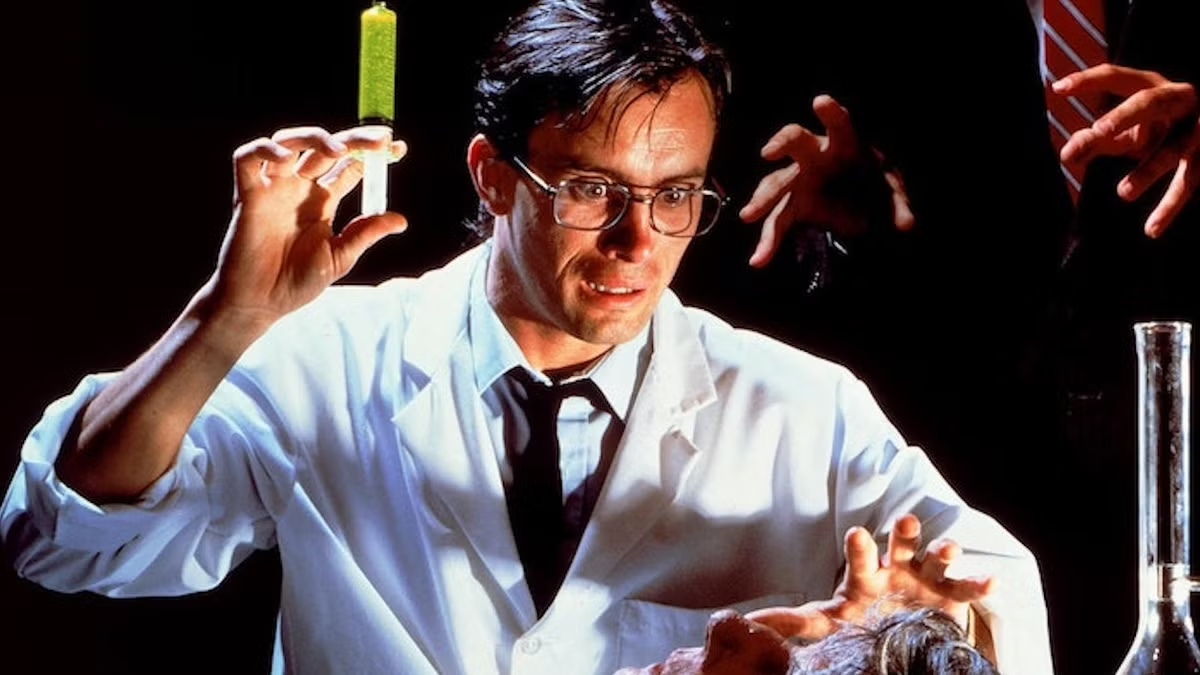
I can’t remember the first time I saw Re-Animator. While this will probably piss someone off, my first real introduction to a variation of the source material was with Joshua Chaplinsky’s Kanye West – Reanimator. Maybe I had seen the film before that, but I wasn’t certain. I decided to go back and watch (or rewatch) the film to compare it to the satirical book. To my surprise, I loved it! I’m not sure why I didn’t remember watching the film, but I was so enthralled that I wanted to make my second tattoo a Re-Animator tattoo! Five tattoos later, and I still don’t have one.
What is Re-Animator About?
Daniel Cain (Bruce Abbott) is a medical student at Miskatonic University, along with his girlfriend Megan Halsey (Barbara Crampton)… Megan just happens to be the daughter of Dean Halsey (Robert Sampson). Herbert West (Jeffrey Combs), who recently transferred to Miskatonic, finds a posting with a room for rent at Daniel’s. Paying with a fat stack of cash, Herbert quickly moves into Daniel’s and gets down to business. The only problem is, Herbert’s business is reanimating the dead.
As someone who has been adamant about not liking horror comedies, Re-Animator really tickles me in a way most don’t. There’s a supremely dark tone to this film that is brightened by the overly campy performances, deadpan jokes, and brutally funny practical effects. Re-Animator is one of the rare films that could have been singularly played for laughs or fear, but exists in this middle ground where it’s the best of both worlds. While this film isn’t deep enough to glean new meanings or gain profound lessons, each rewatch never ceases to be less enjoyable than the last.
One of the Best Lovecraft Adaptations
Writers Dennis Paoli, William J. Norris, and Stuart Gordon took (racist) H.P. Lovecraft’s Herbert West–Reanimator and unknowingly made one of the best Lovecraft adaptations to date. There’s a peculiar phenomenon in horror where films attempt to be overly Lovecraftian, much like the genre’s tendency to label films as Lynchian. What people don’t get about Lovecraft is that not everything was all tentacles and otherworldly. Obviously, there’s a level of that that plays into what Lovecraft was. I would personally label Re-Animator, along with In the Mouth of Madness and Color out of Space, as the best three Lovecraft adaptations/Lovecraftian films to date.
There’s little to say about a film like Re-Animator that hasn’t been said already, but there is one specific point that needs to be echoed. Well, two. Firstly, Re-Animator was director Stuart Gordon’s directorial debut. His insistence on creating a viscerally nasty, sexy, funny debut film was important to set his name apart from others. Stuart Gordon came out swinging and, throughout his career, didn’t stop swinging.
The second point that needs to be echoed is just how amazing the film’s practical effects are. Whether it’s the played-for-laughs cat puppet or Dr. Carl Hill’s (David Gale) decapitated head, each practical moment is handled with dignity, care, and the utmost beauty. While a handful of shots may not hold up as much now as they did in the 80s, the practical effects that grace Re-Animator rival some of the rare practical effects that are used today.
Why Re-Animator Still Matters in Horror History
If you haven’t seen Re-Animator, what are you doing? It’s full of brilliant, campy performances that could be a masterclass in Horror Acting for Screen 101. Barbara Crampton is a gorgeous badass, Bruce Abbott is a hilariously hapless himbo, and Jeffrey Combs showed how he was cultivating his career to be exactly what he wanted it to be. A film like Re-Animator will live on in horror history for the rest of time. My only question is…how hasn’t there been a (yuck) remake yet?


As Iron Lung begins, the film places you in an overhead shot looking down at a submarine that’s seen better days. Jagged metal teeth of a broken cage sit at its head, illuminated by a light from the ship above that’s about to cut it loose. As you’re about to be dropped into a roiling ocean of blood, you become quickly invested in its story.
A dire paternal voiceover runs you through your place in the world as an observer: someone is being sent into the “waters” of a far-off moon in a dead, dark galaxy. They’re in search of an answer you’re automatically aware will never be enough and a penance they will never attain. It prompts an obvious, cutting question: if Hell is where we’re looking for an answer, how bad must things be among the stars to go searching there for hope?
A Surprising Outing for Writer and Director Mark Fischbach
The debut feature film of writer and director Mark Fischbach, better known to the internet at large as Markiplier, is as surprising as it is atmospheric. And no, not surprising because Fischbach is an internet personality crossing over into film. And no, not surprising because this is a video game adaptation that is actually quite good.
The surprise here is mainly from the way Fischbach dodges a number of first-time filmmaker torpedoes that would otherwise sink the film straight to the sea floor. It’s in the very clear coordination and trust he has with his cast and crew. In a way, the film itself is a mirror of the submersible his character is forced to pilot: flawed, surely, but strong enough to complete its mission and deliver an exceptional experience.
What Is Iron Lung About Exactly?
The story goes as follows: in the wake of an event called the Quiet Rapture, the stars themselves have been snuffed out. Most of the galaxy has been plunged into sudden darkness, and a mass dying off has consumed countless worlds (think the worst possible aftermath to The Nine Billion Names of God).
Convicted for a reprehensible crime, the convict Simon (played by Markiplier himself) has been given a rare opportunity to return to life among the survivors. The mission is to pilot a death trap of a one-man submarine into the blood oceans of an alien moon, looking for a scientific sample useful enough to earn his freedom. That is, assuming he doesn’t lose his mind or his life in the process.
Bespoke Set Design That Matches the Premise Perfectly
Iron Lung should be commended first and foremost for being a bottle film with the perfect set design to match. Not overly ambitious, but not too simplistic either. Contained in a marvel of a small space, the submarine here is a tactile nightmare of rusty metal and antiquated technology you never get sick of seeing more of.
While Fischbach and director of photography Philip Roy have the camera linger in close ups almost too often, I don’t blame them for wanting to capture the finer details and leer at them. It’s clear every inch of this condensation covered machine was engineered by the art team and production design to emphasize its prison cell qualities as a barely functional vessel.
The ship’s external camera fires off like a flash bulb on its interior, barely illuminating the cabin with its next horrific image of the sea floor before plunging us back into darkness. The oxygen gauge and its cold robotic voice are a countdown to the painful annihilation that awaits its pilot. Its proximity sensors give only the barest indications of what’s going on outside, ticking a dull noise warning us: you are not alone. It’s a punishment to operate, and the set design as well as the very solid sound design that accompany it make that violently clear and effectively spinetingling.
Translation From Game to Film Isn’t So Perfect Though
This perfect setting isn’t always used perfectly though. The translation of the game’s mechanics and gameplay to the screen are both a weakness and a strength. They make the pacing of the first third run to a slow start, especially when Fischbach’s screenplay grinds against the strong suit of the film’s cinematography: the panic of it all.
Like its video game source material, David Szymanski’s Iron Lung, the film is really at its best when it’s instilling a sense of active and imminent panic. A tone that matches the borrowed time the submarine is glued together with. Putting out fires, both literal and metaphorical, ratcheting up its claustrophobia as you’re placed cheek to cheek with Simon in steamy, metallic darkness. This is where Iron Lung shines.
Markiplier’s Performance in Iron Lung is Hit or Miss, But Mostly Hits
It’s outside of these moments of panic where the weakest parts of the script and Fischbach’s performance are highlighted. Some weak line deliveries and beats of dead air kill the real tight headlock the film could have you gripped in from start to finish. And while Fischbach is phenomenal at playing terrified or pleading or even simple exhaustion in the face of the impossible, he really requires someone to bounce off of as his solo work just isn’t as compelling. Even the clunkiest bits of dialogue between him and his jailer (Caroline Kaplan) are better than the best of his moments where he talks to himself or tries to inject some humor into the bleak story.
This is a shame too, because the minimalist storytelling and background we get for his character is genuinely very intriguing. It’s thematically rich for what the film is trying to say about the power and terror of belief, and it’s doubly satisfying that the film has enough confidence to not lay everything out in a longwinded speech explaining the motives and lore that landed him here.
All that being said, his performance is hit or miss, but he mostly hits. The dialogue becomes more urgent as we approach the climax, and all of the cast delivers on that impending doom nicely. It reaches its peak in the final act, and Fischbach is on fire as he struggles to hold himself together in the face of absolute madness leaching its way into the pressurized cabin.
Iron Lung: A Redemptive Finale With Pure Liquid Body Horror
What a fantastic final act it is, one that makes up for its imperfection in the first two parts with a homerun of pure liquid body horror. It’s just phenomenal how the film’s digital and practical effects present the true horrors of Iron Lung. There’s a near perfect mesh between the two, and they highlight the best influences of similar genre films that came before.
Soaked with all the gore, madness, and mystery of the likes of Event Horizon and Pandorum, Iron Lung is a worthy successor in the cosmic horror genre as it rises above its own problems. It’s a moody, environmentally precise stunner of a horror film that sets a benchmark as the movie to beat for forthcoming releases this year.


Tim Burton, Representation, and the Problem With Nostalgia

[INTERVIEW] Tucking Into ‘Hannibal Lecter: A Life’ with Author Brian Raftery

‘Re-Animator’ Review: The Lasting Legacy of a Horror Comedy

‘Iron Lung’ Review: Exceptionally Atmospheric Cosmic Horror

No, Cult Cinema Isn’t Dead

‘The Ritual (2017)’ Review: When Grief Gets Gruesome

‘Wait Until Dark’ Review: A Timeless Psychological Horror Thriller

‘Return to Silent Hill’ Review: A Misogynistic Betrayal of Silent Hill 2

‘Lake Mungo’ Review: Still the Greatest Ghost Film of All Time

How ‘Child’s Play’ Helped Shape LGBTQ+ Horror Fans

‘The People Under the Stairs’ Review: A Brilliantly Bizarre Horror Classic

‘Five Nights at Freddy’s’ and The Story of William Afton Explained

Slappy Was the Blueprint: How the Dummy from Goosebumps Became A Horror Icon

Glen and Glenda: Don Mancini’s Reverence for Queerness in ‘Seed of Chucky’ (2004)

‘Truth or Dare’: Who Did it Best?

V/H/S Franchise Ranked, Best to Worst

Everything You Need to Know About Jason Voorhees

The 11 Most Disturbing Horror Movies Ever, According to an Actual Horror Fan

[REVIEW] ‘Cherry Falls’ (1999) Brittany Murphy Shines in This Cult Classic Slasher
