


Before getting into this, I just want to say that I really, really liked The Killing Cell.
Found footage is one of the best tools in horror. It allows tenacious filmmakers a chance to express their wicked ideas with a low budget and a bit of wiggle room. Audiences are more likely to forgive certain flaws in found footage that those same audiences would crucify in a “traditional” film. And that’s okay! Short films and found footage are two of the most significant ways that horror has been delivered over the past two decades, at least. But that doesn’t mean every single issue with a found footage film should be overlooked. The Killing Cell is a good example of a film that showcases the wild talent of filmmakers who hit too many of the wrong beats.
The Killing Cell’s Found Footage Premise and Setting
In the summer of 2006, local police arrived at River’s Edge Penitentiary. There, the police discovered one of the most horrific crime scenes in Georgia’s history. Zack (Karsen Schovajsa), Dan (James Bessey), Jeremy (Jordan Whitley), Saddie (Erin Caitlin Collins), and Shawn (Luc Sabatier) head out to the long-abandoned River’s Edge Penitentiary, which is rumored to be haunted. Little did this Hell Gang know, they were getting a lot more than they bargained for. Ghosts of the past may just be the ghosts of the present.
Co-writers/co-directors James Bessey and Karsen Schovajsa have a nasty little picture on their hands with The Killing Cell. It’s very clear to see the talent, passion, and dedication behind this project. Each film typically has a “wow” moment. The Killing Cell has multiple. Found footage has always lent itself to progressive filmmaking; it has historically been a tool that pushes the boundaries. There are many found footage films out there that would kill for one of the many standout moments in this film.
A Haunting Prison Location That Steals the Show
Location scouting is one of the most underappreciated jobs in film. Whoever found this film’s location and [hopefully] secured a filming permit hit the nail flat on its head. (If I’m not mistaken, this location is the River’s State Prison, right outside of Milledgeville.) River’s Edge Penitentiary is a hauntingly gorgeous location. To say the cliched line, it’s one of the film’s main characters. Dark, dusty, desolate hallways are littered with graffiti and litter; hidden rooms reveal deep secrets.
But all of that glitz isn’t so glamorous.
Where The Killing Cell Struggles: Pacing, Sound Design, and Performances
The film suffers heavily in two areas: pacing and sound design. (And somewhat, acting.) No one is expecting an Oliver Reed-like performance in found footage. Hell, Deadstream was lauded for that performance somehow. Erin Caitlin Collins and Stephen Lamar Lewis provide standout performances. Lewis brings a standout physical performance, though revealing how would be a bit too spoilery. The physicality he brings to The Warden is visceral and unique. Collins, on the other hand, just knows how to handle Saddie and provides the fullest performance of the bunch. The rest of the cast isn’t bad, but they just left me wanting something more.
Maybe it’s an editing issue, maybe it’s a writing/directing issue, but the pacing throughout The Killing Cell doesn’t work to the film’s benefit. Once the action picks up, the film gains some pretty heavy stakes. While that’s great for the viewers, if the pacing doesn’t match, it’s going to negatively affect the experience. Much of this film shifts to sloppily improvised ambling. At times, it feels more like an urbex hangout flick than a horror film. It just really brought the adrenaline of the film down quite a bit.
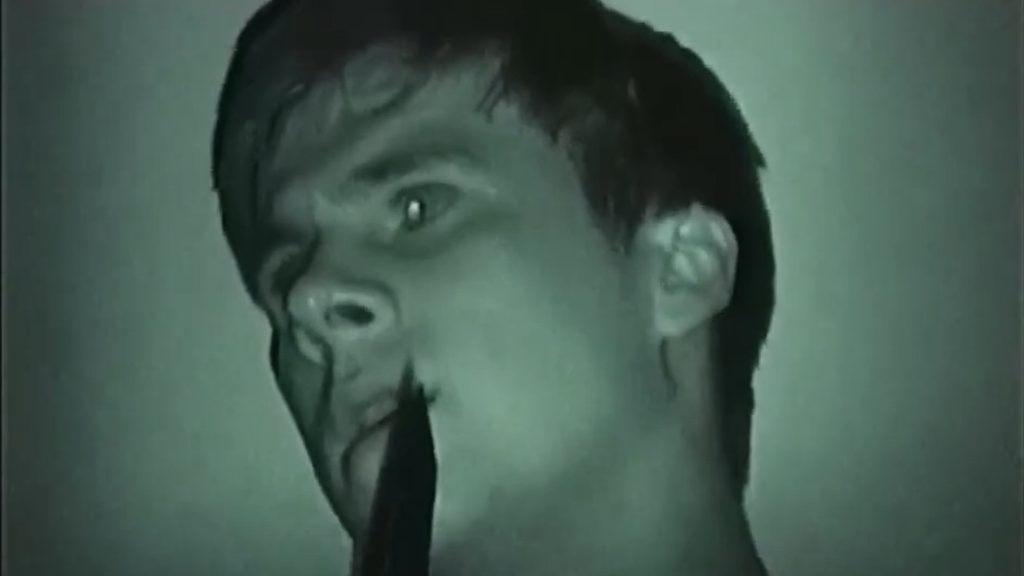
Sound Design Issues Diminish the Film’s Brutal Practical Effects
It’s the film’s sound design that really got me down. The film’s practical effects look BRUTAL. Unfortunately, the sound design doesn’t match most of the violence that takes place. Soft squishes, lackluster stabs, and overall disconnected sounds lessen unique and impactful practical effects. The Killing Cell’s sound design is its biggest disservice and heavily distracts from the overall project.
A Promising Future for These Found Footage Filmmakers
The Killing Cell is a fresh voice that screams from the depths of found footage. Anthony Cousins is listed as an assistant director, and apparently, his hands will be in the pots of some of the best found footage we see over the coming years. Even with the distracting issues I have with this film, I can’t help but appreciate it for what it is and the bars it has set. James Bessey and Karsen Schovajsa are wildly talented filmmakers with big ideas rattling around in their brains, and I’ll without a doubt, be lined up for whatever they have next. I hope they take the lessons they learned from The Killing Cell and, somehow, come back with a stronger, ruder, crazier film than this.