


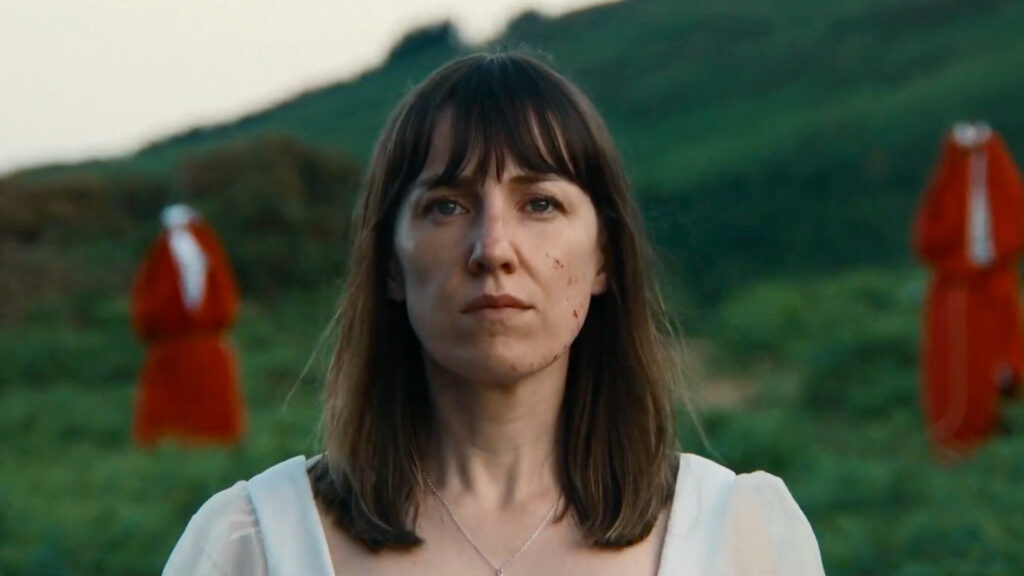
“What kind of movies does this guy even like?” is presumably what someone will say after I start my nth review with, “I’m not a huge fan of X subgenre.” Films like The VVitch, Midsommar, and Hereditary (and tangentially Goodnight Mommy) have taken horror in a weird direction. These films have made art house/elevated and folk horror very prominent throughout the festival circuit. Hell, these films are why people refer to most films that don’t look like shitty Marvel slop as A24-like. But folk horror, and how it’s affected the trajectory of horror, is what we’re here to discuss with Fréwaka.
Fréwaka: A Bold Entry in Folk Horror
Fréwaka follows Shoo (Clare Monnelly), a young woman in the midst of becoming a home care nurse. Her pregnant fiancé, Mila (Aleksandra Bystrzhitskaya), stays back to clean out Shoo’s recently deceased mother’s house as Shoo heads to the countryside to care for Peig (Bríd Ní Neachtain). Peig seems paranoid and on the verge of a mental break, and Shoo is forced to go with the flow so she and Mila can make ends meet. It soon comes to light that Peig might not be as paranoid as she seems, as Shoo is dragged into the weird world of whatever the hell is coming after Peig.
Irish Language Makes History in Fréwaka
My main issue with folk horror is how annoyingly ambiguous they try to be. We get shots of random glyphs, ominous people staring, and long shots of, usually, nothing. There’s nothing wrong with having the audience work during a film and making us fend for ourselves. It’s just that so many folk horror films don’t do a good enough job of disseminating enough information to the viewer to make them feel like it was a worthwhile experience. Fréwaka succeeds at being fairly ambiguous while giving the viewer the information they need to put the pieces together in an authentic, not hand-holdy way.
Stunning Cinematography by Narayan Van Maele
Narayan Van Maele’s cinematography elevates Fréwaka to a level that many films try too hard to accomplish; it feels effortless. Whether navigating through Peig’s house’s halls or shots of the stunningly gorgeous countryside, Van Maele captures Clarke’s vision well and uniquely. It’s hard not to appreciate how delicate Clarke’s story is. From the jump, Clarke plays with the idea of Peig’s illness in a way that doesn’t feel exploitative while simultaneously raising the question of believability. Is Peig a crazy old kook, or is there validity to what she says? The back and forth between this gives the film a supreme identity over other films of this ilk.
My main issue with the film is a character thread that isn’t technically resolved. Mila is an important character in Shoo’s arc, but at points, it feels like Mila is only there to add a forced layer of emotion and lacks true agency. There’s a way Mila’s addition to Shoo’s story could have been resolved without feeling forced, but I also don’t hate the way Clarke handled it.
Aislinn Clarke: A Rising Star in Horror
