


Welcome back to Horror 101, a series of articles where we explain horror movie legends and their lore. For beginners, the confused, or just those who need a refresher, these articles are for you.
It’s been a popular topic recently: finding someone who matches your freak. And horror is full of them, just straight-up nasties whose limits of experimentation know no bounds. But who are the unmatched freaks? The unrivaled weirdos, not just in this world, but across all realities?
If Clive Barker is to be believed, it’s the Cenobites.
And today’s Horror 101 is all about the stars of the Hellraiser franchise: who they are, where they came from, what they want, and how that funny little puzzle box plays into it. Hellraiser is a sprawling franchise with comics and short stories galore, beyond the massive scope of its 11 films. To simplify things, we’re sticking to the films, except for Hellraiser: Judgement, because it left on a cliffhanger that doesn’t make sense in continuity and most likely won’t be continued—obviously, spoilers for almost all the Hellraiser films. Let’s get into it!


WHAT IS THE LAMENT CONFIGURATION?
Before we can explain what the Cenobites are, we need to explain the thing that summons them. Known as the Lament Configuration, Hellraiser’s iconic infernal invention is a puzzle box, that when solved opens a gateway between Hell and Earth, allowing the Cenobites free passage between the realms. This passage can only be closed by reverting the box to its original form.
The Lament Configuration was made by a man named Philip Lemarchand (because, as with all bad things, the French caused it). Hellraiser: Bloodline shows us that Lemarchand was commissioned by a French occultist, De L’Isle, who performed an intricate and bloody ritual to summon a demon. This unleashed Angelique, the first of the Cenobites. Lemarchand was struck with guilt and cursed, with his bloodline becoming dedicated to destroying the passage De L’Isle created, but more on that later.
Regardless of where it is in the franchise, the Lament Configuration is an artifact of terrifying power. The 2022 remake of Hellraiser shows the Lament Configuration in several other forms, each granting the user one wish. However, the wishes are a bit on the Monkey’s Paw side, as the film’s secondary antagonist Voight ends up wishing through the Sensation configuration for endless pleasure. He is of course given the Cenobites idea of endless pleasure: being made functionally immortal and implanted with an advanced mystical torture device that never relents.


WHAT ARE THE CENOBITES?
Speak of the devil, and you’ll inevitably have to explain his lore. The Cenobites, known as The Order of the Gash or Pinhead’s Gash for short, are an order of interdimensional demons whose perceptions of pain and pleasure are one in the same. These grotesque (if not stylish) beings are brutal and efficient torturers whose idea of a good time involves putting their victims through hell and dragging them back to their dark world.
Each Cenobite is brutally deformed, usually complete with flensed flesh, barbs and hooks, missing or deformed body parts, and bloodless pale skin. They also almost always wear leather outfits to fit their extreme BDSM ideals. On a textual level, the Cenobites and how they ravage people has always been an allegory for addiction (and in particular, sex addiction, but it expands as the series goes on and gets broader). They are beings stripped bare of anything but desire, and the extremes they’ll go to get what they want, and their aesthetics are tailor-made to match that.
WHERE DO THE CENOBITES COME FROM?
All Cenobites were once human, victims of the Lament Configuration that were chosen as priests by Leviathan due to a lack of faith or having a particularly cruel streak. We learn in Hellraiser II and III that they’re created by fusing a demonic spirit, completely amoral and chaotic killers, with a damned human spirit, whose ideas of structure and order allow the ruinous power to be focused and execute Leviathan’s commands.
WHAT DO THE CENOBITES WANT?
If their victim’s spirits escape Hell, however, they will endlessly hunt for them, and take out anyone in their path to get them back. Though their name would make them seem like a dark order of monks, they mostly act as jailers for the Hell they reside in. The Gash follows a structured hierarchy and destroys threats to that hierarchy with impunity. At the top of it all is the boss called Leviathan.


WHO IS PINHEAD?
Though the Cenobites of The Gash seem unrestrained in their merciless methods, every depiction of them shows them led by a head priest: Pinhead.
While the novella and subsequent stories don’t give much of an origin to Pinhead, we find out in Hellraiser 2 that he was once an English soldier named Elliot Spencer, who grew callous with life and began seeking new pleasures. Running into the Lament Configuration on his hedonistic journey, he was killed by the box and turned into Leviathan’s servant during World War 2. Since then, he has been such an icon of horror that you can’t have a Hellraiser without him.
…Or her, or they, or it! In the 2022 remake, Pinhead (just called The Priest) doesn’t have any of this backstory, and is portrayed by Jamie Clayton instead of a traditional male actor one would expect. This is overtly a nod by director David Bruckner to the fact that in the original novella, Pinhead is androgynous with some feminine traits (but is only referred to with the pronoun “it”). The story version is seemingly gender nonconforming, while all the press and discussion about the film indicates remake Pinhead as female.
All of this to say, at the end of the day, a Pinhead is a Pinhead regardless of gender, and this franchise would be way worse without him, her, or them.
HOW DO YOU DEFEAT THE CENOBITES?
While it’s seemingly impossible to destroy the Cenobites, they can actually be slowed down and even swayed to your side. The simplest method of getting away from them is to, of course, revert the puzzle box to its original form and send the Cenobites back to Hell. The Cenobites have on one occasion been reminded of their formerly human lives, and turned on Leviathan for making them that way. However, this was only a temporary armistice as Pinhead eventually returned to his wicked ways.
But the most surefire way to stop the cenobites is one of the franchise’s most controversial moments: going to space and boxing them up like a gift. Remember how earlier in the article I mentioned the Lemarchand bloodline trying to negate the effects of creating the box? The Lemarchand family repeatedly tried and failed to create a puzzle box to do so, known as the Elysium Configuration: a device that could produce an unending source of light that would shut the pathway made by the Lament.
This came to a head in 2172, during the events of Hellraiser: Bloodlines. After multiple attempts, Dr. Paul Merchant had designed a space station known as the Minos. When the cenobites went to space to hunt down Merchant, it was revealed the Minos was the Elysium Configuration, and he had lured them into a trap.
Since this is as far into the future of their universe as the story goes, Pinhead and his Gash were all (or will be in about 150 years, give or take) trapped in the Elysium Configuration satellite, constantly being blinded by eternal light.
Live by the puzzles, die by the puzzles.
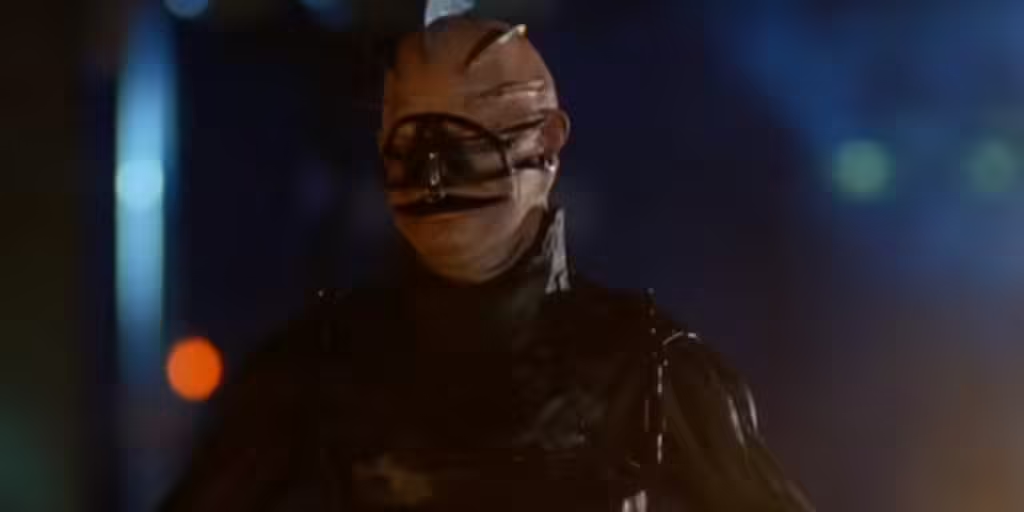
…WHY CD-HEAD?
Why not CD-Head? Look at him!
He is perfect the way he is.
And that will be it for today’s Horror 101 lesson. See you in the next class, and stay tuned to Horror Press’s social media feeds (@HorrorPressLLC on Twitter and Instagram) for more content on horror movies, television, and everything in between!