


If there’s one thing my friends have heard time and time again, it’s that I’m always ready for some dumplings. They are one of my favorite things; not just my favorite things to eat, my favorite things bar none. If you steam them or fry them, I will come.
Now, I say this because the 2004 film Dumplings by director Fruit Chan made me fall out of love with dumplings for months after I had watched it. It is a film that I will never forget and utilizes food on film to tell a bizarre, tragic story in a way very few have.
Exploring the Gastronomic Horror Genre
In the small subgenre that is gastronomic horror, horror focused primarily on food, only a few films in recent memory have managed to make an impact. Flesh was wet spaghetti slapping you in the face, while The Menu was a surface-to-air rocket that blew up the pop culture landscape on release. Dumplings predates both of them and, in my humble opinion, surpasses them on a filmmaking and narrative level completely.
I remember first encountering Dumplings during a time in high school when I had gotten into that genre of YouTube video that talked about “disturbing films”, something I’ve derided in previous articles on Horror Press; I stand by the opinion that 9 times out of 10, you will be disappointed when you see a film on those lists. And Dumplings, ultimately, is a very grotesque film that is undoubtedly disturbing, but it’d be a reductive descriptor. Because it’s freaky, bloody, and sometimes psychosexual expression is not so secretly a piece of political counterculture created by a Hong Kong visionary: Fruit Chan.

Fruit Chan, The Man And The Myth
Cinema savant Fruit Chan is a one-man show of film talents: he’s an editor, a writer, but foremost a director. He cemented himself as a legend of the independent film scene in Hong Kong following a slow decade-long crawl to the top and is seen by many as the man who resurrected indie filmmaking during a time of great uncertainty.
The Handover of Hong Kong in ’97, in which Britain relinquished control of the country to mainland China, threatened the country’s economic stability due to speculation of a harsher and more restrictive regime than the United Kingdom’s. This meant a risk to all sectors, including film, and in turn, spurred a new generation of indie filmmakers to take center stage from their mainstream counterparts.
Alongside cinema legendary Wong Kar Wai and terribly underrated master Mabel Cheung, Fruit Chan became a hero of the Hong Kong New Wave era with his crime thrillers Made in Hong Kong and The Longest Summer which tackled the motif of change and Hong Kong’s evolution. And eventually, he brought those same ideas to the horror of Dumplings.

A Story of Tasting Beauty And It’s Ugliest Parts
SPOILERS FOR DUMPLINGS BEGIN HERE.
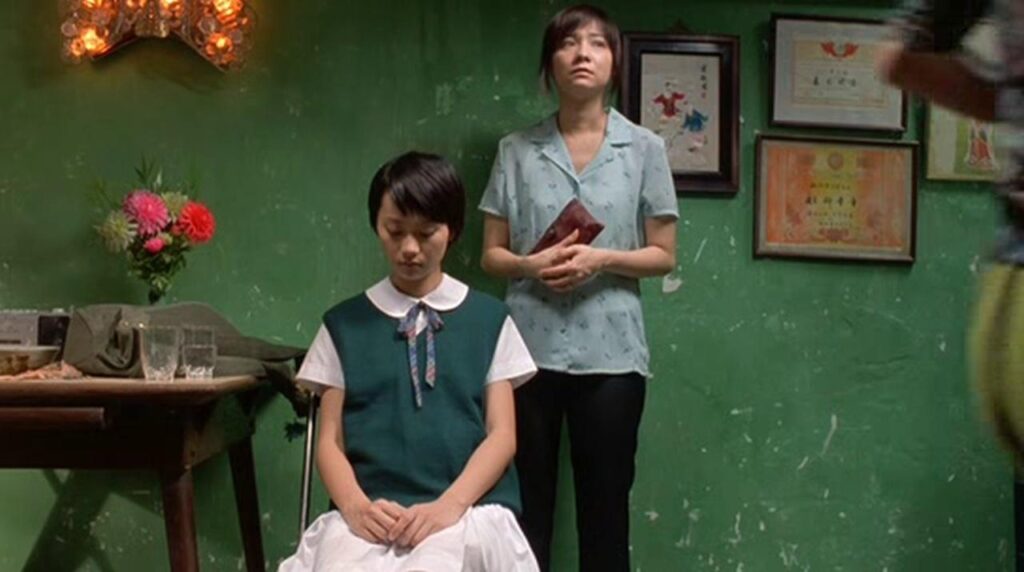
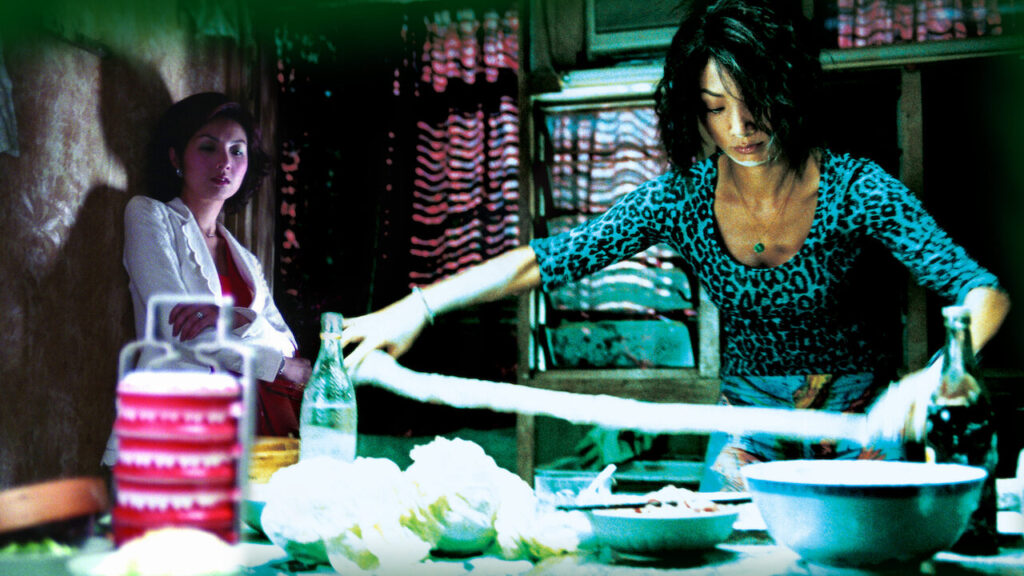
Released in October of 2004, Dumplings was adapted from the Lilian Lee book of the same name, and later cut into a short film collected in the anthology Three…Extremes. The star of the show is Mrs. Li, an aging starlet whose marriage is slowly dying due to her husband’s infidelity. Blaming her appearance and infertility, Mrs. Li begins paying lump sums of cash to a medicine woman named “Aunt” Mei for miracle dumplings: with a bit of ginger, cabbage, pork, and a potent secret ingredient minced extra fine, Mei cooks up dumplings that restore the youth of the eater. Just one problem…the secret ingredient is fetuses.
The Tragic Descent of Mrs. Li
As Mrs. Li and Mei’s relationship progresses, the duo becomes more entangled as the actress wrestles with the creation and side effects of the “magical” cure to all her problems, which may or may not actually be working at all. The story is equal parts modern fairy tale, drama, and horror show as we watch Mrs. Li’s mind deteriorate and see her slowly become more and more unstable as she’s entrenched in the craving for youth and beauty.
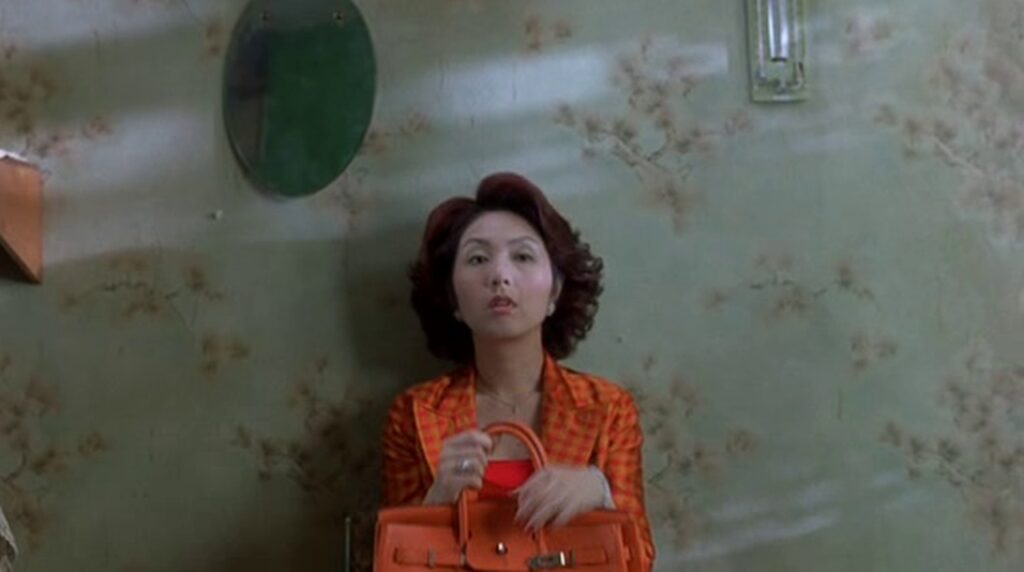
Miriam Yeung as Mrs. Li, captures a depressing sight with elegance, as you watch a figure of beauty and grace be swallowed up by the delusion of becoming “beautiful enough” for a man who doesn’t love her, all the while being acutely aware of her husband’s emotional abuse and infidelity.
Aunt Mei: The Sinister Medicine Woman
Bai Ling’s performance as Aunt Mei is especially memorable and the part of the film that brought it back to the forefront of my mind. Ling embodies the quirks and mannerisms of a witch who has her client by the throat with this underlying sinister mood. There’s a subtle malicious tint to all she says and sings as she tries to sell a ghastly cure to a desperate woman.
And by the end, you’re not particularly rooting for either of them. Still, their chemistry on screen has you craving some resolution as their relationship gets messier and messier. Fruit Chan gives you just that, and a side of cruelty to go with it.
Unsettling Atmospheres and Claustrophobic Spaces
When it comes to the film’s look, Dumplings has a very specific inhospitable vibe that clashes with the small, would-be-comfortable interiors you’re forced to sit in. Mei’s apartment is a tight space, with a wall often being the central feature dividing her and Mrs. Li. The walls are adorned with photos, knick-knacks, and kitschy paintings of children that take on a sinister new meaning watching over the duo as Mrs. Li eats. Shot in Shek Kip Mei Estate, the first public housing estate in all of Hong Kong, it’s filled with people living their lives quietly in the background, but still feels lonely because of how everyone is spaced and placed.
When you get to Mrs. Li’s unfinished mansion, the interiors are framed, often blocking off her guests, shooting around corners and in close-ups being a crucial part of Fruit Chan’s camerawork that communicates the isolation of his subjects. The pristine white walls are more sanitary than classy, and the space as a whole feels like an eternal spec house, never meant to be inhabited.
Cold Lighting and Disgusting Delicacies
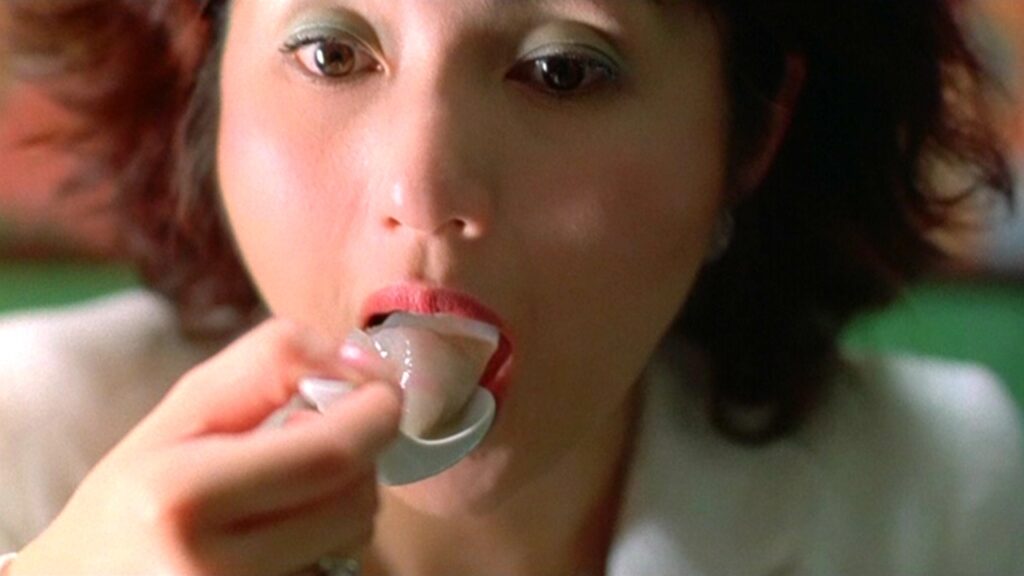
Lighting is the key element to making these spaces as uncomfortable as possible, and it’s also the driving force behind making the food in the film unbelievably unappetizing. Because Fruit Chan commits the cardinal sin of food photography, he uses cold lighting. Nothing makes food more unappetizing than cold lighting, and if you’ve ever been in a takeout restaurant late at night with fluorescent bulbs beaming down on whatever combination plate you ordered, you know how bad food can look in the wrong context. This might seem obvious, but this simple cinematic choice amplifies the already disturbing nature of Mrs. Li’s story by taking comfort food and making it feel like something being forced down your throat rather than willingly eaten (a recurring motif of Yeung’s performance while eating in the film).
And none of that is to discount the incredible foley work that gives you every agonizing sound of consumption; every chew, lick, and swallow is audible, and if you’re like me, you’ll want to squirm out of your headphones when you hear it. In a way, Fruit Chan invented a proto-ASMR.
If the goal of ASMR was to be as disgusting as humanly possible.
Deeper Themes: Misogyny, Consumption, and Cultural Anxiety
The script itself? That’s a whole other philosophical feast on its own.
The film’s writer and acclaimed author, Lilian Lee, weaves a story that delves into internalized misogyny, sexual violence, and the commodification of young women by the industries and men that use them. Lee makes a contrast early on between Mrs. Li’s consumption of the dumplings and her husband Mr. Li’s taste for balut (fertilized eggs with unhatched chicks in them); there is a clear mirroring between Mr. Li’s appetite for younger women and Mrs. Li’s appetite for his love, one that makes her story all the more futile and tragic as she decays both literally and morally to “better match” her husband.
Betrayal and Structural Violence
Mei’s eventual betrayal of Mrs. Li to sleep with her husband becomes a multiplying factor in that tragedy, as she becomes just one more person to act on the misogyny torturing Mrs. Li. Dumplings has a Cronenberg-esque relationship with sexuality, reminiscent of Videodrome and Crimes of the Future (2022) where sex is often correlated with violence; more on the Crimes end of the spectrum, Dumplings shows sex as a metaphor for structural violence, and how that violence often gets people to act against their own best interest.
Political and Cultural Reflections
What is a messed-up folk tale of misogyny and lost love on the surface also becomes a historically and politically charged film. The illegality of abortion in Hong Kong is brought up several times during the film by Mei, a doctor working in abortion clinics in China during the 1960s and whose marriage dissolved because of it. She travels back and forth from China to Hong Kong in the film, and a great emphasis is put on not only the physical and legal divide, but the cultural divide between the two countries: they’re so close, but so far apart.
The film’s most memorable song is Mei’s renditions of “Wave after Wave in Honghu Lake”, a CCP folk song whose tune changes throughout the film as she sings it to Mrs. Li. It is ultimately completely changed in meaning and tone by the time it is played through the film’s final moments, reflecting the shift in the cultural and political landscape of Hong Kong since the handover.
Cannibalism as Cultural Critique
Yun-Chu Tsai, a doctorate in East Asian languages and literature, posits that the film is a modern analysis of Chinese society and the act of consumption on both the personal and national scale. In her dissertation, “You Are Whom You Eat: Cannibalism in Contemporary Chinese Fiction and Film”, Tsai sees Dumplings as one of the late-stage pieces of media that take cannibalism and uses it to tell the story of a particular cultural anxiety: “both the anxiety of being marginalized and consumed others and the desire for consumption in a post-socialist, neoliberal Chinese society”.
Why Dumplings Remains Unforgettable
In all that I’ve said here today, I have yet to begin to scratch past the surface of Dumplings. To capture all the intricacies and finer details of this film, let alone the numerous readings you can make of it would be borderline impossible.
Dumplings takes a simple staple food and turns it into a conversation that, as any good one shared over a meal, can branch out in a hundred different directions with a thousand different trains of thought wrestling for control. And that conversation will keep the movie in your mind for much, much longer.
So, get out there and get to watching.