Welcome back to Horror Press’s Horror 101, a series of articles where we explain horror movie legends and their lore. For beginners, the confused, or just those who need a refresher, these articles are for you. Today we delve into an antagonist described as “the perfect organism” with a “structural perfection [that’s] matched only by its hostility”, the Xenomorph from the Alien franchise. An alien species that’s oft imitated but never surpassed by its many pop culture counterparts, H.R. Giger’s iconic design evolved into a creature shrouded in as much mystery as its costume is in KY Jelly.
While the Alien franchise is quite sprawling, we will only look at the mainline Alien films for canonical explanations of all our questions. As much as I’d love to include the stellar Dark Horse comics and the Alien: Isolation game, we’ll have to touch on those another day.
So how did the Xenomorph come to be, and what exactly is it? Let’s find out.


WHAT ARE XENOMORPHS?
Depending on who you ask, they’re either the worst or greatest thing to happen to the galaxy at large. What the android Ash calls “A survivor, unclouded by conscience, remorse, or delusions of morality”, the Xenomorph is driven only by primal instincts to kill and reproduce at high speeds.
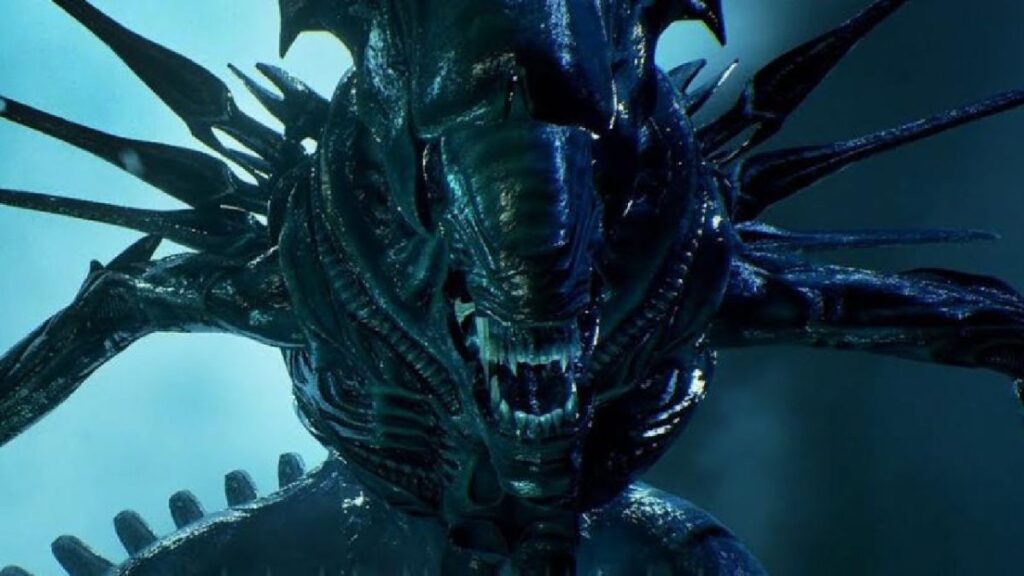
The xenomorph is the byproduct of a bioweapon called “the black liquid, ” or, more commonly by fans, the black goo. Through genetic experimentation, the xenomorph was engineered as a killing machine with peak agility and strength. Most xenomorphs stand around 6’10”, and sport an iconic, shiny black exoskeleton that grants them unbelievable durability.
Among its most distinctive features are a lack of eyes, a second set of inner jaws that can punch through reinforced glass and metal, and a bladed tail. Bright green acidic blood, capable of burning through almost anything, makes it borderline impossible to engage at close quarters without harming yourself.
HOW DO XENOMORPHS REPRODUCE?
Its most frightening and iconic quality, however, is its reproductive cycle.
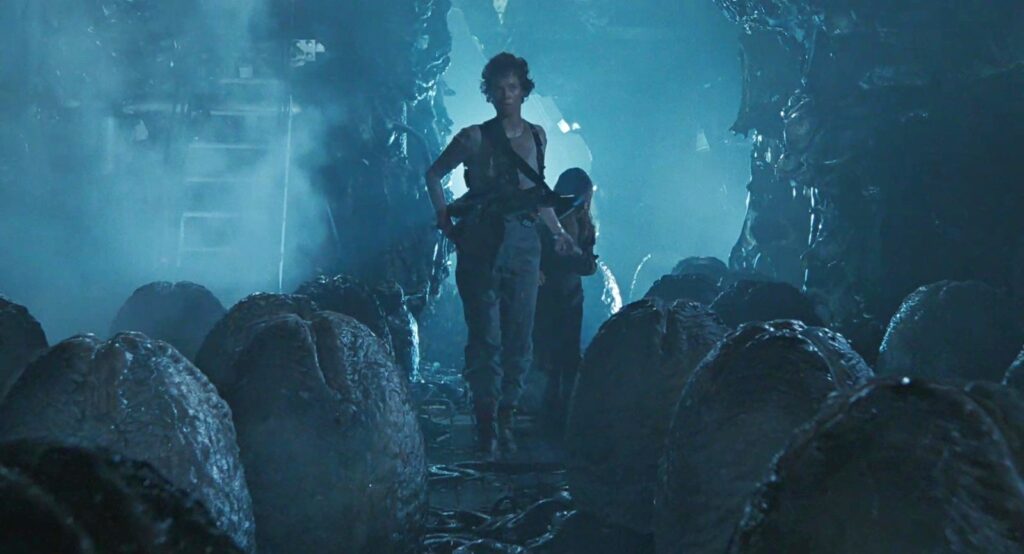
When a living being approaches a xenomorph egg, a spiderlike “face-hugger” leaps out and attaches to living prey to implant an embryo orally. Within a matter of hours, the embryo develops into a self-sufficient juvenile alien that forcibly (and fatally) claws out through the torso of the victim, earning it the nickname “chest-burster”. It then grows into a fully-fledged drone, or a queen that produces more eggs.
Xenomorphs, by their nature are incredibly adaptive parasites, able to gestate in any living mammal that can sustain its egg. These xenomorphs will also take on the traits of their hosts; The Dragon from Alien 3 was spawned from an ox and was uniquely quadrupedal as a result.
WHO CREATED THE XENOMORPHS?
To get to the bottom of that, we need to explain the black goo and who made it!
WHAT IS THE BLACK GOO, AND WHO MADE IT?
Introduced posthumously in Alien, then later fully in Prometheus, the Engineers were an advanced alien species that seeded life on many planets, including the building blocks of human life on Earth. However, when the Engineers were unhappy with their creations, they would deploy a devastating planetary bioweapon to depopulate entire worlds of species that they deemed “mistakes”. This was the black goo.
Its most notable user is David, a malicious android made by the Weyland-Yutani Corporation and modeled after founder Peter Weyland. He is also the predecessor of the androids Ash and Bishop from Alien, Aliens, and Alien 3, and a brother model to the android Walter from Alien: Covenant.
David studied the black goo extensively following his encounter with its creators in Prometheus and the subsequent attack on their homeworld (Planet 4) in Alien: Covenant. As per the short film Alien: Advent, his research claims that the black goo was made up of “advanced nano-particles” which he considered biomechanical artificial intelligence. Like a slime mold in motion, the black goo has some senses and intentionally seeks out organic targets; this is most evident in the bombing scene from Alien: Covenant, where it tears through crowds of Engineer civilians.
The black goo AI would model itself after natural evolutionary development, curate the genes most likely to succeed, then accelerate the process by mutating those traits instead of waiting for hundreds of generations to develop them. The resultant mutations would usually be too intense and liquefy their targets from the inside out.
The operative word is usually.

OKAY, THERE, NOW WHO CREATED THE XENOMORPHS?
David recognized the limitless potential of dynamic DNA that could rapidly mutate on command. He began to engineer the black goo with the insects and plant life that survived his attack on Planet 4.
In Alien: Advent David began using selective breeding to steer small amounts of the black goo into making him a species designed to expand across the galaxy, though most early attempts are failures. By the time of Alien: Covenant, he makes the dream a reality, and the first face-hugger eggs are made, resulting in the creation of a fully-fledged xenomorph (dubbed the Neomorph) via a human host. He later stored other eggs in a ship headed for Earth on behalf of the Weyland-Yutani Corporation, but their fate is currently unknown.
However, David was not the only one to succeed in this. In Alien and Aliens, a separate vessel piloted by long-dead Engineers had crashed on the exoplanet LV-426, carrying similar fully formed eggs. One surviving egg spurs the events of the first film, while a dormant hive would cause chaos in the second. This would mean the Engineers also managed to create near-identical xenomorphs independent of David’s actions.
In short: The Engineers and David both used the black goo to make parallel versions of the xenomorphs, but there’s no reason why the xenomorphs couldn’t have sprung up on other worlds through the tampering of other species.
It’s also why I believe the Alien vs. Predator films are canon because the Yautja could have done the same process with their tech.
Let me believe.
I have to believe.
WHY DID DAVID MAKE THE XENOMORPHS?
David’s first encounter with an Engineer in the film Prometheus not only resulted in his head getting ripped off, but also broke his heart too.
Prometheus showed that the Engineer planned on destroying Earth after it was woken up from its slumber. When the failed Prometheus mission dissolved as a result, David became disillusioned. According to Ridley Scott, through having met his maker’s maker, he grew to resent both Engineers and Humans and sought to supplant them as creators. Hence, bombing Planet 4 and the subsequent xenomorph project.

WHY ARE THE XENOMORPHS SO BUGLIKE?
They’re wasps. Like, the bug, not protestants.
Outside of the obvious design inspiration insects serve for these often-hunted bugs, the first successful Xenomorph created by David was derived primarily from the wasps on the untitled Planet 4 that he bombed with the black goo. He called these insects the “shock troops of the genetic assault”, as they developed the features most similar to the face hugger, able to implant new parasitic offspring that would take on traits of the host.
This also explains why the xenomorphs make hives out of every place they dwell in, plastering the walls with organic insulation like a paper wasp would with dead plant material.
HOW DO YOU KILL A XENOMORPH?
Not to insult a fictional android, but David’s perfect galaxy-controlling weapon has a few blind spots.
Xenomorphs may not explicitly be anymore weak to fire than a human would be, but it is undoubtedly the only weapon that they’ll actively avoid contact with. Horror Hall of Famer and protagonist of the first four films, Ellen Ripley, uses a flamethrower against them to great effect. She also incinerates her first alien with the thruster of the Nostromo’s escape shuttle.
And despite how powerful they are on the outside, shots aimed inside the mouth, like Hicks’ messy shotgun blast from Aliens can bypass it. Explosives like the grenades in Alien: Resurrection, or enough gunfire from a pulse rifle can mulch them into green paste. Make sure not to step in said paste. And hey, if all else fails…