


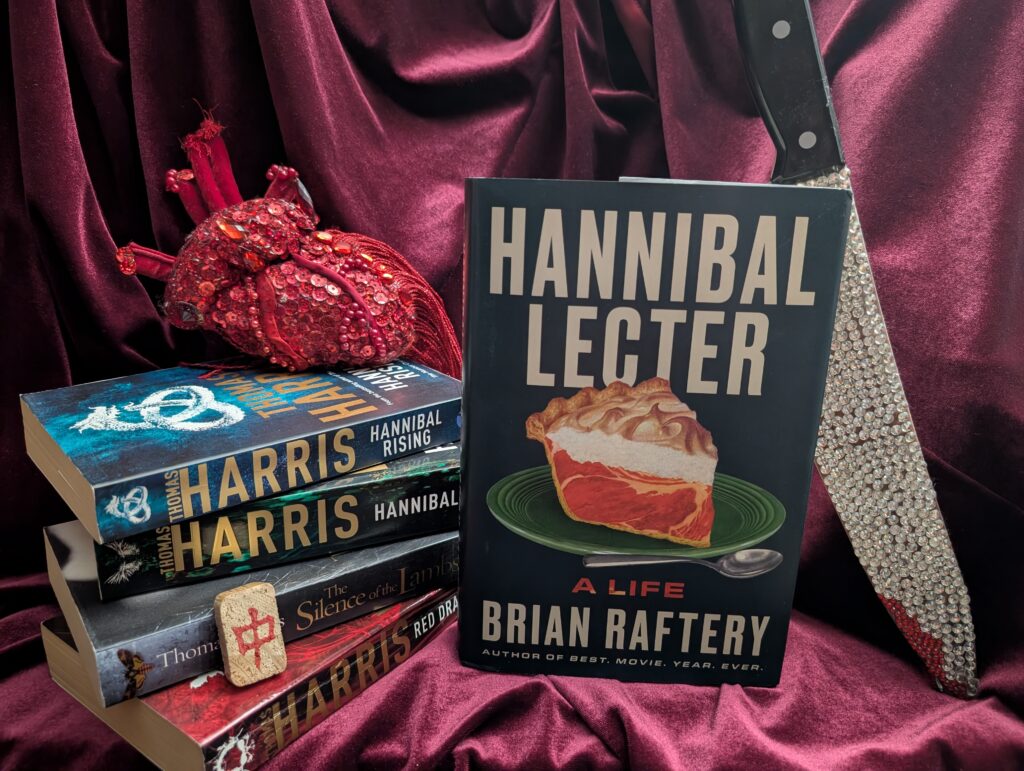
If you’ve had so much as a single conversation with me, you’ll know that I am unhealthily obsessed with the television series Hannibal. What you might not know is that I put off watching it when it first aired because I was uncertain it could match the heady thrills of The Silence of the Lambs, one of the first horror movies I ever saw and one that left an indelible mark on me. These pieces of media, along with the Thomas Harris book series upon which they’re based and early adaptation Manhunter, are cornerstones bricks in my psyche as a horror fan. So when Simon & Schuster announced that they were publishing Hannibal Lecter: A Life, I knew I needed to add a copy to my collection pronto.
Author Brian Raftery’s upcoming book is a biography of a character who may not be real, but who has taken on a life that goes far beyond, perhaps, anything his elusive creator ever planned for him. To tell Lecter’s story, Raftery dives into the archives of Silence of the Lambs’ director Jonathan Demme and conducts new interviews with key figures like Manhunter director Michael Mann and actor Brian Cox, the first person to portray Lecter on screen. He also teases out how the rise of Hannibal Lecter as an enduring antihero dovetails with the pop culture-fication of true crime—and considers why a certain politician kept mentioning the “late, great” Hannibal the Cannibal on the campaign trail.
As a self-proclaimed Hannibal Lecter stan (dare I say apologist), I had to get the chef on the phone. The following interview has been edited for clarity and conciseness, and nothing here is vegetarian.
An Early Taste of Hannibal Lecter: A Life With Brian Raftery
Samantha McLaren: Since the book is presented as a biography and you are not a character in it, I want to start with you. What is your personal history with Hannibal Lecter—where did you first encounter him in the wild?
Brian Raftery: The weird thing is, I have a very specific memory of that, which is when The Silence of the Lambs film came out. I was aware of the book—I’d seen some adults that I knew reading it—but I didn’t know what it was about. At that point, I was mostly just reading Stephen King and/or comic books and/or Rolling Stone magazine. And I remember in my eighth grade Spanish class, I was in the back not studying (which I should have been), but I was reading Peter Travers’ review of this movie [in Rolling Stone]. At that point, my horror experience was mostly kind of the classics, like the slasher movies and The Exorcist and The Omen. And I was reading this review and it was a rave, and I was like, wait a minute, this is a respectable, high-end movie about a cannibal. I couldn’t believe this existed, and I was fascinated. I read the review a couple of times.
I didn’t see the movie in the theater—I didn’t see it until it came on VHS. But I was fascinated with it for years; I watched it over and over again. I think when I first watched it, when I was 15 or 16, it was just the shock of Hannibal Lecter and how crazy these kills were. It’s one of those movies that I really remember, as a teenager, the rug being pulled from under me in terms of that ending, where you think they’re going to the house where [Buffalo Bill] is and they changed it up… But then I watched it more and more, and it was one of the first movies that I kind of started to study. It was definitely one of the first commentary tracks I ever heard or owned. They did one really early in the mid-90s when not a lot of people were doing them. And there was so much writing about it and enthusiasm for it in the 90s, it was a movie that never went away throughout the decade.
Then I read the books. I saw Manhunter and read Red Dragon. I was very excited when the Hannibal novel came out. A little less excited when I finally read it. The funny thing is, I missed a lot of the TV show. The TV show came out right after I’d had my first daughter, and I remember putting it on and being like, I can’t watch that. I was just not in the right headspace. That show is amazing to me. I can’t believe the stuff they got away with 10 years or so ago on network television—on NBC of all things, that was airing like Betty White’s competition shows at that point.
So I’ve always been fascinated by the character. He’s just one of the few villains that has never gone away. The character goes away for long stretches because the movies take a while, the books take a while, but [they’re] always circulating somewhere, unlike some horror villains who go in and out of coolness… So when we started talking about the book, I was at first interested in a book on The Silence of the Lambs, and then my editor said, why don’t we look at the Lecter character in general? That spurred the idea of doing a biography about someone who never actually lived.
How Hannibal Lecter Became a Cultural Icon Without Being Everywhere
SM: It’s a great approach because there’s a lot written individually about the different iterations, but less about the Hannibal character as a whole.
BR: The thing that’s so strange… I re-read all the novels when I started working, and it’s still shocking to me how little Hannibal Lecter there is in those first two books. It’s like 12 pages in Red Dragon. It’s wild to me. Even The Silence of the Silence is mostly a Clarice Starling book. And when you get to Hannibal… the first 100 pages is all Clarice Starling again. The fact that he’s remained so popular despite being kind of underexposed is very strange. There are very few characters who have that kind of presence with that little screen or page time for a big chunk of their career, for lack of a better word.
SM: The book reflects that aspect of Hannibal’s character in that he’s obviously the star, but there are times when he takes a back seat while you tell a broader story about the world around him and the lives he’s impacted in some way, in fiction or in real life. Was it difficult to find the right balance there?
BR: It’s interesting because there is so little on Hannibal. Even if you were to write a Wikipedia entry on Hannibal Lecter’s life and background, there’s so little about his personal life in the books until you get to Hannibal and Hannibal Rising. So I went in knowing that you can’t have Hannibal on every page, and at a certain point, I was just as interested in how the culture created and responded to Hannibal Lecter almost more than I was in the character itself, because whether you’re looking through the lens of horror or the bigger cultural impact of him, he’s really unique in the sense that he has a kind of visibility, despite not really being a guy who’s around a whole lot.
When I signed the contract for the book, I think Trump had only mentioned Lecter once or twice. And then, I’m not kidding, like two weeks later my book agent was like, I’m going to stop texting you every time he does it because he’s doing it so often now that I’d be doing it every day. That was kind of confirmation that, okay, these are people who probably haven’t watched the movies or read the books in 30 years… and he’s still an enduring punchline to so many people. Why this character? How can a president talk about Hannibal Lecter in kind of a heroic way in a way you couldn’t talk about Jason Voorhees or Michael Myers? What is it about this guy, and what was his popularity and his ascent? Where did that come from and what does it mean?
SM: There have been so many parodies and references to Hannibal Lecter in everything from children’s movies to Silence! The Musical. Was it a conscious decision to focus on the canonical, official Hannibal versus all the other ways he’s crept out into society?
BR: It’s funny. Two weeks after I turned the book in, I saw a trailer for the new Naked Gun movie last summer that had a Hannibal Lecter joke in it, and I was like oh, I should have waited until that came out! And there was a Variety story a few weeks ago that Zootopia 2 had a whole scene that was going to basically recreate Clarice and Lecter’s encounter from The Silence of the Lambs, which I thought was a pretty funny idea, and they scrapped it because they were like kids won’t have the patience for this and won’t understand it. I’m old enough to remember The Silence of the Hams, the Dom DeLuise parody. At a certain point, I was worried that if I just kept mentioning all the parodies and riffs, it would maybe distract.
I probably could have included a few more, but there were just so many of them. They kind of never stopped. For me, I was much more interested in how the success of The Silence of the Lambs back in 1991 created (along with Se7en) so many serial killer movies. I remember that I saw Copycat, that Sigourney Weaver and Holly Hunter one, at a screening in the mid-90s, and even I was kind of like, you’re gonna call this Copycat and you’re doing a serial killer movie after The Silence of the Lambs? It was just a little on the nose.

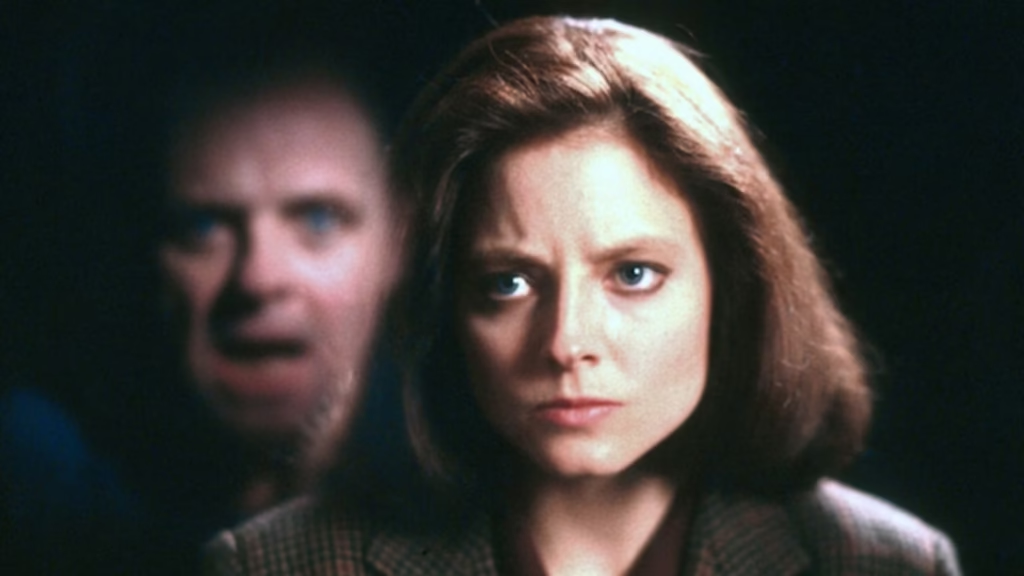
Jodie Foster as Clarice Starling, Silence of the Lambs (1991)
SM: There are a lot of Hannibal connections that are widely known at this point, but you also uncovered stories people might not know, like the women agents who helped shape Clarice. Were there any connections or details you uncovered in your research that you were especially excited to share with a wider audience?
BR: I’m totally blunt about this in the book: I could not talk with Tom Harris. He’s given three interviews, I think, in 50 years. But it meant that basically anything I could find about Tom Harris, any scrap, I had to look at it and be like, can I use this?
I was very lucky in that Jonathan Demme, who is the director of The Silence of the Lambs, and who remained friends with Harris even though he didn’t make the Hannibal sequel—his papers are at the University of Michigan. I got to go through and there was a ton of amazing stuff in there. I can’t say enough good things about the University of Michigan. These were random faxes from Tom Harris to Jonathan Demme and the producers, and there’d be little clues in there. At one point, he mentioned the names of some of the FBI agents he spoke to for the books—that’s the golden ticket.
One of them is still alive and I spoke to her for two hours. Her name is Athena Varounis. She’s fantastic, she should have her own book… She was someone who Harris met with repeatedly while writing The Silence of the Lambs. There’s also a woman named Patricia Kirby who Harris met with at least once or twice during the 80s working at the Behavioral Science Unit [who he spoke to about] being a female FBI agent. That stuff was fascinating because I didn’t know any of it, and to find the name of someone he spoke to on a handwritten fax is phenomenal as a reporter.
Even though it’s called Hannibal Lecter: A Life, to me, Clarice is equally important. I don’t think the movie The Silence of the Lambs would have taken off if it weren’t for Clarice Starling. Hannibal Lecter is not interesting to us unless we’re seeing him through Clarice Starling’s eyes, so I wanted to make sure that her story was told and how she came about. I think they’re the most perfect horror couple… It’s not a love affair, but it’s the closest two humans ever come in a movie despite (aside from brushing fingers) never touching each other.
SM: Harris is known for being elusive. If you had been able to speak to him, is there a burning question you were left with from your research that you would have loved the opportunity to ask?
BR: I had to take a lot of things on secondhand accounts or inference. What’s interesting about what serial killers informed Buffalo Bill or Hannibal Lecter is, he’s barely ever spoken on that. I mean, [former Behavioral Science Unit chief] John Douglas and the FBI have theories, and it’s clear when you look at Tom Harris’ relationship with the FBI, the agents he’s talking to and the killers they were studying, there’s connections there.
My big fascination, which is probably not everyone’s question they want to ask Tom Harris, is Hannibal Rising. With the first two movies, he wanted no involvement; he was happy to cash the checks and he would talk to Jonathan Demme if he needed to. They did the Red Dragon remake, and he was kind of involved again. And then, after proclaiming his dislike of Hollywood, he writes this screenplay and the book [for Hannibal Rising] at the same time, which any writer will tell you is a terrible idea. Every agent, every studio executive, they do not want a novelist working on a screenplay at the same time—it’s usually disastrous. The movie and the book were disappointing commercially. I want to know, how much of that was his trying to wrestle back control of the Hannibal character? Because at a certain point, the character becomes bigger than the books. It was hard to write about Hannibal Lecter without people seeing Anthony Hopkins.
I’m kind of fascinated by Hannibal Rising because it’s one of the 2000s’ most interesting failures. There’s very little documentation about. I talked to the director of the movie and found everything I could about it, but Harris did the screenplay and worked on the book—he didn’t do press. He didn’t really coordinate with a lot of people or communicate with a lot of people. So what he was thinking at the time, I can only guess.

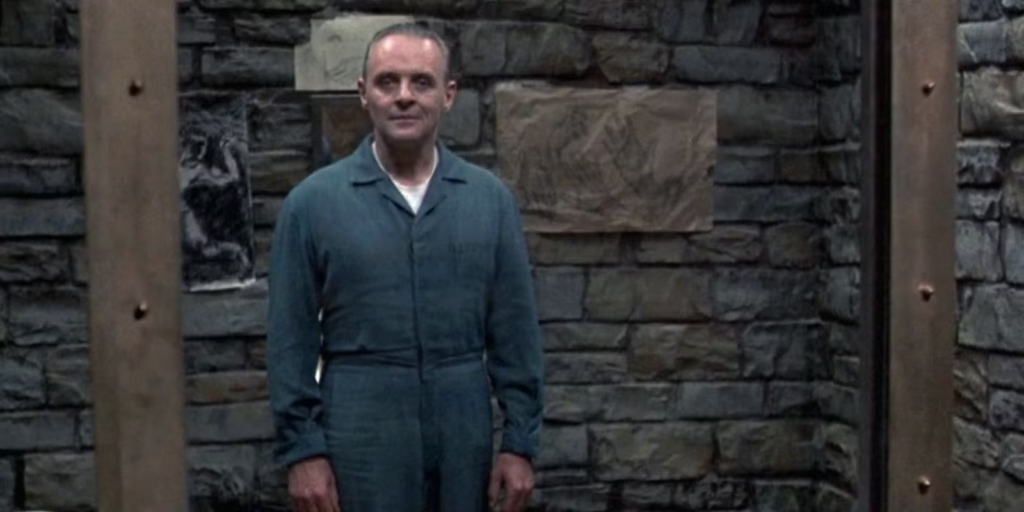
Sir Anthony Hopkins as Hannibal Lecter, Silence of the Lambs (1991)
Living With a Character Who Never Quite Goes Away
SM: You talk in the book about how engaging with the Hannibal Lecter media has a profound effect on some people, from David Lynch’s revulsion when he was initially attached to adapt Red Dragon to William Peterson feeling like he was Will Graham after filming Manhunter. Did your research and being immersed in this world have an impact on you?
BR: I’ve always been very good about separating fiction. I love the books, I love the movies—I don’t find that material particularly disturbing, but I was also not William Peterson trying to be Will Graham. It’s a different process.
What I found tough was, I’m not a true crime expert. I’ve been interested in true crime in various cases over my life, but for this, I had to really go deep on some serial killers. There were definitely days where I could get up really early and send my kids off to school and be like, I don’t want to deal with Ed Gein. I don’t want to read the Life magazine story about him, I don’t want to go through John Douglas’s FBI photos, but I did. That stuff, after a while, did start to upset me.
Anthony Hopkins went on this long drive from Utah to Pittsburg right before the filming of The Silence of the Lambs, and because he has a steel-trap memory, he at one point named for a reporter every city he stopped in along the way. And I thought, I bet there’s been a serial killer in each one of those cities. I kind of wanted to make that connection between the country he was going across to play this fictitious killer, and we have all these real killers in the country. I had a week where I was just looking through numerous local papers for unsolved murders and cold cases, and a lot of them were really grisly. I remember by Friday I was kind of like, all right, I think it’s time to watch Singing in the Rain.
It was really unpleasant… We think that the world is more violent now, but when you go back to the 60s, 70s, and 80s and go through these newspapers, there’s a lot of really terrible things going on and I didn’t need to know about every single one of them.
SM: Barring the epilogue, the book ends with the conclusion of Hannibal, the TV show. But there have been further adaptations after that, like Clarice [2021, CBS], which doesn’t feature Hannibal but is in his world. How did you decide to end it where you did?
BR: I knew that the TV show was always going to be the last chapter because I knew it was always going to be chronological in terms of where Hannibal Lecter came out. The thing that’s so remarkable to me about Hannibal the TV show is the fact that Bryan Fuller had this many episodes. He planned for many seasons and the ending they had was the ending they had to do—the show was canceled after three seasons. And it’s one of the best endings for a TV show. This could be the end of the show, or the show could have started again three months later and picked up from there.
I like the ambiguity. The idea of Hannibal falling off a cliff and you’re not entirely sure what happened to him is kind of like the ending of The Silence of the Lambs where Hannibal Lecter goes into the crowd. I wanted the book to end with Hannibal Lecter still out there in some way. It’s a biography of a character, and a character who’s still alive, not the “late, great.”
I did talk to Bryan Fuller a bit about how he would like to do a Silence of the Lambs TV series, and he’s talked about it in other interviews, but I didn’t want to speculate. I want to end with what we know about. What we know is he falls off the cliff, and there’s that coda which, of course, implies something else going on. But I like the idea that after that show went off the air, the way that Hannibal Lecter has lived in the last 10 years is in the culture somewhere. He pops up in strange places—he pops up in a Trump speech; he pops up in college courses. It’s almost like you’re waiting for him to come back in from the cold.
For all I know, Tom Harris could have another Hannibal Lecter book, because he’s surprise released almost all of these books. Maybe he’ll do it again. Maybe they’ll figure out the rights situation and who owns what and make another movie or TV series. A couple of people have asked me like, aren’t you afraid they’re going to reboot it? It’s a pretty durable character… It’s the kind of character that you can play a lot of different ways and interpret a lot of different ways.
SM: So what you’re saying is, there might be a second edition in 10 years if Harris surprise drops Hannibal V.
BR:At the least, we’ll have to do a couple of chapters.
Hannibal Lecter: A Life by Brian Raftery hits shelves on February 10. Learn more, including where to pre-order the book and upcoming appearances from Raftery, by visiting Simon & Schuster’s website.

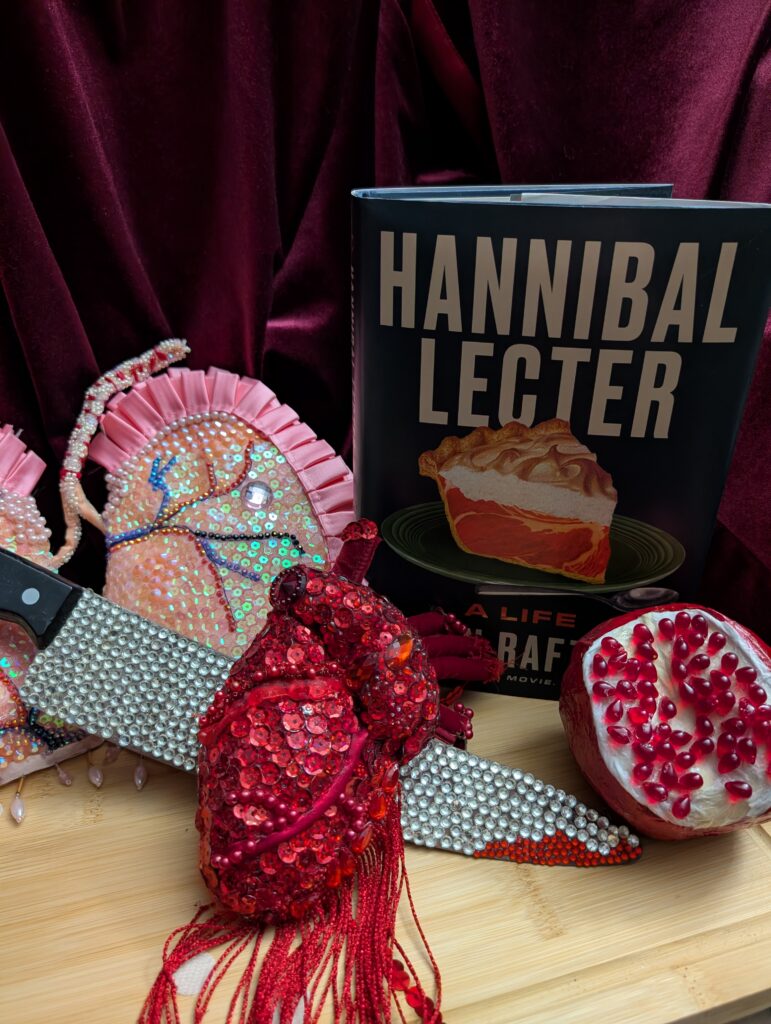
Photo taken by Samantha McLaren.