

TV
A VERY VALENTINE FAMILY REUNION: Chucky Season 2 Episode 4 “Death on Denial: A Jennifer Tilly Mystery!” Recap & Review


A punny title about that terrible Gal Gadot movie? Sutton Stracke, Real Housewife of the Real Housewives of Beverly Hills? The long-awaited return of Glen/Glenda to the Chucky franchise? This episode really IS for the shes, gays, and theys!
This is an episode for all the Jennifer Tilly fans considering it’s another big meta-humor episode. In particular, “Death on Denial” calls back to the simpler times when John Waters was photographing a perverted doll, with its farcical fourth wall breaking, focused on jokes about Tiffany pretending to be Tilly.
We begin with Chucky announcing that this episode is in fact, the season’s B-Plot and that the Hackensack gang will be absent this week. At Chez Tilly, Glen and Glenda return home for their birthday bash to their mother cleaning up a suspicious blood lake that’s been left by a dead detective (still annoyed Michael Therriault didn’t play him!).
As Tiffany tries to act natural, conflict arises when the children address their mother’s rampant spending and deteriorating mental state. On top of their mothers’ issues, the existential crisis of Glen and Glenda as an entity comes into frame. Glenda addresses never having felt whole following their voodoo separation from their original doll body and mentions that their dreams are haunted by visions of the former doll’s own secret origins; we get a return to Seed of Chucky, complete with the makeshift flamethrower flashback.
Color me impressed that this episode has a genuine textual richness to it despite the silliness, with Glen and Glenda finally having their day in the sun to explore the more nuanced aspects of being a non-binary person (people, technically). The whole dialogue is a very subtle and very well-meshed metaphor for dysphoria, and the fact that it gets visualized in the incredible split-screen performance of Lachlan Watson is just the icing on the cake. Only Mancini and company could pull something like this off.
But this is supposed to be a party, isn’t it? And soon, those party guests flood in, including:
- Jeeves, the obnoxious and bigoted butler who’s only here for a check
- Honorary uncle and aunt Joe Pantoliano & Gina Gershon in a Bound reunion with their co-star (and secret lover)
- Sutton Stracke, slightly embittered poker buddy and real housewife from down the block in her first scripted acting role
- And The Big Chill star Meg Tilly, Jennifer Tilly’s actual sister!
Everybody present is close to sussing out Tiffany’s masquerade, but it’s hard for them to focus on the cracks in the facade when Jeeves gets into a tiff with Joe, who he keeps insulting with slurs and The Sopranos callbacks. Gina and Sutton catch strays from his crass comments, and after some blatant hatred for Glen and Glenda’s identity, everybody teams up against Jeeves in a wonderful moment of anti-asshole solidarity that forces him to head out of the room and back to guarding Nica’s quarters.

When the power goes out, Tiffany finds a dead Jeeves on the ground and Nica’s now empty bedroom prison opened before everyone else stumbles across the body. In a surprising stroke of genius, Tiffany gets everybody to believe a poisoned Jeeves is playing dead as part of a murder mystery game. Tiffany retreats to try and find Nica after an alarm goes off and gets cornered by a tipsy and handsy Gina, and an equally drunk and nasty Joe. Elsewhere, it’s revealed Glen is in cahoots with Nica in a secret basement room hideaway.
Flashing back to three months ago, a drunk Tiffany brags about “her” performance in Liar, Liar before passing out and leaving Nica unprotected from the prying eyes of her kids. Though both meet Nica and agree to help her, Glenda ends up meeting the Chucky inside of Pierce after accidentally triggering the victim’s blood aversion. Chucky emotionally manipulates Glenda into siding with him, preying on the youth’s violent tendencies; the two plan to arm Nica-Chucky, literally, with swanky new robotic limbs.
Back in the present day, Nica bonds with Glen momentarily over phantom limb itches, but transforms into Nica-Chucky after stumbling upon a dead Joe in the elevator. Glenda knocks out Glen to secure her opportunity to strike back at Tiffany, and Glenda along with Chucky, make a grand entrance to kill their mark… And stumble right before the finish line with an empty gun. You see, neither of the twins took out Joe and dumped his body in the elevator, but rather Gina, shot him in a fit of murderous passion. Nica comes to after a slap from Tiff and escapes out the front gate. Glenda sprints like an olympian to try and catch Nica (side note, Lachlan Watson’s athleticism is scary, CRAZY strong form), and the two escape in a step van driven by none other than, plot twist, a still very much alive Kyle, in a brunette post-explosion wig! But now an unconscious Glen is stuck back at the house with a mother mourning the loss of her hostage, and Meg Tilly.
Back in the studio wraparound segment we opened the episode on, WWE superstar and fellow Child’s Play super-fan Liv Morgan arrives. Just when I thought we couldn’t get any more cameos! Although this is cut short when Liv dies by Chucky’s hand to even out the kills for the episode. Oh, and Chucky fills us in on the solution to the murder mystery. Glenda killed Jeeves with the pocket arsenic in the study.
Tale as old as time.
VISUAL HIGHLIGHTS: Honestly, I couldn’t think of anything in the directing that stood out to me outside of those fun shots of Nica escaping in her wheelchair. But I do get to talk about how great the costuming was this episode. Tiffany’s dress, or even just Glen and Glenda’s outfits speak volumes to the complexities of the characters. Solid work all around.
Also…that pinky swear gag. Genius.
PERFORMANCE HIGHLIGHTS: This episode soars because everyone is bringing their A-Game. Jennifer Tilly gets to just cut loose and inhabit Tiffany’s sad and slightly pathetic side, all of our guest stars have perfect comedic timing, and Fiona Dourif continues to prove that she is the only person who can hold a candle to her father’s performance. But above all else, Lachlan Watson got thrust into a double role almost instantly and expertly, magically, somehow made the return work. With such a tall order, it’s beyond impressive.
QUOTE OF THE EPISODE:
“Who would commit murder over pronouns?”
“EACH. AND EVERY. ONE OF YOU. […] And that is why I love you.”
– Joe Pantoliano & Tiffany Valentine, on reasonable reactions to misgendering
RATING: 10 (Network Television Allotted Uses of the word F**k)/10. I’m genuinely convinced that this season may not have an episode with a score under 8. This really is a super condensed spiritual successor to Seed of Chucky, in the best of ways. It is over too soon for how fantastic it is.


“Where are all the Black witches?!” We scream into the media void. It seems that no matter how many Black witches in movies and TV may exist, their stories exist for someone else’s benefit. Despite them being the most powerful in the room, they are often reduced to secondary and tertiary characters. If they aren’t depicted with a cauldron and gothic attire, they aren’t considered a witch at all. Historical references can tell us why the term “witch” has been whitewashed in such a manner, just as history tells us how it became a tool for misogyny.
While we’re still owed Black witch representation, the characters mapped out here test the boundaries of this archetype on-screen. They don’t all fall under the term “witch,” nor do they ride a broom at midnight. Our pop culture references are Eurocentric, after all. Those of African descent don’t always subscribe to the pagan practices of the stereotypical witch. Popular media has led us to conflate the fantastical depictions of on-screen witchcraft with elemental healing and divination practices. And so, it’s important to make the distinction between Black characters practicing their respective magick.
Voodooists, Hoodooists, Healers, & Diviners
The term “witch” can mean a lot of things, and they usually have a negative connotation. It’s a taboo that our society is still working through. But beneath the heresy of Black magic is a network of people (not just women) using natural elements, divine entities, and their own power to take control of their lives and for the betterment of their community. Vodou and Hoodoo aren’t much different. While Vodou operates as an organized religion like Brujeria, Hoodoo is folk magic most similar to the popular idea of witchcraft. Somewhere in there are root healers who can identify with either system and deliver the same (if not better) results as green witches. Though the earlier depictions were usually racist and demonizing, we reclaim these characters the way we reclaim the term “witch”.

Mambo Michele Marie LeFleur (The Chilling Adventures of Sabrina 2018-2022)
Mambo Marie, played by Skye Marshall, appears as a Vodou priestess before it’s revealed that Marie LeFleur is just a mask for her true identity: Baron Samedi, the Haitian spirit of the dead.

Mama Maitress (Sugar Hill 1974)
Mama Maitress is a former Vodou queen enlisted for revenge and she’s portrayed by Zara Culley.

Annie (Sinners 2025)
Annie, played by Wunmi Mosaku, appears as a Hoodoo practitioner by way of her grandmother and her knowledge of herbs and holistic medicine helped to protect and heal those around her. Read our review of Sinners here.

Klili Gordon (The Love Wanga 1936)
Portrayed by Fredi Washington, Klili is a Vodou-practicing, Black plantation owner using her craft for revenge on a white man.

Dr. Beehibe (The Exorcist: Believer 2023)
Played by Okwui Okpokwasili, Dr. Beehibe is a Haitian roothealer who used her spirituality in tandem with plants and herbs to aid in the exorcism of two young girls.

Marie Laveau (American Horror Story: Coven/13)
Based on the real Vodou Queen of New Orleans, Angela Bassett plays Maria Laveau whose powers, enhanced by Vodou, equate to that of the Supreme.
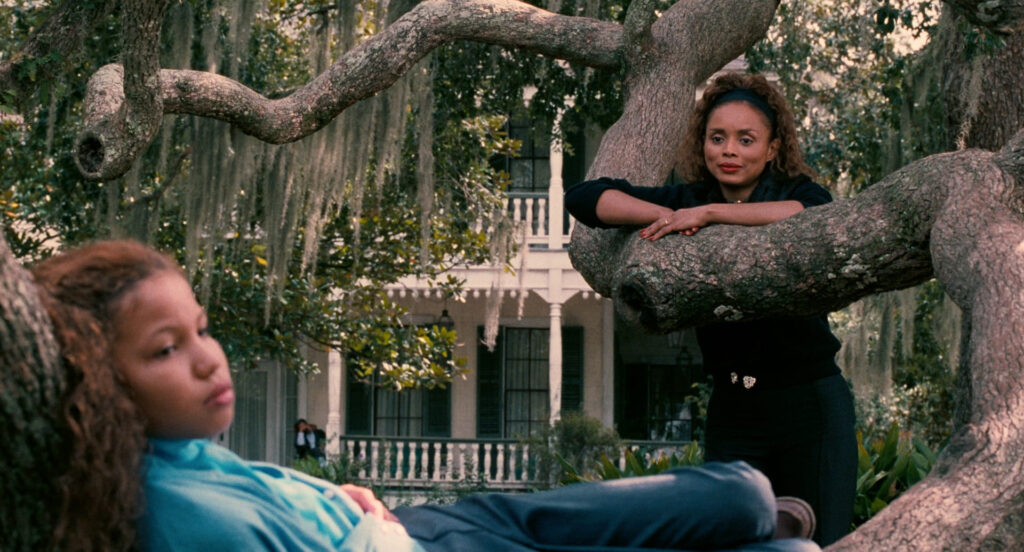
Eve and Mozelle Batiste (Eve’s Bayou 1997)
Eve (played by Jurnee Smollett) and Mozelle (played by Debbie Morgan) have the gift of second sight, otherwise known as Seers, which provide divine premonitions and communication with the spiritual plane.

Elzora (Eve’s Bayou 1997)
Elzora, played by Diahann Carroll, is a Vodou practitioner who is deemed as a “crazy witch” until her prophecies start to ring true for the Baptiste family.

Ms. Eloise (Spell 2020)
Loretta Devine plays a hoodoo practitioner who traps a man, Misery-style, with the use of a figure she made with his skin and blood.
Witches
Considering that most of our favorite Black witches are written from a white perspective, there is a great disservice in simply squeezing these characters into the Western idea of a “witch”. A lingering ghost of culture and identity haunts these shows and films like an elephant in the room. These are the secondary and tertiary characters written for fodder. When they’re not, they are characters that we simply didn’t get enough of. We’re left wanting more.

Kyra, The Seer (Charmed 1998-2006)
Also played by Debbi Morgan, The Seer was canonically a demon with the power to see the future but her powers were all the same as an archetypal witch who casts spells and brews potions.

Rochelle Zimmerman (The Craft 1996)
Rochelle Zimmerman is a latent witch whose abilities are interlinked with her coven’s, channeled through their Creator of the Universe Manon, and she’s portrayed by Rachel True.

Fig (Forbidden Fruits 2026)
Fig, played by Alexandra Shipp, practices the kind of witchcraft that was persecuted in Salem: mundane and fueled by feminism and sisterhood.

Prudence Blackwood (The Chilling Adventures of Sabrina 2018-2022)
Prudence, played by Tati Gabrielle, has the archetypal powers of a witch and ages at a slower rate compared to mortals.

Ambrose Spellman (The Chilling Adventures of Sabrina 2018-2022)
Technically a warlock, Chance Perdomo plays a male witch who specializes in necromancy and ages at a slower rate like Prudence.

Behold Chablis (American Horror Story: Apocalypse 2018)
Behold Chablis (played by Billy Porter) is a Level 3 male witch also considered to be a warlock.

Melissa Cavender (The Midnight Hour 1985)
A latent witch, played by Shari Lynn Belafonte, who invokes the spirit of her great-great-great-great-grandmother, and the undead, by reciting a curse on Halloween Night.

Jennifer Kale (Agatha All Along 2024)
Played by Sasheer Zamata, Jennifer identifies as both a root worker and a witch whose powers include spellcasting and potion-making.

Queenie (American Horror Story: Coven/13)
Played by Gabourey Sidibe, Queenie is the self-proclaimed “human vodou doll” who practices vodou simultaneously with her natural gift of witchcraft.

Vincent Griffith (The Originals 2013-2018)
Vincent is the former Regent of the Nine Covens who is powerful enough to subdue Original vampires and he’s portrayed by Yusuf Gatewood.

Lafayette Reynolds (True Blood 2008-2014)
Lafayette Reynolds, portrayed by Nelsan Ellis, is a medium whose power can be traced back to his great-great-grandmother who practiced magic.

Bonnie Bennett (The Vampire Diaries 2009-2017)
Played by Kat Graham, Bonnie Bennett comes from a long line of powerful witches and operates as both an Anchor and a Huntress.

Charm City Coven (Wicked City 2022-Present)
The Charm City Coven is made up of five witches (played by Taylor Polidore, Shaquita Smith, Mercedez McDowell, Chantal Maurice, and Chanel Mack) in Atlanta who bring their individual, unique powers together to navigate supernatural forces and personal life terrors.

Domino Day (Domino Day: Lone Witch 2024)
Domino Day is a powerful lone witch, portrayed by Siena Kelly, who feeds off of the of energy men.

The works of Stephen King are back in the spotlight once again, if they ever really left. Mike Flanagan’s Carrie series is set to release on Amazon Prime this October 7th, and the heat is on. This would be the fourth run at the tale of a tortured psychic girl suffering through serious religious trauma and bullying; it’s also the first successful television series adaptation. Famously, the 2002 TV film was supposed to serve as the pilot for an extended Carrie series, but that never got off the ground.
There’s a variety of reactions to the show already; from complaints about getting another Carrie White that doesn’t look like Carrie White, to thoughts about introducing other psychic students into the story. It’s fair to say there’s, at the very least, renewed interest in re-evaluating the many adaptations of Stephen King’s works. Old habits die hard.
There’s a ridiculously large swath to choose from, ranging from the obvious classics like The Shining and Pet Sematary, to irregulars like The Langoliers and The Night Flyer. If you’re feeling especially bold, you might try a King original like Storm of the Century or Rose Red (I’m overdue for a watch of Storm anyways). But among all these lies one of the strangest and most forgotten King adaptations. One that was sold as an adaptation of a single novel, but is really a spiritual sibling to the entirety of Stephen King’s canon. That adaptation is the SyFy original series, Haven.
The Silver Age of Supernatural Television Drama
The development of Haven sits smack dab in the middle of what I would call the Silver Age of Supernatural Television Drama. The hypothetical Golden Age that precedes it isn’t pinned to exact years but rather defined by a few masterpieces of evergreen television. These are the shows throughout the ‘90s that really impacted cable TV at large. The obvious cultural touchstones of the genre: The X-Files, Twin Peaks, and most importantly Buffy the Vampire Slayer and Angel, which would see monumental success. They were rapidly followed by the likes of shows like American Gothic and Roswell. I would count Smallville too, but again, blurry edges.
The Silver Age then is marked by an explosion of shows, not necessarily being created as knee jerk reactions to that success, but certainly heavily inspired by these network defining hits. Shows that enjoyed the episodic “monster of the week” format while retaining a focus on the interpersonal drama between its characters. They debuted as their progenitors ended or went late in their run, effectively meant to “replace” them.
This time saw the rise of J.J. Abrams renown with the shows Alias, Fringe, and most importantly, the mega-hit Lost. The most successful of all of them, Eric Kripke’s Supernatural, is still reverberating through pop culture today after its 15 year long run. And for my fellow Warehouse 13 enthusiasts, you know that this is the era that the highly underrated show thrived in.
Also, MTV’s Teen Wolf was there too, I guess.
From The Dead Zone to Haven Island
Among these much more successful shows was an odd little Stephen King adaptation: USA Network’s The Dead Zone. It was a very fast and loose interpretation of King’s novel of the same name. You know the one: go into a six-year coma, come back with psychic powers, meet an evil politician, race to stop him from causing the end of the world. Also, Anthony Michael Hall is here too, I guess.
As one might expect, the premise was rife with procedural potential. Despite a solid initial viewer base, The Dead Zone ran for 6 seasons before being cancelled due to waning ratings. But two of its writers, Sam Ernst and Jim Dunn, ended up as showrunners for a similar but even stranger translation of King’s work: a television adaptation of the book The Colorado Kid called Haven.
When The Adaptation Is Unrecognizable
Haven premiered in July of 2010 on SyFy, joining during a great (if not the best) era for the network. There were phenomenal runs going on with Merlin, Warehouse 13, and later the American remake of Being Human. And, unsurprising to anyone who got 20 minutes into the show’s first episode, “Welcome to Haven”, it fit in much more with those shows than it did with its source material. In fact, the premise betrayed all expectations for fans of the novel.
What The Colorado Kid Is About…
For context: the book is about an intern at a newspaper, Stephanie, trying to solve the bizarre death of a nameless drifter with her new bosses, Dave Bowie and Vince Teague. Details are sparse, and what few the trio have just don’t line up. What results is a hard-fought battle to finally crack the case of who, or what, killed the Colorado Kid. More importantly, The Colorado Kid is pretty explicitly a mystery novel about mystery novels; it has a victim, but there’s little information about the killer, and that’s intentional.
The blank space in this case is the focus. King is really more interested in observing how an audience interfaces with a mystery and what makes them so compelling. He spells all this out as much in an afterword, down to explaining why he wanted to write the story and his perspective on “wanting” an answer being better than “knowing” the answer.
…Is Far and Away from Haven’s Premise
The TV show Haven, however, is very, very different. The show follows FBI agent Audrey Parker (Emily Rose), who is drawn to the town to investigate the inexplicable murder of a criminal who escaped federal prison. When it’s revealed he was killed by impossible means, she soon discovers a phenomenon known as “The Troubles”: the sudden and often subconscious manifestation of dangerous supernatural abilities in the townspeople of Haven. As Audrey realizes her past is intertwined with The Troubles, she attempts to solve the mystery of what’s causing them and who she really is as she becomes entrenched in the lives of Haven’s locals.
Different versions of newspaper owners Dave and Vince, as well as The Colorado Kid himself in season 2, do show up in Haven. But fundamentally, the show is an entirely different beast tonally. It is far and away from the novel, and strangely enough, that was at Stephen King’s request. He initially told Ernst and Dunn when the show was being pitched to ABC to spice it up with more supernatural elements.
Hence, how it ended up as a monster of the week show on Syfy. Double hence, how it became an unrecognizable adaptation of a hardly supernatural book. If I had to compare it to any of the Golden Age shows, it’s most obviously inspired by The X-Files. That being said, it’s hard not to draw comparisons to Fringe. Especially given how, like Fringe, Haven becomes really, really serialized rather than episodic.
A Flat, Kind of Cheesy First Season That Grows on You
The initial monster of the week format set up in Season 1 does carry into the following four seasons, but it becomes very clear that there is a main mythology that will take precedence by early Season 2. While the supernatural mysteries that make up the bulk of the episodes are solid (see episodes 1, 4, 6, 8, and 10 through 13 for the best of the first season), they’re mostly establishing the groundwork for Audrey’s personal narrative arc.
The mysteries are also the backdrop for Audrey’s budding love triangle with local handsome cop Nathan Wournos (Lucas Bryant) and local handsome rogue Duke Crocker (Eric Balfour). The romance is kind of terrible, and unfortunately very frequent since they’re often cooperating to solve the mysteries together.
So, that’s all I’m going to say about it in an effort to be kind.
Haven Season 2 Deepens Audrey Parker’s Mystery
Haven’s first season is mostly tame, erring on slightly underwhelming, with some very cheesy dialogue and drama. The characters aren’t nailed down as anything but loose pastiches until the last several episodes. By then, they’ve built some weight and dimension to them. Where Season 1 leaves off is a pretty solid cliffhanger that will have you at least curious enough to venture into Season 2 if you’ve watched this far. It serves as the first big bite into the intrigue of the question “Who Is Audrey Parker?”, which is the central pillar of the show.
Season 2 is much more engaging, and the episodic mysteries feel much more significant and dangerous. Eventually, the mythology around Audrey and the Troubles sprawls out into a maze of even more questions involving secret societies, split personalities, time travel, and tears in the fabric of reality. That last bit might stand out to fans of The Dark Tower series, and that’s because I’m talking about exactly what you think I’m talking about (no spoilers!).
A Stephen King Adaptation About Stephen King Stories
The show is only somewhat effective at establishing its mythos around Audrey and The Troubles. But I have to appreciate it for what it manages to do in the process, especially throughout the second season as it gives us one good solid villain to follow in the malicious Reverend Driscoll. He is a classic King-style villain, and an embodiment of what Haven really excels at. The same way that The Colorado Kid is a mystery novel about mystery novels, Haven is a Stephen King adaptation about Stephen King Stories.
This goes beyond the fact that they’re effectively trying to find a new person with the shine every week and stopping them before they have their own personal “Black Prom” level meltdown. The show is chockful of references, small and large (the vast majority are sight gags referring directly to Stephen King stories) to his writing. There’s an abundance of episodes whose plots are overtly reinterpretations of King’s works, especially in season two with various homages to It, Maximum Overdrive, and The Dark Half.
And even when the show doesn’t have a one-to-one analog with a King story, it excels at stocking Haven Island with a variety of secondary characters that genuinely feel like the cast of a Stephen King book. The dialog might be corny and the residents strange, but it does feel like a lived in setting, a hallmark of the author’s many fictional small towns in Maine (which get namedropped a decent amount in the show, obviously, they’re all neighbors). Also, when we get the answer of who exactly Audrey is, it actually does end up connecting to the greater Stephen King mythos in a way that is surprising and kind of fun, even if the ending is a little underwhelming and gives Buffy finale flashbacks.
Haven Isn’t Half Bad
At the end of the day, I can’t confidently say Haven is a great show. Especially with how it drags in a lot of places (that double-wide trailer of a fifth season is particularly egregious). It can be exceptionally hit or miss. But it’s so uniquely dedicated to recapturing the vibes of a Stephen King story, that I have to admire it when it does succeed, when some might find that a futile task. Paradoxically, the further it gets away from the source material it was barely riffing off of, the more King it feels.
It is at the very least an incredibly unique show in the Silver Age of Supernatural TV, and if you can tolerate the melodrama of your Supernatural’s and Warehouse 13’s, you’re likely to find some amusement in it even if you’re tuning in and out while watching it. More than ten years out now from Haven’s 2015 finale, it’s safe to say the series won’t click with everybody, but for fans that enjoy homages to the prolific horror author’s extensive repertoire, you’ll be hard pressed to find a show that shows more love to King than this.
