

Reviews
[REVIEW] The Prophecy Calls For Faith In ‘End of Days’ (1999)
Jericho Cane (Arnold Schwarzenegger) lost his job, family, and seemingly, his drive for life. Bobby Chicago (Kevin Pollak) and Jericho Cane spend their days as armed security for bigwigs throughout the five boroughs. Their latest job is to protect The Man (Gabriel Byrne), and when the job goes seriously wrong, Jericho and Bobby are thrust into a world much darker than they could have imagined. A war of good versus evil comes to light as Jericho finds himself to be the sole protector of Christine York (Robin Tunney). Will they succeed and fend off the devil? Or will this all lead to…the End of Days?

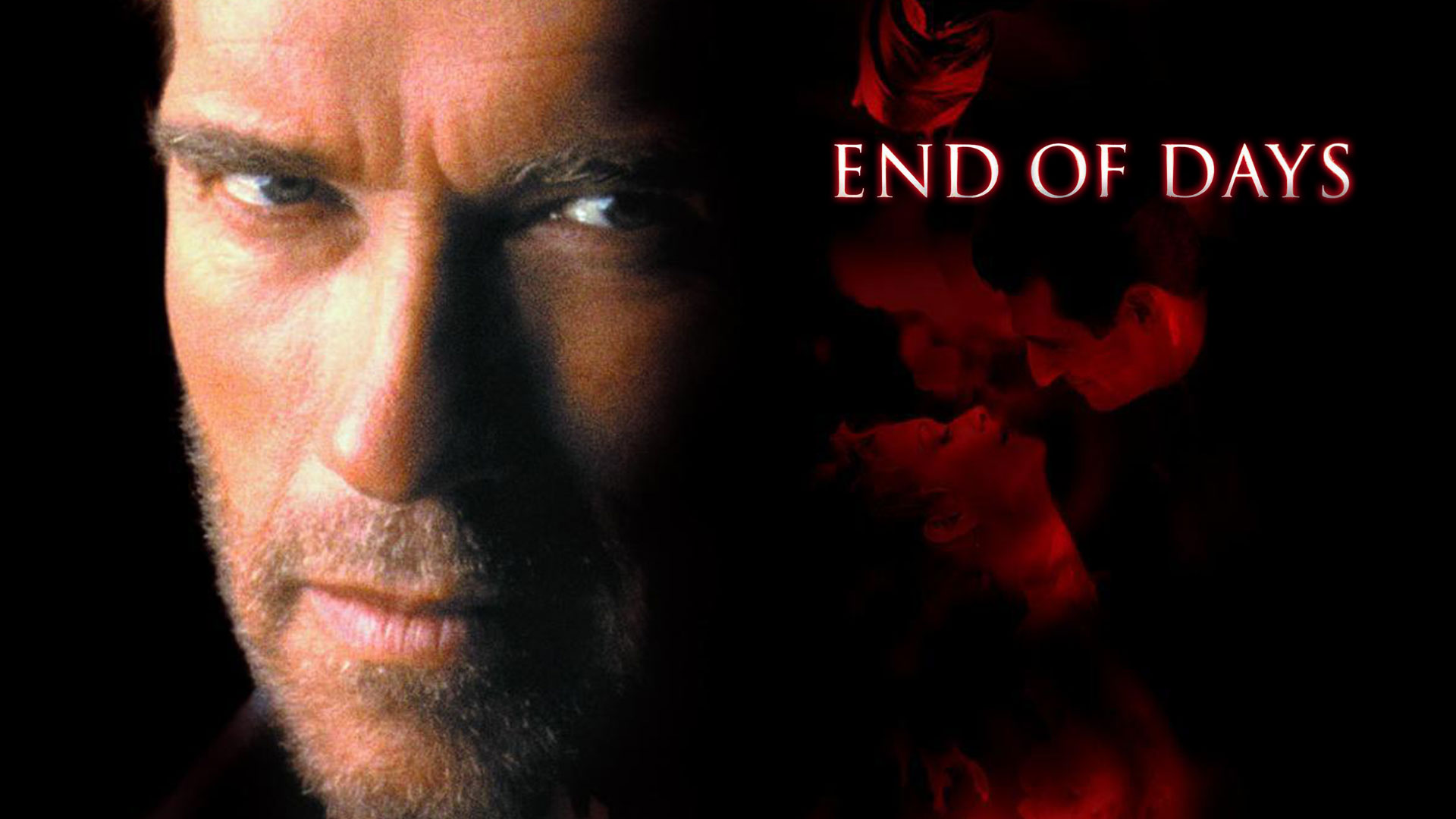
Stereotyped actors in Hollywood throughout the ‘80s and ‘90s never really took chances. Sylvester Stallone, Jean-Claude Van Damme, Chuck Norris, and (yuck) Steven Seagal played it close to the chest. Later in their respective careers (sans Seagal), they would occasionally step out of their genre, but more often than not, they stayed with characters they were comfortable with. The only one of these types of actors who really tried to do things differently was Arnold Schwarzenegger. He broke the mold with films like Twins, Kindergarten Cop, and End of Days.
Jericho Cane (Arnold Schwarzenegger) lost his job, family, and seemingly, his drive for life. Bobby Chicago (Kevin Pollak) and Jericho Cane spend their days as armed security for bigwigs throughout the five boroughs. Their latest job is to protect The Man (Gabriel Byrne), and when the job goes seriously wrong, Jericho and Bobby are thrust into a world much darker than they could have imagined. A war of good versus evil comes to light as Jericho finds himself to be the sole protector of Christine York (Robin Tunney). Will they succeed and fend off the devil? Or will this all lead to…the End of Days?
From writer Andrew W. Marlowe and director Peter Hyams, End of Days is a fart-rock-fueled blockbuster of epic proportions. We truly don’t get many films like this anymore. Marlowe’s story is a wonderful David-versus-Goliath story with a modern setting propelled by Arnold’s willingness to give into the role. Some digital effects don’t meet current standards; however, they’re used sparingly and work well with the practical effects.
A Broken Hero in a Dark, Supernatural Thriller
Arnold is the lifeblood of End of Days. Gone are his badass action zingers and his machoman attitude is replaced with a broken man at the end of his ropes. Arnold struts around Manhattan fully clothed and un-oiled, delivering lines in a way he hadn’t until this moment. The only moments of this film that genuinely don’t work (for me) are when Marlowe writes some Arny-like lines. Thankfully, there aren’t many of those lines. Arny starts the film with a gun in his mouth, which is a visual you could never imagine from the characters he’s previously portrayed, and it’s almost breathtaking.
End of Days fills the screen with a beautifully gritty New York with shots we haven’t seen in over a decade. Images that would be filmed on a green screen studio take place in a crowded Midtown. Helicopters fly inches away from buildings, bombs go off, and bullets reign. Interestingly, there is only one glimpse of the Twin Towers. Movies that take place in New York around this time usually made sure to get a few full frames of the Twin Towers. But that’s neither here nor there.
Christine’s birthmark is another interesting point. It’s in the shape of the Lululemon logo, or should I say, the Lululemon logo is in the shape of her birthmark. Does that mean Lululemon is also a conduit for the devil? Personally, I would consider Chip Wilson a demon for the number of lives he’s ruined with his awful pyramid scheme.
End of Days Legacy: A Rare Gem in Action-Horror History
With all of that said, Peter Hyams brings an excellent blend of horror and action throughout End of Days. If you’ve ever wanted to see Arny and Miriam Margolyes fight in hand-to-hand combat, then this is the film for you. Surprisingly, the scenes of action revolving around Gabriel Byrne are the most engaging. Beyond the action, Marlowe’s script brings verbal action between Byrne and Arny and between Byrne and Udo Kier. Their verbal back-and-forths with Bryne is a level of fighting that rivals many of the scenes in some of the best ‘80s action films you could name.
End of Days marks a time in cinema when big actors weren’t afraid to take chances, and studios cared about making something practically. Action horror isn’t a subgenre that gets made often, and End of Days feels like a needle in a haystack. The film’s ending concludes the story, so we won’t be getting a sequel. As someone who is on the fence when it comes to reboots, if they could do a fully practical reboot shot on location, I think I’d love to see this film remade. That is, as long as they kept Rob Zombie on the soundtrack.


The tagline for Godzilla Minus Zero is a striking one, and in the context of what writer-director Takashi Yamazaki is doing in this sequel, certainly the most fitting. “There is no third time. Everything ends here.” It’s a chilling phrase that doesn’t just let you know they’re pulling out all the stops for this Godzilla duology; it also taps into the core of what Minus Zero wants to say. What Yamazaki has made here reckons not just with Godzilla’s legacy as a metaphor for the atomic bomb, but with the nature of life after war, and the cost of finding peace. And it does it in an unforgettable fashion.
It’s a film that is heartbreaking, horrifying, and emotionally resonant throughout its runtime in spite of the burdens it has as a sequel. And if that dramatic weight isn’t enough to hook you, rest assured the physical weight of its kaiju onscreen will: Godzilla Minus Zero brings some genuinely awe-inspiring special effects to the table, and the best kaiju brawl the franchise has seen in over 20 years.
To learn more about the Godzilla monsterverse read our guide here!
What is Godzilla Minus Zero About?
After killing the force of nature known as Godzilla, former fighter pilot Koichi Shikishima (Ryunosuke Kamiki) has found peace. Two years have passed and his life with Noriko (Minami Hamabe) and their daughter Akiko (Sae Nagatani) has settled down. There’s a semblance of normalcy in domestic life, even as Japan is haunted by the ruins of the beast’s rampage. Unfortunately, the emergence of a new extraterrestrial threat has cast its shadow over Japan now: a chimeric, evolving dragon from space known as Ghidorah.
With the kaiju threatening to take away everything from them once more, Shikishima and Noriko are forced to reunite with old ally Dr. Noda (Hidetaka Yoshioka) and a new team of experts to try and kill it. But as Ghidorah grows more powerful and adapts to their plans, it soon becomes clear only one thing can stop the airborne abomination from completely destroying an already ravaged nation: a newly resurrected Godzilla.
A Sequel That Reads More Like the Second Act of a 4-Hour Epic
Despite being a sequel, Minus Zero really feels more like the second act of one extended and truly epic Godzilla film; in sequence, Minus One and Minus Zero can be watched as a singular four-and-a-half-hour experience just due to how seamlessly their narratives link. It’s Toho’s very own Twilight of the Gods for their flagship fiend. Or maybe Cleopatra if Elizabeth Taylor was replaced with a relentless radioactive lizard. Needless to say, it’s a far cry from the vast majority of Godzilla films; standalones that have the luxury of being watchable in isolation.
Minus Zero’s script is at times overly reliant on returning to threads from the first film. This is often in a way that feels much more like the back-half of a play or a musical, utilizing motifs from its first act to really hit its emotional beats. Sequels are beholden to what came before them always, yes, but the few new characters Minus Zero introduces are entirely meant as foils for the original cast members to play off of rather than feeling strongly written in their own right.
New Characters Work Well Against the Original Cast, But Can Feel Undercooked and Overlooked
Dr. Aoyama (Masami Nagasawa), for instance, is a meteorologist savant haunted by a failure to predict a tsunami; she quickly becomes Noda’s apprentice and mirrors in his journey for redemption from the first film. The most interesting of these parallels is Dr. Murakami (Min Tanaka), an elderly biologist with ulterior motives whose arc resembles Shikishima’s in a very surprising way.
As a result, the new characters feel underdeveloped against Shikishima, Noriko, and Dr. Noda, who still get the brunt of the focus in this film despite having already wrestled and reckoned with their conflicts in Minus One. That doesn’t stop Minus Zero’s writing from being an emotional tour de force at points; the moments between Akiko and her parents will manage to make even the most hardened Goji fan misty eyed. And thematically speaking, it’s as fully bodied and rich in its commentary as one could wish for. But it does leave you wanting more of the golden fragments of great character writing Yamazaki merely teases. Moreover, you’re sometimes left feeling like you’re retreading arcs for characters you’re well acquainted with.
Perfectly Designed Special Effects Give a Godzilla vs. Ghidorah Battle for the Ages
Despite the faults the film has script wise, few complaints can be made about the rest of Godzilla Minus Zero’s cinematography. The editing in some of its scenes can be distracting, especially during one pivotal emotional moment for Murakami that leads into the film’s most disturbing sequence. But all in all, everything within the frame and soundscapes of Minus Zero is so masterfully done that it confidently matches and even surpasses the film that came before it in terms of aesthetic excellence.
When it comes to the creatures of this feature and embodying their destructive scale, Yamazaki is a certified maestro orchestrating a wild symphony of super-charged special effects. It’s a stunning show that really puts the bumped-up budget to use, holding surprises for even the most seasoned tokusatsu lovers. There’s aggressive and impressive attention to detail in these digital effects, down to every scale on Godzilla’s hide and every gravity rupturing blast of Ghidorah’s beams.
The spectacle is equal parts chaotic and concentrated in how it pulls off the many moving parts of its action sequences, both in the air and on the ground. And when Yamazaki wants to make the creatures frightening, they can be downright terrifying; no mean feat given how used to Godzilla and his roster of enemies we’ve become.
Godzilla Minus Zero Is Perfectly Massive for the Biggest Movie Monster of All Time
When Godzilla and Ghidorah finally meet up and go at it, the slugfest is definitively the best we’ve had since 2004 with Godzilla: Final Wars. Things get downright grimy and gory as the two take chunks out of each other and bring some classic Showa era smackdown energy to the table. Sonically, the movie is a masterclass with its operatic soundtrack and truly penetrating sound design. The noise feels sculpted and full of intent, and it makes every roar and clash hit straight at the center of your being.
Every facet of the movie just feels properly gargantuan. It’s a perfectly massive film that was made for IMAX, and it really does live up to that label. Like the king of the monsters at the end of nearly every battle he has, Godzilla Minus Zero stands tall with the wounds and scuffs it has. It stands triumphant, and it’s not a Godzilla film you’ll soon forget.

The second (of two) feature I was able to check out at 2026’s Brooklyn Horror Film Festival was a rather peculiar film. Anthony Oberbeck’s latest feature film, Little Doors, was one of the films from this year’s festival that I had previously heard very positive rumblings about. Out of all of the films I had requested a press pass for, this was the film I was most excited to check out. After writer/director Anthony Oberbeck’s intro, where he said it’s still up in the air whether the film was considered a comedy or horror, I was excited to see the weird world we were about to enter. As the credits rolled, I wasn’t too sure what to make of Little Doors. Was it horror? Was it comedy? Or did it meander a bit too much in between?
A woman (Megan Koester) finds herself navigating an apocalyptic world, as she [presumably] squats in a gorgeous McMansion. The apocalypse is about to get even worse for this woman as one day she finds a tiny door on the side of her stomach, where a cyst once was. After hiring a locksmith (Anthony Oberbeck) to open a locked door in her house, she comes to the realization that just because the world is ending doesn’t mean she can’t find love. Can the locksmith open the literal and figurative doors in this woman’s life? Or are some locks best left…locked?
Little Doors Makes The Mundane Interesting
Little Doors is a troubling film. There are moments where it lags behind itself and then moments where it gets a burst of energy before retreating back into its shell. Writer/director Anthony Oberbeck is, unquestionably, a talented filmmaker. He finds unique ways to make the most mundane of scenes into something fun to watch. But it also feels like he’s not confident in his own style.
Oberbeck, from what I could tell from his intro and Q&A, is a very deadpan person. Kind of like a slightly less self-aware Nathan Fielder. From his short intro to the film, it was clear what the overall vibe of the film was going to be. Little Doors, by definition, is a horror film. But in practice, it’s more or less a dry dark comedy. The idea of the ongoing apocalypse is left as background fodder. Which is fine, but when you have two characters who view a little door appearing on someone’s body as just another day, I think some worldbuilding would be helpful.
Finding Your Voice
In a way, Oberbeck has his own style. And I hate being one of those people to say x movie is like if movie A and movie B had a baby. But when I was watching Little Doors, I just kept feeling as if I was watching a Yorgos Lanthimos-lite movie. And that’s where my biggest issue comes from. Lanthimos is one of the greatest screenwriters of our generation. Attempting to emulate any form of his style is a Herculean task. How can you perfectly capture that level of purposeful esotericism without alienating an overwhelming majority of the viewing audience?
Granted, filmgoers who attend festivals are more likely to enjoy the jigsaw puzzle of a difficult film like Little Doors. But where Oberbeck and Lanthimos depart from one another is that Lanthimos can still craft a film that could be enjoyed even if someone doesn’t understand it. Little Doors exists in this vague figurative limbo that asks more questions than it answers. That being said, it created a nearly two-hour discussion between my wife and myself as we transited back home. And by the time we reached our front door, our consensus was, “eh.”
Anthony, Please Keep Reading!
Anthony, if you’re still reading this, please don’t stop. All of this isn’t to dissuade anyone from watching this film. Even though I ended the last paragraph the way I did, that does not mean I hated the film. As stated at the top, I think Anthony Oberbeck is a very talented filmmaker. I just think he needs to focus more on his own style, rather than trying to amalgamate the styles of others into his aesthetic.
I loved the two main characters, the pacing, and how interesting Oberbeck could make an empty room feel. Little Doors just feels both all over the place and way too narrow. There are points where it feels like the commentary on love and relationships contradicts itself. But the acting is incredible, and the idea of a little door appearing on someone’s torso in the middle of an apocalypse is genuinely a riot. Whatever Oberbeck makes next, I will watch. But for me, this little door should have stayed locked.
