



I really wanted to love Night Patrol. And to be quite honest, I did for the first 40 minutes or so. The set up has the right amount of intrigue, the characters have great potential and chemistry, and the world building begins to polish its concepts nicely around its midpoint. But as this action horror exploitation film progresses, strange choices in the screenplay and editing tarnish what it sets up.
What you’re fed is filling at first, but soon the cup runs dry. While its final moments do feel grand and fun, they are undoubtedly clumsy. And though Night Patrol’s chances of garnering a cult following seem highly likely just for the niche concept it hits on, the back half of the film leaves a sour aftertaste that makes it hard to enjoy as easily as most cult classics.
Night Patrol Sees Gang Members Take On Vampiric Cops
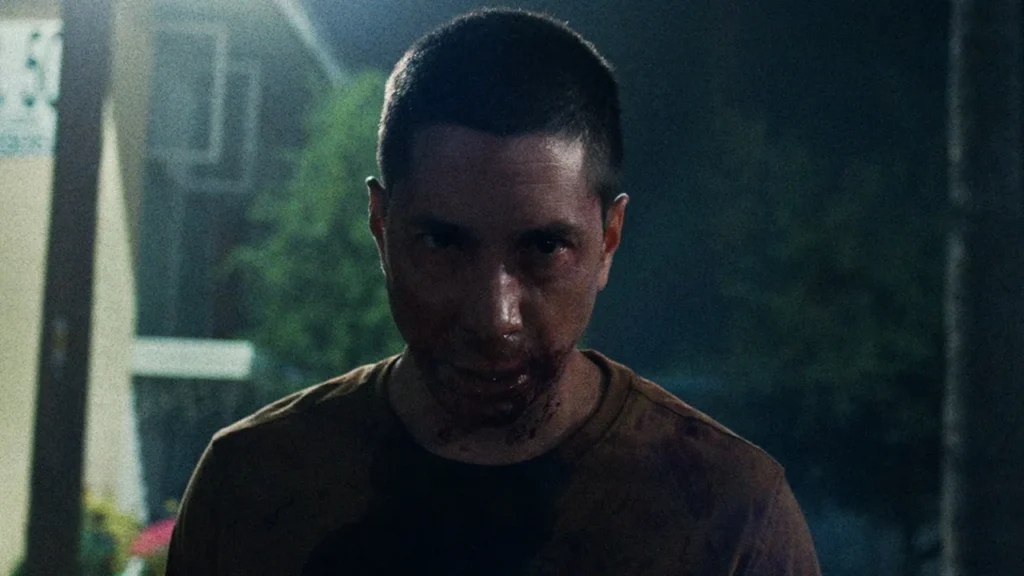
Crip Wazi (RJ Cyler) has his night take a sharp turn for the worse after a hookup with his Piru lover gets interrupted. But his misfortune isn’t from members of either gang spotting them: it’s the LAPD who arrive on the scene. What starts as a stop and search turns bloody fast as the mysterious unit of cops known as Night Patrol kill her suddenly. The newest member, Hawkins (Justin Long), doesn’t flinch as he becomes part of the deadly police gang in ritualistic fashion.
Narrowly escaping the encounter, Wazi returns home to the Colonial Courts to try and get help from the local Pirus, led by Bornelius (Freddie Gibbs). The plan is to avenge their own, but the entire neighborhood ends up in the crosshairs of the monstrous task force. Where the residents see a place and people to protect, Night Patrol sees little more than a chance to feed on its black and brown citizens.
A Strong Cast Led by RJ Cyler Delivers
At its core, it’s a solid concept: rival gangs band together with guns and African mysticism to fight some literal blood-sucking racist cops. If Pirus and Crips all got along, they might be able to gun down some vampires by the end of this movie. Its fun ideas are matched with an eclectic but appropriate cast: Freddie Gibbs, Flying Lotus, RJ Cyler, Justin Long, Dermot Mulroney, and most surprisingly of all Phillip Brooks, who you might know as WWE superstar CM Punk. Cyler, star of The Harder They Fall, very much carries with his performance here as he did there. He gets to show his emotional range throughout the film and works well with what he’s given. He’s only outpaced by Gibbs in terms of entertainment for the sheer number of great reactions Bornelius gets.
Justin Long’s physical performance oscillates from impressive to underwhelming here, but he is about as compelling as Cyler, all things considered. One scene in particular where he has an emotional outpouring as he discovers what Night Patrol is really all about struck hard. Brooks also manages to sell his vitriolic bastard of a character well, putting another mark down on his resume as a welcome sight in horror going forward.
A Clever but Confused Script
But unfortunately, fun performances can’t make up for the feet of clay the movie stands on. Its true weakness is in its storytelling and editing, which chops scenes and sections of the film up in a way that’s impossible to ignore.
Now, credit where it’s due. On a meta-textual level, the script has some clever flourishes. Its Black characters don’t start the movie on the back foot, intimately aware of the existence of Night Patrol, even if they can’t pin down exactly what kind of monsters they’re up against. There’s something to be said here of what it reflects: the acute awareness Black Americans are forced to have about the dangers of interacting with the wrong police officers and being at the mercy of violent policing.
The characters arm themselves well, they don’t walk into scenarios recklessly or leave themselves open to be torn apart (at least, not until late in the film). Wazi’s mother who evangelizes on the Zulu peoples and their occult knowledge, has been preparing for them for a long time. And when the vampires show up at their doorstep, the counter-offensive is quick.
In Spite of Night Patrol’s Charm, It’s A Plot Stretched Too Thin
I bring this up because, for as thoughtful and clever as that all is, those quality decisions highlight the uninspired and dull ones as well. The plot is still undeniably stretched out in an odd way. Part of the problem is the fact that there are effectively three different main characters in this story: Wazi, Hawkins, and Xavier (played by Jermaine Fowler). Xavier is Wazi’s cop brother, and Hawkins’ partner before he joins Night Patrol, making him the bridge between the two. But it’s a rickety bridge, and little care is paid to Xavier as a character who is one-dimensional in the end and really just human shaped fuel to keep the plot going. Hawkins gets a similar demotion later on but at least gets to be part of the ending and have a decent amount of screentime.
This problem of a plot stretched thin between characters is exacerbated by a slightly bloated runtime and a very disorderly rearrangement of scenes that plagues its back half. The characters have interactions in the third act that should have been established in the first or second. Expository and comedic beats that don’t fit the dire nature of the situation make for tonal road bumps. In some cases, continuity of where characters were and what they said is thrown out the window entirely. There’s a big reveal for comedic effect in the film’s last scenes, but its undercut by what a character said just minutes prior spoiling the joke.
A Nightmare of Editing Hamstrings Ryan Prows Fantastic Directing
Director Ryan Prows has proven himself highly competent in the past with his feature Lowlife, and his handling of the camera in this film is no different; it even indicates some serious growth. He has a firm grasp of lighting his locations and framing his characters, he’s good at setting a tone. I particularly love how he handles the sequence where the cops inevitably and violently storm the Colonial Courts. It manages to be highly stylized while capturing the genuine horror of the attack, and he demonstrates a clear sense of balancing those cinematic elements. He is, without a doubt, highly skilled.
But unfortunately, the way that Night Patrol is plotted, paced, and cut together tears apart and reassembles Prows solid vision, taking what could be a great horror film and seriously hamstringing it. It’s a flesh golem of great ideas, stitched with the right organs in the wrong places—and some of its guts missing altogether by the time those credits roll.
