


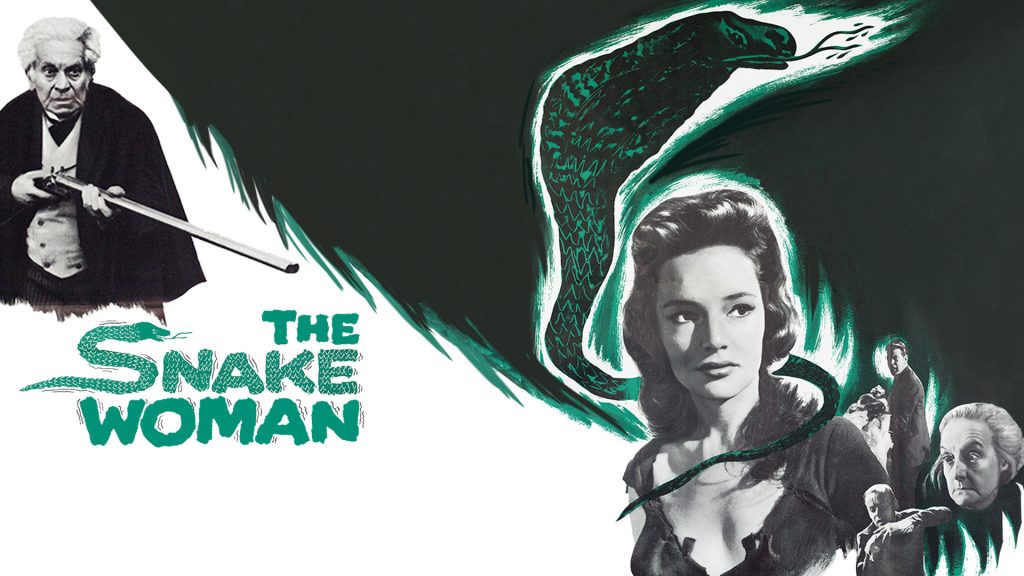
When thinking of political horror, what comes to mind? Is it the capitalist blue-skulled aliens of Carpenter’s They Live, or perhaps the sinisterly center-left surgeons of Peele’s Get Out? Whatever it is, it probably is not femme fatale snake-human hybrids—until now.
The Snake Woman is an extremely obscure British horror flick from 1961. Despite its painfully dry pacing and more-than-occasional silliness, the film houses some ahead-of-its-time commentary on women’s mental health and the dangers of pseudo-science. Whether this was intentional or just a by-chance byproduct of attempted brainless schlock, The Snake Woman remains fascinating in today’s climate.
The Strange Premise Behind The Snake Woman
Directed by Sidney J. Furie from a screenplay by Orville H. Hampton, The Snake Woman tells the story of an 1890s doctor who tries to cure his pregnant wife’s unnamed mental illness by giving her snake venom. The townsfolk believe that the child might be demonic, and oh boy are they right. Years later, deaths by snakebite begin to pop up around the area. Maybe the baby did not just grow up into a woman, but a snake woman.
The movie itself is perfectly fine. Nothing to write home about, its execution is dry, if occasionally silly. If it were a little more polished, who knows? Maybe this could have been a Hammer-adjacent classic.
The acting is funny enough to ease viewers through the dry plot points. Everyone plays it up like crazy, and while the large chunks of talking can get tiresome, watching Brits yelling at each other in overdramatic amazement about snake curses is pretty fun. There is also some jaunty flute music!
Technical Limitations Date the Film
Probably the biggest issue with The Snake Woman is the filmmaking itself. The shots are uninteresting, the low-budget effects pretty lame by old-school monster movie standards. During the 1930s horror cycle, they might have held up, but by 1961, they just look outdated. However, as is typical with creature features of the time, there are some hilariously lackluster death sequences.
Let’s be real: not all 60s creature features can hold up to The Birds. You’re not gonna turn to The Snake Woman for intelligently executed scenes of arthouse horror. You stick it on to see some fucking snakes!
While you may not get the knee-slappingly schlocky death scenes of other films of the era, there is fun to be had in The Snake Woman. The titular woman is (somewhat disappointingly) not a snake-human hybrid, but rather a human cursed from birth who can “turn into” a snake. And by “turn into,” I mean quick-cutting from her to a slithering snake. It’s pretty funny, and the ridiculous death scenes make for top-notch—if fleeting—fun.
Unpacking The Snake Woman’s Accidental Feminist Themes
While feminism was nothing new to horror cinema by 1961 (see 1942’s Cat People for a great example), a random supernatural snake movie is probably the last place one would think to find it. But, shockingly, The Snake Woman could secretly be ahead of its time with some of the topics it tackles. The real question, though, is not whether or not this is political, because it inherently is, but how intentional that was.
The Snake Woman’s core premise, remember, concerns a pregnant woman who, because her husband deems her mentally ill, is given a radical, pseudo-scientific treatment against her will. This can obviously be read by modern audiences as a parable about what was dubbed “female hysteria” at the time, conjuring the specter of lobotomies, shock treatments, and other horrors prescribed for women suffering from depression—or common pregnancy symptoms—in the 1950s and ’60s. The movie serves as a cautionary tale for men making assumptions about women’s mental health.The townspeople who allow this to happen are cursed, and the patriarchy pays in blood for how the mother of the “snake woman” was treated.
The Femme Fatale Trope and Its Complications
Of course, the feminist leanings of The Snake Woman are complicated by the fact that the snake woman herself is a deadly femme fatale. While this archetype has been reclaimed as an empowering paradigm for feminist agency, it was initially born out of post-war fears about women’s independence, and had not yet shaken its problematic origins by the time the film went into production. So, while the movie can be read as a feminist allegory, this may have been far from the filmmaker’s intentions—or not crossed their minds at all.
The same can be said for The Snake Woman’s messaging around quack science. The snake venom used to “treat” a pregnant woman is the root of all the movie’s terrors. So, is it warning audiences of pseudo-science danger? Or, more likely, was it intended to simply be a dumb, cheaply made folk horror film about a killer snake lady?
Probably the latter.