

Reviews
‘Slaughter High’ (1986) Review: A Disappointing Dud

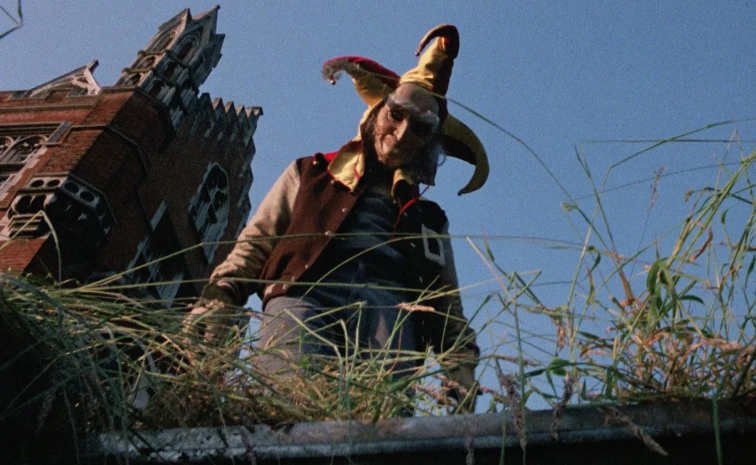
I remember the day I bought this film. There was a multipack at Walmart that had C.H.U.D. II, Chopping Mall, and a handful of others that came with it. Most of the films I watched from this pack were, well, duds. (For me at least, I know these films have their audience.) For that reason, I never went out of my way to watch Slaughter High. It’s been brought up in conversations here and there, but I still never felt the need to watch it. So, keeping with the theme of back to school, I decided to finally give it a shot.
Slaughter High: A Tale of Revenge
A group of [awful] friends decide to “prank” Marty Rantzen (Simon Scuddamore), a nerdy outcast on the fringe of social groups. The first prank goes as planned, but they’re caught by a coach (Marc Smith) who puts the offenders in detention. A second prank is the setup for the third prank, which leaves Marty disfigured with acid burns. 10 years later, the group of friends are invited back to the high school for a reunion. When they arrive at the school, they realize the building is decrepit, and they’re the only ones there. As the night goes on, the body count rises. Will anyone escape Slaughter High?
Slaughter High has a huge identity problem. This could be partially because it was written and directed by three people: Mark Ezra, Peter Litten, and George Dugdale. Each member of the bully group is nothing but overwritten caricatures of friend group archetypes. You spend more time getting acquainted with this disgusting group of cardboard cutouts, while we barely spend any time with Marty. Simon Scuddamore is the only shining grace in the nearly 20-minute-long setup. Jon Clark is also pretty great in his limited screentime.

Unlikable Characters: A Slasher Film Pitfall
We’ve discussed before that having your main characters be unlikable isn’t always a bad thing. Look at House of Wax! The film’s main issue is that it has EIGHT bullies. How can we get to know any of them efficiently enough to care whether they live or die? And by the time the dying starts, you’re completely over anything that’s happening. The biggest sin a slasher film can commit is to be boring. And the overwhelming majority of Slaughter High is boring.
What makes Slaughter High slightly worthwhile is Peter Mackenzie Litten’s SFX design and John Humphreys’s prosthetic work. The kills are fairly brutal and work for what this film is. But I don’t think the kills are enough to set Slaughter High apart from similar films. The first kill we see sets a high bar; someone’s stomach basically explodes out of his abdomen. From that point on, the kills start to lose their edge, never able to capture the viciousness of the first.
Slaughter High: A Missed Opportunity
With how much I’ve heard people hype this film up, I was left feeling little to nothing about what I watched. Not to mention the ending left much to be desired. April Fool’s Day handles this kind of ending in a much better way. All in all, Slaughter High fails to do much other than pass the time. Marty Rantzen may fuck, but Slaughter High sucks.


Luz: The Flower of Evil is a movie simultaneously charged with and mired in ambition. It’s genuinely comical how overly ambitious of a first-time film it is for writer-director Juan Diego Escobar Alzate: a microbudget, shot on location in the mountains of Colombia, character driven psychological horror film meant to explore the very nature of good and evil while also tackling cults and misogyny.
So, it’s shocking how much of it works. Not all of it works, not at all, but it is cohesive enough to serve as a surprising experience with the colorful aesthetic it employs and incredibly dark places it goes to.
What Is Luz: Flower of Evil About?
After the death of their mother Luz, three sisters in a rural cult community find their faith waning. The three are the centerpiece of an elaborate theology crafted by their cult leader father, a man who is becoming more difficult to deal with by the day. So, when he brings a mute boy into town, chaining him up and claiming he’s the people’s messiah, an already tense situation devolves into outright madness. What ensues is the slow dissolution of the cult, and the torturous end of an already fractured family.
Let this usual synopsis section also serve as a content warning: the film does depict sexual violence very early on, about 25 minutes into the film. It’s not Irreversible levels of horrifically long, but it’s also not particularly brief and still graphic content by its nature. It can be difficult to stomach, so I’m mentioning it now for those who would rather avoid that sort of thing.
A Ponderous Arthouse Folk Horror About Good and Evil
The film has shocking moments, but it’s not very interested in shock value. This is first and foremost a slow burn, a piece of arthouse folk horror that is more about bleeding out than it is about a violent demise. The most obvious comparisons are to The VVitch and Midsommar, but even that feels like an inappropriate mix, even when it leans towards Aster’s commercial darling or Egger’s colonial nightmare.
Fundamentally, Luz is a study about people who mythologize suffering and cruelty and excuse it as being driven by outside spiritual forces rather than their own decisions. It’s about deconstructing harmful religious and cult mentalities, and it wears its philosophy on its sleeve (aggressively so). Alzate creates a visually and textually fascinating meltdown of his characters and the community they find themselves within.
I would say it’s a “descent into madness” if it didn’t feel clear that the characters were already in a tailspin right at the film’s outset. The script, especially through its second act, starts to feel repetitive and a little simplistic, with a somewhat anticlimactic ending and dialog that starts to feel less naturalistic and more tedious. But it’s an interesting dissection of a family, even if it’s rough around the edges.
Hyperreal Sense of Color, But Shaky Directing and Writing
The film’s most obvious and striking feature is its hyperrealist palette, bearing a rich Technicolor aspect that permeates throughout the entire runtime. Colorist Felipe Martinez U paints the mountainous countryside with such vibrancy, a simple but very effective contrast to the dying days of a cult the story centers on; bleak, muddy times, punctuated by vibrant nature all around. Aesthetically, it’s pretty clearly visually inspired by the early works of Pedro Almodóvar and the visual warmth of Robin Hardy’s The Wicker Man.
Even the naturalistic tendencies of Terrence Malick make an appearance here, though how much of that is just in the gorgeous location scouting and how much is actually emulated by Alzate is up for debate. All around, the film lacks polish. The camerawork is amateurish in some ways, slightly cramped and occasionally uninspired in its framing. Sometimes the oversaturated look of the film can feel a little saccharine and heavy, but the pop of color here feels purposeful enough that I can forgive it as being highly stylized rather than trying to mask the weak points of a first-time director.
Is Luz: The Flower of Evil Worth the Watch?
In the search for great Latin American horror, Luz was an odd duck to stumble upon to be certain. But I’m a champion of strange birds with a lot of character, so you do the math.
Luz: The Flower of Evil is a struggle of a film, hard to watch at points despite how visually appealing it can be. It’s a brutal, bleak piece of psychological folk horror that certainly has a thin audience and will test the patience of even those the premise appeals to. But it does have as much substance as it does style, even when it treads into murky waters, and for that I think it’s worth the watch.


If you’re not watching Indonesian horror, you’re missing out. The region is producing some of the craziest genre movies around right now, thanks in no small part to the efforts of writer-director Joko Anwar. His latest, Ghost in the Cell, which celebrated its North American premiere at Fantastic Fest 2026, combines everything we love about the filmmaker’s work—supernatural scares, inventive kills, and gnarly gore—along with a strong vein of comedy and political satire.
What is Ghost in the Cell About?
Ghost in the Cell centers around Dimas (Endy Arfian), a journalist whose life falls apart after he tries to run a story on corporate corruption and mysterious worker deaths. Wrongfully convicted of the horrific murder of his boss, Dimas finds himself with a one-way ticket to Cell Block C, where he quickly meets a colorful cast of prisoners—the good, the bad, and the seriously nasty. Among the good guys, there’s Anggoro (Abimana Aryasatya), who is constantly getting into trouble for defending fellow inmates, and Six (Yoga Pratama), who claims he can see people’s auras.
As if Dimas’ situation couldn’t get any worse, his arrival seems to trigger a series of brutal killings in the prison. Bodies are showing up mangled beyond recognition and displayed in positions that wouldn’t look out of place in Hannibal. It soon becomes clear that Dimas isn’t behind the murders, which begs the question: what did he bring in with him?
Anwar Embraces Horror-Comedy Whole-Heartedly
Prison is a scary place, and Anwar makes great use of the setting, with the action moving from the dingy showers where predators lurk to the bleak cellblock where inmates are at the mercy of their captors and the cafeteria where rival gangs eye each other up with ill intent.
But for all the human misery contained within the film, Ghost in the Cell is ultimately a horror-comedy, one that isn’t afraid to lean into broad slapstick and quippy dialogue when it wants to raise a chuckle. The tonal shifts can take a little while to adjust to, especially if your previous experience with Anwar comes from his more serious horror outings like Impetigore. This might be a problem if the film wasn’t actually funny, but Ghost in the Cell has enough laugh-out-loud moments to make you forget about any whiplash.
Ghost in the Cell Is a Genre-Bender to the Max
Comedy isn’t the only new flavor that Anwar has tossed into the mix. In Ghost in the Cell, dance sequences and martial-arts fight choreo sit side-by-side with some of the most extreme gore scenes seen outside a Terrifier movie in recent years. Then there’s the eerie way the spirit presents before it kills (trypophobia sufferers, beware) and the extensive critique of political corruption, power, and inequality. It’s an everything-and-the-kitchen-sink approach that shouldn’t work on paper, but under Anwar’s assured hand, it does.
It helps that for all the slapstick, the film lands a surprisingly earnest message, amplified by its vast ensemble cast. Dimas and Anggoro at times feel like main characters, but everyone in Ghost in the Cell has a big part to play, and that’s the point: in seemingly impossible circumstances, there’s strength in unity.
Ghost in the Cell Is an Endlessly Entertaining Blend of Goofiness, Heart, and Gore
If you’re looking for nonstop scares, you won’t find them in Ghost in the Cell. What you will find is a delightful blend of horror, comedy, and action that is apt to leave you grinning from ear to ear.
The film doesn’t skimp on the gore, throwing flesh and fluids at every surface. But it’s also charmingly goofy, with a cast that doesn’t take itself too seriously and a script that’s all too happy to devolve into a comedic dance scene when it feels like the spirit might strike. In every sense, Anwar is doing the most, and the end result is a film where there’s nary a dull moment in sight.
