


New Jersey was once the frontier of movie-making. The invention of the first movie viewer and movie camera originated from the East Coast, not Hollywood, which would later become the hub of filmmaking after World War II. In those early days, films like The Great Train Robbery brought name recognition to the state before the industry shifted west. Then, in 1976, a little Alfred Sole feature named Alice, Sweet Alice (originally titled Communion in the U.S.) was shot entirely in N.J. – the first major motion picture since 1933, according to a premiere report in the Daily News. It’s a bloody, perplexing mystery that has tangled audiences for decades. It has since become a cult classic, starring Brooke Shields in her film debut.
New Jersey Setting Enhances Horror in Alice, Sweet Alice
The location of Paterson, New Jersey, supplies the film with a gritty texture. Made on a budget of just $350,000, according to the director himself, as stated in a Blu-ray commentary released by Arrow Films in 2019, the film takes a sacrilegious perspective on religion and faith. The chapel of Paterson General Hospital served as the playground for much of the film’s most graphic, disturbing moments, particularly the first killing, which takes place just outside the sanctuary in the transept. A young girl is beaten, choked, and subsequently set on fire, her body shoved inside a delicately decorated coffer.
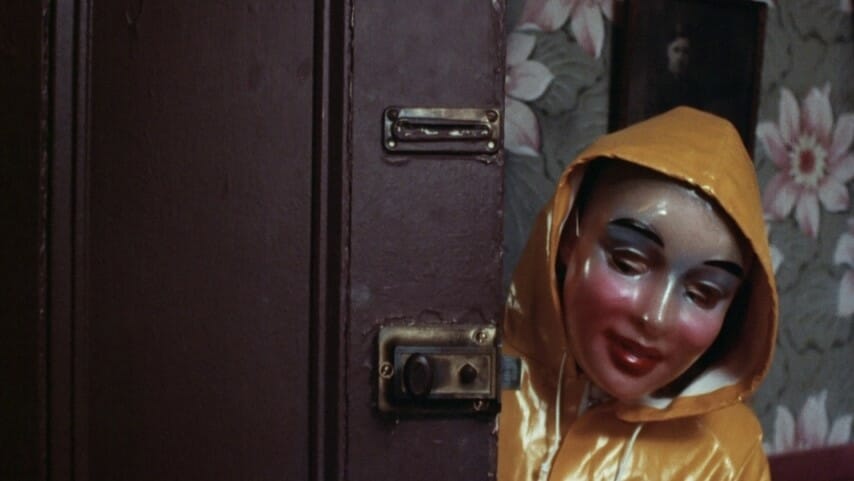
The profane nature of the killing, inside a church’s most sacred walls, sets the tone of irreverent murder. The seeming godlessness and lost innocence fuel the masked killer, dressed up in a doll-like party mask and yellow raincoat. In biblical terms, the color yellow often symbolizes God’s glowing presence, and can also signal glory and divinity. In donning such a bright color, the killer draws attention and makes an indelible impression on the victim. It’s a color you won’t soon forget. It also testifies to childlike guiltlessness and play-pretend. It’s often a shield to the elements, perhaps hinting at the killer’s resilience against human nature and their darker instincts.
Sibling Rivalry and Psychological Depth in Alice, Sweet Alice
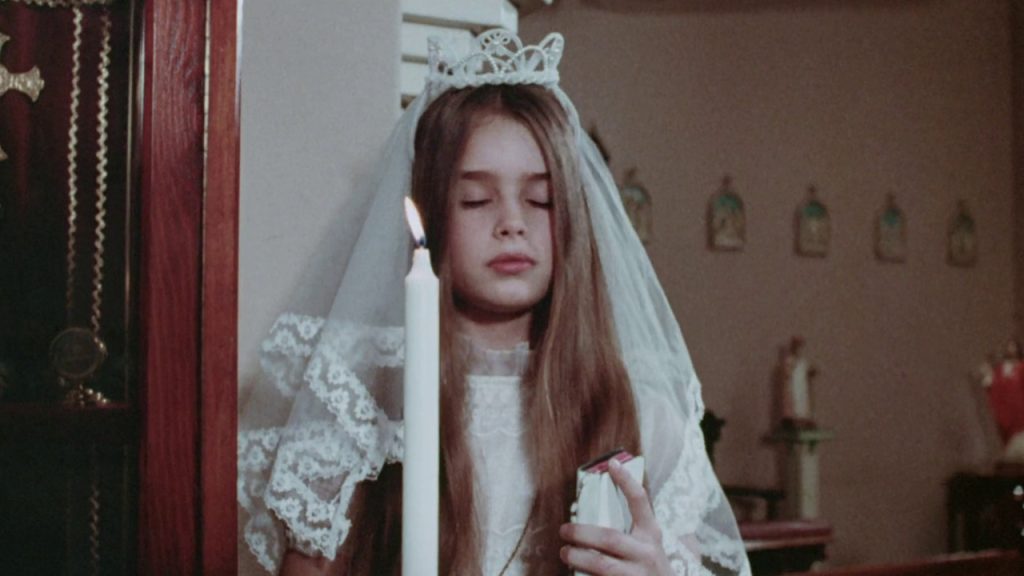
12-year-old Alice (Paula Sheppard) frequently torments her younger sister Karen (Shields). Alice steals Karen’s playthings and communion veil as acts of rebellion and desperation. Their mother Catherine (Linda Miller) dotes upon Karen, showering her with kisses, hugs, and gifts, but often holds Alice at an arm’s length. A sick disdain for her eldest is practically sacrilegious. Alice is even deterred from taking communion, even by Father Tom (Rudolph Willrich), whose equally favorable attentiveness toward Karen is evident. Such glowing adoration positions Karen as the chosen child, while Alice seems to be primed to be a killer, owing to her disturbing tricks and seething jealousy of her sister. That bitterness pools in her eyes, perfectly hoodwinking the audience into believing she could be the killer.
When Catherine’s disagreeable sister Annie (Jane Lowry) is viciously attacked on the stairs, she crawls out onto the front stoop, the rain streaking the blood in her wake. Her nasty behavior toward Alice gets a fair exchange for her injuries. In the hospital room, religious iconography is displayed throughout, with photos, crosses, and various biblical scenes on the walls and tables. She still insists Alice is the culprit, vengeance burning in her eyes. Such lying all but seals her fate, as the killer remains on the loose. Their devious, bloodthirsty schemes soon lead Alice’s father, Dom (Niles McMaster), to believe that Angela (Kathy Rich), Annie’s reprimanded daughter, is the killer, who lures Dom out to a secluded warehouse.

The Killer’s Motives: Religious Extremism and Guilt
On a brilliant day, the killer unmasks themselves as they bind Dom up in rope and roll his body towards the second-floor window. “God wants you punished,” they froth at the mouth. The wickedness shimmers in their eyes, their teeth grating together. “Thrust into hell, Satan and the other evil spirits who rob this earth, seeking the ridden of souls!” The killer intends to teach perceived sinners of their immorality, but they remain still racked with guilt, even attending confession to make atonement for their iniquities. But their body trembles with pure sin, the most disgusting there could be. “Children pay for the sins of their parents,” they say through the layered partition separating them from the priest.
As we’ve seen throughout time and history, religious extremism pollutes the Bible’s teachings. Devout believers taint scripture about compassion and Jesus’ true way by picking and choosing verses that fit their social and political agendas. Or perhaps adhere to the straight, white, and male version of interpretations that occurred in 1946 by a panel of scholars.
Climactic Communion Scene and Tragic Finale
The killer in Alice, Sweet Alice feels directly ripped from that blasphemous playbook – opting for carnal destruction rather than absolution and redemption. In the final few moments, during communion, the killer kneels upon the altar and readies to accept their portion of bread and wine. But Father Tom stops the proceeding and attempts to convince the killer to come with him quietly, while the police wait at the front door. Tragedy befalls even the most pious. Blood squirts from the killer’s butcher’s knife, and Father Tom’s eyes roll in the back of his head. He’s deader than dead, his lifeless body thumping to the floor.
Alfred Sole’s feature film remains one of the most essential slasher prototypes. Coming two years before John Carpenter’s Halloween, it finetuned much of what we know and appreciate about the subgenre. From the masked killer to the blood-dripping kill sequences, Alice, Sweet Alice would not have reached cult classic status as it has. Without its double-edged godlessness and thematic defiance, its irreverence for faith in both the script and visual storytelling cues, from iconography to the killer’s motives, wouldn’t quite stun the audience into submission.
A landmark New Jersey film, Alice, Sweet Alice, still remains an essential horror film in the broader cinematic history to this day. Its scrappy, lo-fi technique makes it a surefire dose of murder and mayhem. There’s nothing else quite like it.