


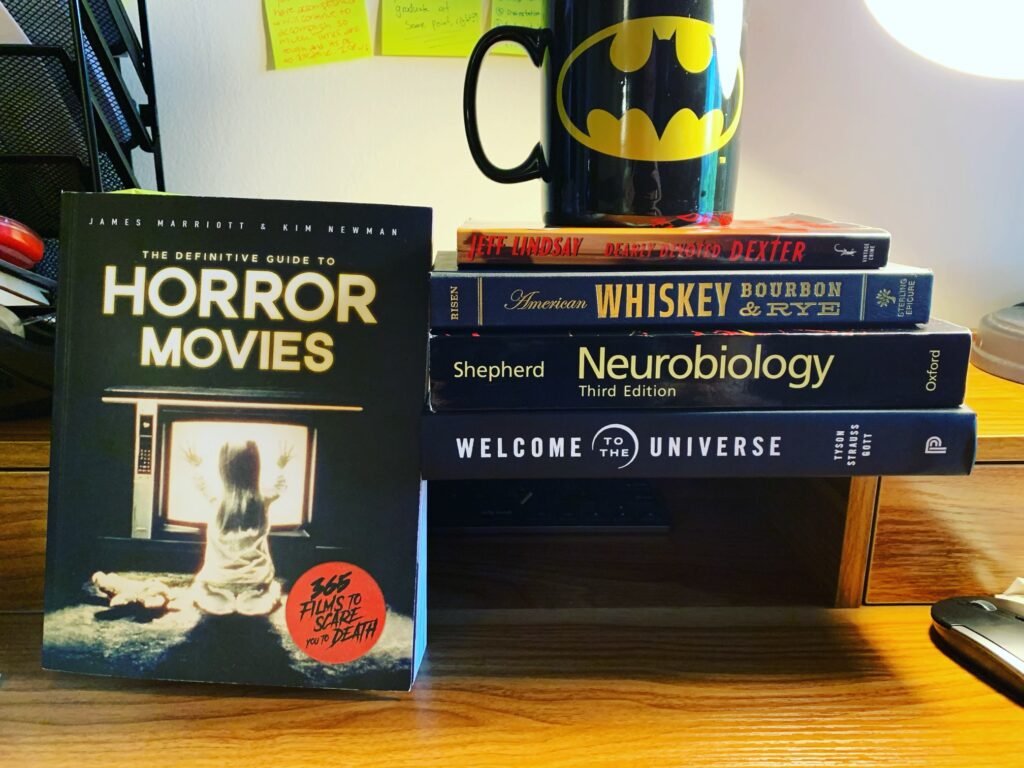
I recently had the pleasure of chatting with our very own Brucker Nourse, the host of Autopsy of a Horror Movie. We obviously talked horror movies, but Brucker also gave me insight into how he got into podcasting, and his spooky family history.
Horror Press: How did you start working with Horror Press?
Brucker: I found them on Twitter; it was a goal of mine when I started the show to partner with a website like HP. I just reached out to James-Michael directly – because I liked the site and what he was doing with it – and I asked him if he was interested in partnering with a podcast. We just chatted on the phone for an hour and hit it off. We were super on the same page for many things and about what we were interested in doing. I liked his vision for HP, and we’ve become friends.
Bash: How long have you been doing Autopsy?
Brucker: I’ve been doing Autopsy for about a year and a half-ish now, I started in February 2021. Autopsy is my second round of Podcasting. Before that, I hosted a show called Film on the Rocks back in 2019. I did it for a little over a year, with a good friend of mine from college. We had a good run, but he had to quit because he was “adulting too hard”. After that, I decided to pursue my own passion project, which became Autopsy!
HP: What made you decide to do horror?
BN: I learned many lessons from Film on the Rocks. I’ve always really liked studying movies, and in my free time, I was always watching horror movies. I didn’t really notice until we started giving recommendations. I was like, “Man, I’m always recommending something from Shudder or a horror movie”. I was like, “wow, this is a really rich genre… and I would love to use that as my outlet, as my passion project. The next thing I want to do, I want it to be horror-centric.”
HP: Why do you think horror is important?
BN: This is something I always try to explain to people that aren’t familiar with horror or look down on it. I think it’s a very important genre because it’s very old. Scary stories, and campfire stories, and stories warning you not to do something have always been around. People enjoy being scared. Horror has always been used as a vehicle for some sort of message. Whether it’s reflecting on something societal or even political, or just reflecting on how things are. It’s always been a way to convey or code a story that might be taboo in any other genre. But for horror, people accept it, and sometimes they don’t even realize it. I really like to talk about James Whale, and the universal monster movies he made. He was an openly gay director in the 1930s. And those movies if you go back and look at them, they were pretty queer coded. And of course, that was pretty taboo, and sadly taboo for some people today. You don’t really think about it because it’s coded in this horror text, and those monsters, and people aren’t trying to dive deep into why Victor Frankenstein can’t have his wedding night with his wife. He has to spend it with his lab friend. Or how his monster is finding kinship with other male characters, and he wants nothing to do with his supposed wife in the movie. I think stuff like that is very interesting if you look at it through that lens.
HP: Can you tell me the story of how you got into horror movies?
BN: I grew up a scaredy cat. I was scared of everything as a kid, but I was always interested in scary things. I had a morbid curiosity, but I never wanted to go and investigate it. I grew up loving Scooby Doo, and mysteries, and unsolved stuff. I eventually got into Agatha Christie books, and really enjoyed those, and wanted to keep chasing that. When I was in college, I watched Scream for the first time. And I was just like, “oh my god, this is amazing. I love this” because it had everything I loved that grew up with. It had the mystery element. It was very much Scooby Doo-ish: It’s a man in a mask. It’s kind of like an encyclopedia of Slashers before it. It educated me on all these tropes I didn’t know about because I wasn’t watching these movies. And it got me really interested in understanding these references, and the rules that it’s built on. I like things that make sense, and things that make sense have rules, so I wanted to check out these other movies that it’s referencing. So, Scream was the actual horror movie reference point that got me hooked.


HP: Is there a specific horror trope that you think is interesting?
BN: I hate to say final girl because that’s the obvious one. I really think that all the tropes that surround slashers such as: “don’t separate from the group, don’t investigate noises, don’t say you’ll be right back, don’t have sex or do drugs.” All those tropes that build a slasher I find interesting because, if you want to get philosophical about it, it reflects a very selfish society. Because it’s all about “don’t separate from the pack, one of us, you can’t be different from us”. Or the whole thing of – you hear a sound – it might be your friend in trouble, you’re not supposed to investigate that. It’s instilling: Don’t help other people who are separated from the group; let them fend for themselves. And then the movie ends with the final girl solving problems, and it’s like: somebody will solve these problems eventually, but it’s not us.
HP: You have a pretty interesting ancestor. What can you tell me about your family’s connection to Rebecca Nurse?
BN: She was one of the “witches” murdered during the Salem witch trials. This all happened in the 16/1700s. She was 72 years old, and had lots of children. It was all political of course. I think we found out later that they were all tripping on the algae in the water or something like that. But it was all political, and some of the motivation to accuse her of being a witch was her old age, and people really liked the land that she owned. People wanted her property, so she was hung. The story that I was told from my grandpa was that the bodies during that execution were not given to the families, and they were actually, I believe, tossed over some cliff into some body of water. At least that’s the story that was passed down. It was that night that two of her sons went and salvaged her body and gave her a proper burial. There’s actually a whole monument that you can go to in Salem… One of her sons went on to establish a farm that’s still operating in Massachusetts to this day. So you can go to Nurse Farms and get jams and stuff there. It’s one of the oldest family-owned businesses that’s still running… So Rebecca Nurse, that’s on my dad’s side, but on my mom’s side, my mother’s grandmother. Her ancestors are from Sleepy Hollow actually… The interesting thing that hit me when I was rewatching that movie is: All of the characters in it are “Van Something”. All of them have that surname van. And her name was Van Sherrid, and that to me just solidified, “Oh wow, I just have spooky blood from both sides.” I think that’s also why I like horror so much!
HP: You’ve got some really interesting family stories!
BN: My grandpa on my mom’s side was very much into the spookiness. I don’t know if I would necessarily say he was a horror fan, but he loved telling ghost stories, he loved trying to scare the grandkids. He even had a ouija board he’d bring out to try to scare us. And one of the movies that’s so sentimental to me in horror is The Blair Witch Project, because of him. I didn’t watch that movie until I was in college, but I grew up in the 90s and early 2000s. As a kid, you’re a sponge… I was over at my grandparent’s house one day, and my grandpa had a VHS copy of The Blair Witch Project. It still blows my mind today that he would go out of his way in the 90s and purchase a home copy of The Blair Witch Project. But I remember I was at his house, and I was 6 or 7 years old. And I found that VHS, and the cover really sparked my curiosity. The picture of Heather on that is so doom and gloom. And I brought that to him… and he got all serious as if I had just found something truly cursed. He took off his glasses and rubbed his eyes, and he looked at me and said, “If you watch that movie you won’t sleep for a week.” I took that as a challenge, but I didn’t watch it until I was in college. I grew up fantasizing about how scary that movie was and always thinking about him, and how he would tell witch stories. So now when I watch that movie, I feel like I’m watching it with him, and feel closer to him. It has a lot of sentimental value to me for those reasons.
I think Brucker really tapped into something a lot of us horror fans feel: we all have our own personal connection to the genre and our own reasons for loving it.
You can listen to his show on Apple Podcasts, Spotify, or your preferred podcast streaming app!
Check out Autopsy of a Horror Movie on our website for more info!