


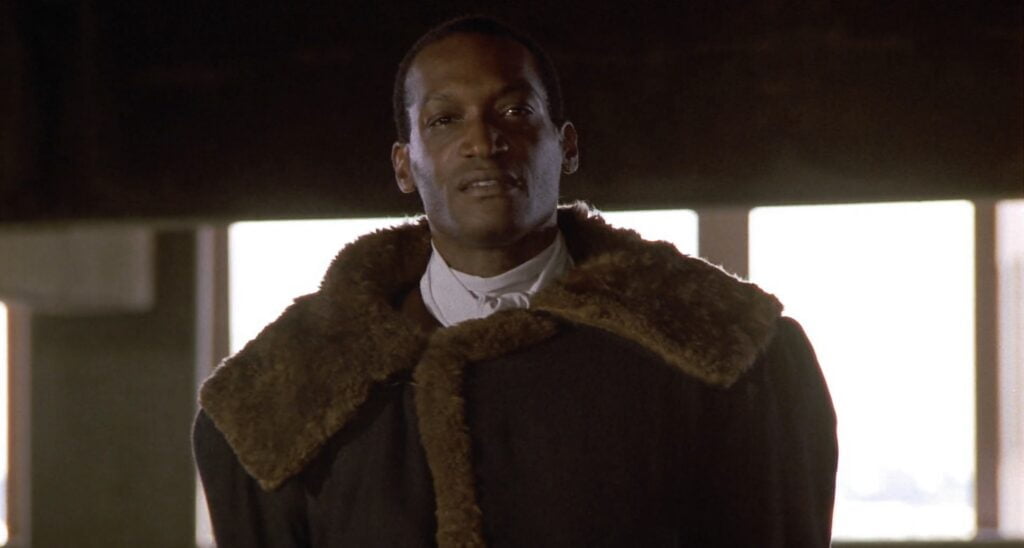
The movie ‘Candyman’ has a complicated history, where facts and narratives continue to spill out into future generations. A “villain” created by society, who you summon into your life. A “villain” with a history of sadness, with a history of art and creation, with a history spanning lynching during legalized slavery to police legalized lynching. A complicated oral history with a story we have to keep telling but that remains so repetitive and true and raw that you don’t just hear it, you feel it.
Many of the themes found in the film, gentrification, police violence, subsidized housing, and segregation are as real today as they were in 1992 when the first Candyman was released. Even today with the 2021 remake of the film, these themes not only touch our lives, but also our courtrooms across the country.
The Real Fear: A Justice System Unchanged
Horror works best when it speaks to our personal fear. And as a youth defender for the State of New Jersey, what kept me up that night after watching Candyman (2021) wasn’t the hook or the bees. It was the horror that not much had changed in the almost 30 years since we first saw Tony Todd as Candyman. Walter Jon Williams said, “I’m not afraid of werewolves or vampires or haunted hotels, I’m afraid of what real human beings do to other real human beings.”
As a public defender, I have witnessed many horrors- not just in the details of crimes but in how an entire justice system can treat young black men. Sweeping reforms that made it easier to Prosecute black boys as adults, found their roots in the frenzied media and racist tropes of the super predator myth of the 90s.
The Tragedy of Robert “Yummy” Sandifer
One such story was that of Robert “Yummy” Sandifer. Yummy was an 11-year-old boy who was killed by members of his gang, the Black Disciples in 1994 in Chicago. Terrifying as that sounds, the real-life details of his murder and what it would mean to generations of young black boys in the juvenile legal system are what truly horrifies. Yummy was suspected of the murder of a 14-year-old girl two weeks prior. He was on probation already for a series of arrests.
His mother was a teen who used crack cocaine and his father was in jail. He was beaten and burned as a child. In an evaluation, when asked to complete this sentence “I am…”, he answered “sick”. Nicknamed for his love of sweet treats, Yummy, and the teen boys who shot him, became the examples on which the super predator myth and media frenzy were built upon.
States used the public’s fear of child boogeymen to fuel reforms to the juvenile court system to allow for more children to be tried as adults, imposing mandatory sentences including life sentences without the possibility of parole. Derrick Hardaway who was 14-years-old when he drove the getaway car following the murder of Yummy received 45 years in prison.
Juvenile Life Sentences: A National Disgrace
The United States is the only nation that sentences people to die in prison without the opportunity to parole, for crimes committed before turning 18. As of early 2020, while Candyman was ready to reemerge in theaters and we were dared to say his name, 1,465 people were serving juvenile life sentences without the possibility of parole. Another 1,716 are serving sentences that amount to virtually life without parole.
79% witnessed violence in their homes regularly
32% grew up in public housing
Fewer than half were attending school at the time of their offense
47% were physically abused
80% of girls reported histories of physical abuse and 77% of girls reported histories of sexual abuse
And
62% are African American
There are people who we, as a country, decided were legally too young to marry, buy alcohol, smoke weed, drive cars, vote, or buy a ticket to see the movie Candyman, that we, as a country, condemned to die in cages. Are you scared yet? (Also, can we all agree to stop trying to figure out ways to get out of jury duty? Great. Thanks)