


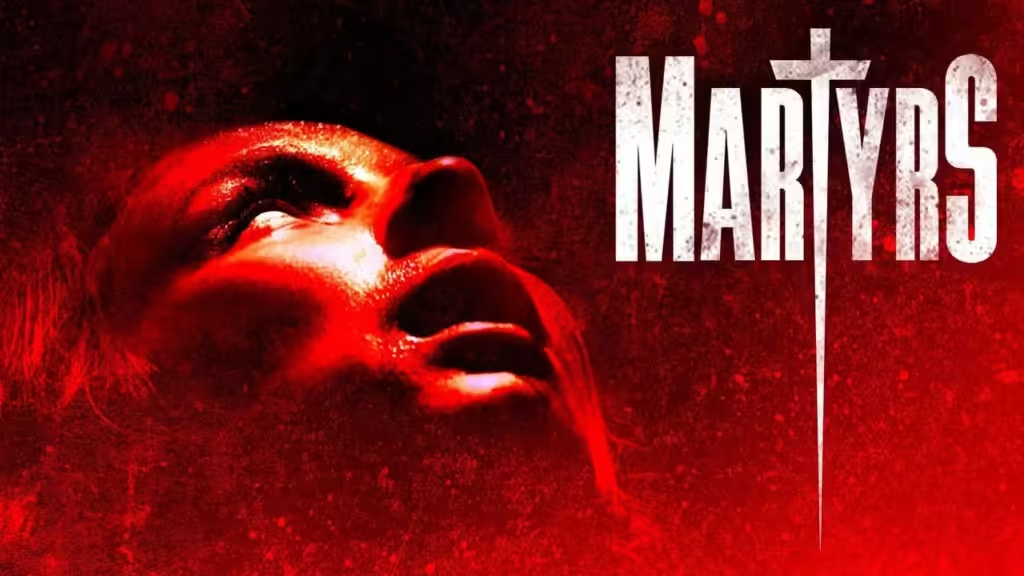
“Horror [films] should be a space of freedom, a territory for experimentation. But what happens is often the opposite.” These are the words of Pascal Laugier, in an Electric Sheep interview regarding his ethos on his horror classic Martyrs (2008). His desire with the premier piece of New French Extreme cinema was to peel away from the conventions of the many horror films he had seen before. To make something transgressive and decidedly not “politically correct”, pushing the boundaries through the horrific elements of the genre to unsettle the audience and leave them unable to predict what was going to happen next. And it was and still is a genuine success in that regard. It was provocative enough to earn an 18+ rating by the French Commission for Film Classification, an anomaly for a country with fairly relaxed ratings.
So understandably, his reaction to the 2015 Martyrs remake was going to be beyond negative. While promoting his film Incident in a Ghostland, Laugier reacted quite memorably when asked about the film. It’s a movie he claims he could only get through 20 minutes of, with some more colorful descriptors for how it made him feel that I’m not entirely sure we can say them here. And can you really blame him?
The Marketing That Made a Martyr of American Audiences
Hailed as one of the most unnecessary and poorly made horror remakes of all time, Martyrs (2015) was ambitious in its blatant rehashing. It had the audacity to market itself as “The Ultimate Horror Movie” in a now infamous movie poster that was set up at Berlin’s European Film Market in 2015. It was very cheap in how it got its viewers, banking on the shock and awe that the original generated to build a crowd. I have heard way too many stories of people being tricked into watching the 2015 version simply because it was the one advertised to them, horribly unaware that the 2008 version was an option.
With a prodigious studio like Blumhouse Films distributing it, it’s easy to understand how the remake got so many eyes on it. Which wouldn’t be so egregious on its own; had it been a shot for shot remake, an English localization for the subtitles-hating crowd, it might have worked. It could have even been a unique experience like Haneke’s Funny Games remake. Had it even just toned down the violence and recut to keep the original’s essence, I believe it might have found an audience; after all, a good deal of the film’s horror lies in what it implies rather than what we see.
But that wasn’t enough: it had to be rewritten from the ground up, and morphed into the most sanitized, most unproblematic story of friendship and flat characters you might ever see in a horror film.
Goodbye to (The Real) Lucie and Anna
If you aren’t familiar with the plot of the original Martyrs, please go watch Laugier’s original first, and return here to delve into the SPOILERS AHEAD. It’s a waste of good suffering not to.
The story of Lucie’s tragic relationship with Anna and the mystery of the creature haunting her was one that, while maybe a bit predictable to some viewers, was nevertheless a perfectly acted tale of trauma. The remake version is regrettably only made toothless by Mark L. Smith’s treatment of the script; there’s no dead romance, and no tragic failure by one to save the other. Just two gal pals doing the wrong thing for the right reasons. Or right thing, given it flattens the actions the duo take in trying to balance the moral scales of Lucie’s home invasion that kicks things off.
It’s not enough for Lucie to succumb to her mental illness and take her own life, she has to be gunned down saving a child with Anna, survive, and then die through martyrdom later (but only in time to be rescued and get her happy ending). There’s no moral ambiguity to her actions at the beginning of the film, because the cosmic debt of hurting people has been paid by her good actions. There is no shock of seeing the film switch main characters halfway through and deny you the escape from its world of sorrow and sacrifice. It’s a long and boring ride through maudlin flashbacks and weak attempts to scare you.

One of the Bleakest Endings in Horror History Exits Stage Left
And the reward for it all is the worst possible ending they could have gone for. The skincrawling martyrdom of Anna, flayed by her captors and sent into a state of telestic madness on the brink of death, is gone. It’s watered down to a painless-looking crucifixion that could have been an affair to remember if it had been done with any level of commitment to depicting how agonizing that barbaric kind of death was.
But here, it feels cheap.
The finale looks and smells like one of those megachurch plays, trading in the uncomfortably sterile environment that the pseudo-scientific torture took place in for flowing white curtains and dining room lighting. It’s ultimately undercut of any nuance and existential threat the original had, instead going for the incredibly American ending of Anna running in with a gun and killing members of the cult (as we all know, ideologies and systematic violence are easily destroyed by bullets). If there was ever a point where it cemented itself as Old American Blandness, the antithesis to New French Extreme, it would be the pithy one-liner response Anna has for the cult leader Eleanor when she kills her with an action movie headshot.
“What is it? What did she see?”
“You tell me.”
Of course, after delivering that, she begins to succumb to her earlier gunshot wound, curling up next to Lucie. It’s a pyrrhic victory where the two women ultimately die together, both experiencing the sensation of martyrdom and, maybe going to heaven? The scene’s cinematic language sure does imply a happy ending, with the music swelling as Anna and Lucie are carried off into another flashback of their happy childhood together. And the crowd goes mild!
The Wall of Noise That Is the Martyrs Remake
Turning the quiet and unsettling affair of the Mademoiselle and her secret society’s insidious motivations into a noisy and unimpressive rescue was the pinnacle of what made watching Martyrs (2015) a miserable experience. And really, when I stopped to give the film a chance and find out if it had any redeeming qualities, it’s the first qualifier that bothered me the most—the noise. I can forgive terrible dialogue, I can even forgive lousy lighting. But the sound was a pivotal element that didn’t need to be sacrificed to tell a different version of the story.
Barring one piece of music that plays during a pivotal moment of Lucie’s suffering (when she faces “the monster” for the first time in the family’s home), the original film’s audio and music is perfectly mixed. It isn’t overbearing, it doesn’t try to force you to feel anything with overblown sound effects and a reused soundtrack. Even Lucie and Anna’s staggered breaths and painful reactions are at the perfect volume. There isn’t a thing out of place, with every movement and noise painstakingly orchestrated to make you feel uncomfortable. It is an orchestra of negative emotions. And that analogy is what really made me realize what the Martyrs remake is.
Martyrs (2015) is bad pop music.
It’s too clean, it’s too loud, it’s underproduced at points and overproduced at others. It’s inoffensive, even with the same premise and many of the same beats as the original’s. It’s too deadened of its roots to communicate anything of value. It relies on trends and the climate around it to try and stand out, desperately grabbing at motifs it’s heard before and quashing them down into one-dimensional reenactments.
And like most bad pop songs, it never had a shot of crossing into people’s long-term memory as anything other than a faint tune you kind of remember. Instead of something that occasionally pops up in a retail store while you’re looking for jeans or in the supermarket’s frozen food aisle, you might hear it brought up in conversation. A streaming service will recommend it, and then just as soon as you gave an amused exhale through your nose (“like I’ll ever watch that again”), it will be gone once more.
Mourn Martyrs (2015), because it never had a shot to begin with.