


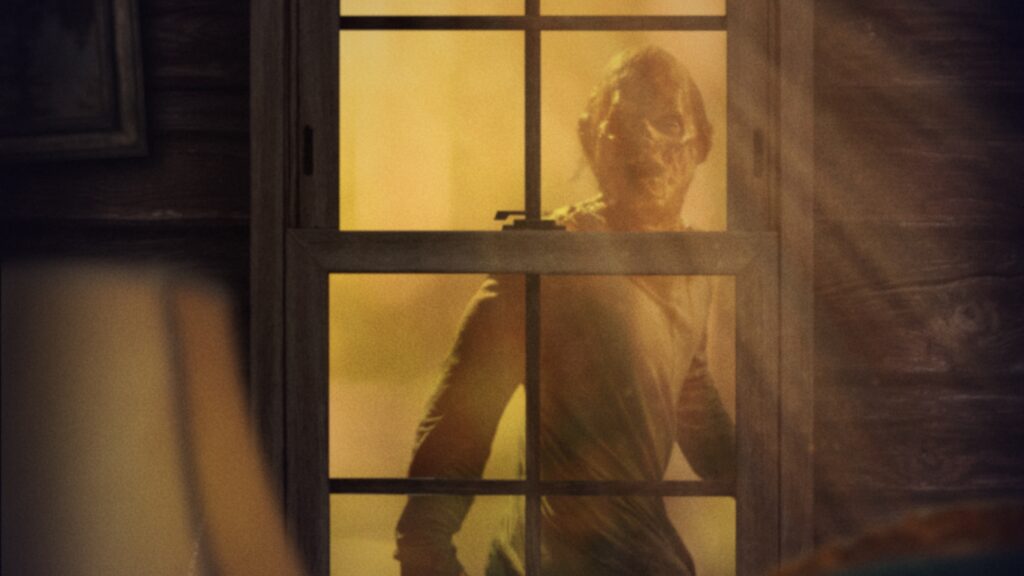
The curious thing about making a film within a subgenre you’ve been watching your entire life is that suddenly, and without warning, you start to look at it in a multitude of vastly different ways. When setting out alongside my intrepid cast & crew to shoot our forthcoming feature film, There’s a Zombie Outside, we knew we were approaching the tropes of the living dead a little bit sideways. For one thing, in comparison to the oft-expected shambling hordes, our movie only had one zombie… and it also happened to be deeply and unapologetically queer.


THERE’S A ZOMBIE OUTSIDE
Exploring the Gay Zombie Trope
Utilizing our titular creature to explore notions of “queer listlessness,” as well as our tenuous relationship with art, I became deeply aware that I was asking audiences to meet us somewhere slightly different than the expected farmhouse with survivors trapped inside.
Yet, as I continued to survey the landscape of time-honored zombie tropes, I couldn’t help but notice that for every film adhering to convention, there were exceptional outliers. Movies with titles like 1995’s La Cage Aux Zombies, 2009’s George: A Zombie Intervention, and 2011’s Remington and the Curse of the Zombadings all explored risen-from-the-grave identity politics or presented flamboyant flesh-eating farce with flair.
Such films, and numerous others, provide evidence of an undeniable interest in zombies on the part of queer filmmakers and viewers alike. Interestingly, among creators, there’s a notable preponderance of gay-identifying men who gravitate to the subject matter. Yet, in most cases, beyond the tacit agreement of the living dead as tool for commentary, these individuals seem all too willing to take their flesh-eaters into a multitude of varying directions that their straight counterparts dare not tread.
In many ways, the unique divergence of the queer zombie has effectively allowed it to “come out of the coffin” as its own subgenre.
However, like the pop culture redefining reanimated corpses that came before them, there’s more to this splintered classification than mere surface-level assignation.

Otto; or, Up with Dead People (2008)
The Queerification of the Zombie
With Night of the Living Dead, George Romero and John A. Russo undeniably reconstructed how we culturally think of zombies. The “Romero Zombie,” as it would come to be known, became the propulsion point forward for nearly all living dead media that would follow. Indeed, so much of the “mainstream” zombie subgenre strives to emulate the tropes of what Romero put forth, modern audiences unwaveringly accept this blueprint as how such movies are done.
Yet, for Bruce LaBruce, award-winning filmmaker of Otto; or, Up with Dead People and L.A. Zombie, there’s a crucial element to Romero’s work that many modern filmmakers overlook.
“Romero made the political zombie,” says LaBruce, “which is one thing people don’t do so much when they’re emulating him. Night of the Living Dead has a Black lead that is shot by the police because they think he’s a zombie…or maybe they don’t. It’s a total political allegory. Romero’s subsequent films are a critique of consumer capitalism. There’s a lot of class and race representation in his work. I think it’s too bad that more people don’t emulate those aspects of his filmmaking.”
…and while it’s true that many modern mainstream zombie films may eschew that sense of allegory, the truth remains that queer artists are often political simply by virtue of existence.
For Chris Diani, filmmaker of Creatures from the Pink Lagoon, the plight of zombie movie protagonists reflects this circumstance.
“To a gay man, the basic set-up of every zombie movie is frighteningly familiar: A group of scrappy underdogs has to use empathy, intellect, wit, and resilience to face off against brainless, shambling slobs dressed in last year’s fashions,” Diani says. “What is that, if not a monster movie version of queers clashing with rabid right-wing protesters at Pride?”
It’s a point that Dr. Heather O. Petrocelli, author of Queer for Fear: Horror Film and the Queer Spectator, seems to reiterate.
“Even in this era of increased acceptance for queer people, we’re living in a liminal state of precarity,” says Petrocelli. “The most recent backlash shows us that it’s not just three steps forward…and then three more steps forward. You can get your ass knocked back. Progress is not a linear track.”
All things undead body politic considered, in many ways, it’s Petrocelli’s inference of liminality wherein the notion of a separate queer zombie subgenre really begins to take shape.

L.A. Zombie (2010)
Why Do Queer People Resonate with the Zombie?
For a queer audience, the liminal state (defined by the dictionary as “the quality of being between two stages or places”) is our ability to see, internalize, and comprehend both sides of what a zombie movie has to offer.
“The particular thing that a zombie has in liminality is that they literally are us.” says Petrocelli, adding that “zombies, as liminal monsters, are as close as you can get to who we are.”
After all, what is a zombie other than a human standing just on the other side of death? Whereas many other monsters of fiction have a supernatural transition of sorts, a keystone of zombie lore centers on the idea of how quickly zombies can go to people we know and love…to other.
In that respect, there’s an aspect of zombie cinema that allows audiences to have a broader point of view in relation to the monster.
“Zombie films flip focus,” says Petrocelli. “You can identify with the zombie or, depending on the movie, you can identify with the person who has the animated masses coming for them. That’s the point of liminality – you don’t have a foothold on either side of the threshold.”
For Bruce LaBruce, the idea of seeing things from the perspective of the ostracized living dead could certainly lend itself to the appeal.
“The disenfranchisement and outsiderness of queers is all very conducive to the zombie trope,” he says, further adding that while other monsters may have gotten a queer read much sooner, there’s something particularly interesting about the zombie’s gay revolution.
“The vampire mythology really tied into ideas of the sexual predator, so of course it was aligned with a gay subtext or they were presented as bisexual. But to transpose that onto the zombie myth is a bit more of a leap, in a way,” says LaBruce. “It’s not so sexy on the surface. The monster is much more of a deadened creature. There’s a bit of necessary necromantic element when you sexualize a zombie…but it’s still kind of the romantic idea of a disenfranchised character who doesn’t fit in.”

George’s Intervention (2009)
Using Monsters to Explore the Monstrous
Explorations of otherness via the monstrous aside, for a creature so closely tied in lore to contagion, there’s undeniably another aspect that those examining the queer community’s connection to zombie narratives can’t deny.
“The rise of pandemics in modern culture definitely had an influence on the zombie in film,” says Dr. Heather Petrocelli.
“It’s not difficult to make the connection between AIDS and zombies,” says Bruce LaBruce. “The fact that gays became pathologized because of AIDS and treated sort of like monsters – it’s a body withering disease where the ravages were so extreme that people were turned into almost living corpses.”
It’s well-documented that many queer creatives channeled their rage and grief over the seismic loss of the AIDS epidemic into art, and for those working within the horror genre, it should come as no surprise that such emotions were filtered through a dark lens of the fantastic. The monsters became symbolic of monstrous circumstances and stories of survivors in the face of overwhelming death became all the more poignant.
Yet, there is often such focus on this particular chapter of history and how it is channeled through the lens of horror that some critics overlook the crucial element of empowerment and escapism retreating into monster stories can provide.
Speaking on this distinction, Chris Diani illustrates how, ultimately, versatility is key.
“It’s the way zombie narratives can be stretched to address countless other struggles faced by the queer community that makes them so attractive to gay filmmakers,” Diani says. “A gay zombie film can be an AIDS allegory, an anti-capitalistic screed, a glimpse at the outsider experience, or a campy takedown of cruising culture. With all these takes and more to explore, it’s not surprising to see the enduring appeal of zombie films to queer horror fans.”
Perhaps nothing highlights Diani’s point regarding this burgeoning subgenre’s flexibility more than filmmaker Michael Simon’s aptly titled Gay Zombie, which focuses primarily on a topic often unexpected in flesh-eating stories: Love.
“When I made Gay Zombie, I thought it would be hilarious and meaningful that the lead character only felt comfortable coming out after becoming a zombie – much more than in his waking life,” says Simon.
…and, although there’s plenty of blood and guts, Michael Simon asserts that his vision of the living dead is less about monstrosity, and more about self-acceptance.


Remington and the Curse of the Zombadings (2011)
Can the Zombie Be Empowering?
“In the simplest of terms – [the message] is that it’s never too late to find love and be yourself. And to be comfortable with yourself,” says Simon.
In so many ways, this is what sets the queer zombie subgenre apart – the idea that we can rise up from the earth and be so much more. To be queer in this world is to always be in transition, to be both the perceived monster and that which must survive the night.
To be the other. To be the lover. To be the revolution.
Yes, George Romero set the mold. His vision used monsters to buck the system…and remind us that sometimes the system is the monster that needs bucking.
But to be queer is to know that we don’t have to shamble forward aimlessly. We can deviate.
Whether Night, Dawn, or Day. We can live. Kinda.
…and for any naysayers who think that the queer zombie’s ability to represent so much more than mere monster lessens its bite, allow me to leave you with this parting thought from Michael Simon, who says,
“Zombies, like gays, will eat your ass before they take shit from anyone!”
***
Be sure to keep an eye on Michael Varrati’s next movie, THERE’S A ZOMBIE OUTSIDE, which will be hitting the film festival circuit soon, and looks incredible!

