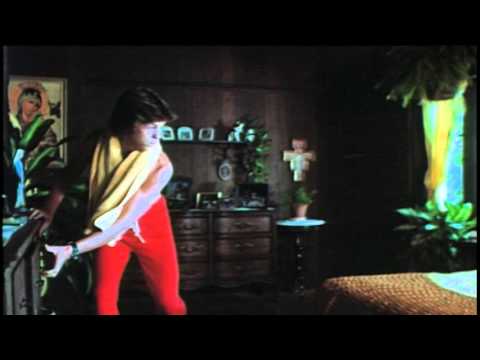
The underrated 80s slasher Butcher, Baker, Nightmare Maker (1981) may seem out of touch in 2022 at first glance. It features a homophobic cop, problematic portrayals of women’s mental illness, and incest. Yet, as I watched this film, I was taken aback by its brutal honesty and surprisingly progressive take. The poorly timed, slightly ridiculous jump scares don’t even take away from what’s really frightening about this horror film—The deeply unsettling fact that each of us could lose any semblance of control we think we have over our life at any moment.
Butcher, Baker, Nightmare Maker’s (BBNM) protagonist is Billy (Jimmy McNichol), a kindhearted seventeen-year-old kid who’s growing up—he has a new girlfriend (Julia Duffy) and he’s a budding basketball star. His aunt Cheryl (Susan Tyrrell) adopted him when he was a toddler after his parents died in a suspicious car accident.
It doesn’t take long to notice that Cheryl has a strange obsession with Billy. The first interaction we see between the two of them is while Billy is asleep, and Cheryl wakes him up by stroking his bare back and leaning in close to purr and mew in his ear. Clearly, there are some boundary issues going on from the get-go.
Susan Tyrrell’s Captivating Performance
Susan Tyrrell’s performance is truly exquisite, as she does a fantastic job portraying the realities of emotional and sexual abuse. Frankly, her performance carries the entire movie. Cheryl is relatively kind to Billy at the beginning, but once he announces his chance of getting a full-ride basketball scholarship to a university far from home, she begins a devious plot to make him stay. And by a devious plot, I mean extreme manipulation, the force-feeding of drugged milk, and—of course—murder.
Cheryl’s character falls into sexist tropes such as the fact that she was driven to insanity because her ex-boyfriend left her. At the same time, Tyrrell’s portrayal of Cheryl’s descent into madness coupled with her exponential ramp-up of psychological abuse in order to make Billy stay is direct, honest, and real.
Progressive Undertones in a Problematic Era
What shocked me the most about BBNM is its progressive take on homosexuality. The story is a blunt and accurate depiction of American society’s general attitude towards gay people in the ‘80s. Detective Joe Carlson (Bo Svenson) is investigating a murder connected to Billy and his aunt when he discovers that the male murder victim had a boyfriend. He then proceeds to be extremely homophobic: he outs the high school basketball coach and tells him to quit or else, he calls many people—including children—a f*g, and he asks Billy’s girlfriend how often they have sex because he believes Billy killed a man over a gay lovers’ quarrel.
You’re probably thinking, “well, that movie sounds god-awful and extremely problematic.” The thing is, BBNM makes it clear that Detective Carlson is no hero. In some ways, he is the ultimate villain of the story. His character reminds viewers that people who are supposed to help us when we’re in trouble may actually be sinister. The movie is firmly on the side of Billy, the hero of the story, who is very close to the gay basketball coach, even after the coach is outed. Homophobia is depicted as a terrifying threat, which I believe is a fantastic message to carry into 2022.
A Deep Dive into Agency and Control
Ultimately, BBNM is concerned with the concept of agency, and that is why this movie is a fantastic fixture in the Horror genre. Aunt Cheryl tries to strip Billy of his agency when he decides he wants to move away and start his adult life without her. The abuse and manipulation she uses on Billy are designed to strip him of his power and make him feel like he has no choice but to obey.
When the police appeared in the story, I sat up on my couch and nodded at the T.V. screen. “Ah, ok,” I said to myself, “now someone will help Billy get out of this horrible situation!” Oh, boy was I wrong. Instead of depicting the police as a source of hope, the film uses the primary detective to further add to the viewer’s dread and contribute to the dwindling hope that accelerates as the story progresses.
Why Butcher, Baker, Nightmare Maker Still Resonates Today
I don’t want to spoil it, but the ending is what sold me on BBNM. I’ll say this: it’s full of surprising twists and I truly had no clue who would be the victor until the very end. In my opinion, the ending is empowering and presents agency in a new light. It encourages us to embrace our individual power while we simultaneously support those we love. It may not appear so at first, but this movie is still fantastic in 2022 because of its raw portrayal of society’s ills, its deeply unsettling—yet ultimately hopeful—themes, and (of course) Susan Tyrrell’s outstanding performance.
You can stream Butcher, Baker, Nightmare Maker on Shudder.