

Editorials
Is It Time for a Queer ‘Jaws’ Remake?
Is ‘Jaws’ (1974) queer coded? Jaws does pass the Bechdel test… once. Aside from a brief geographic conversation between wives, Jaws is homosocial and guided by men and their respective traumas and egos. “In the context of Jaws,” advocates author Jen Corrigan, “homoeroticism can flourish because women are taken out of the equation, but it’s not positioned as a reaction to the lack of women present.” Women are mentioned during the film’s second half, but merely as wives and past lovers. In a film centered around men, it is no wonder, then, that myself and other fans sense something queer is afoot, and maybe it’s time for Jaws to be loud and proud.

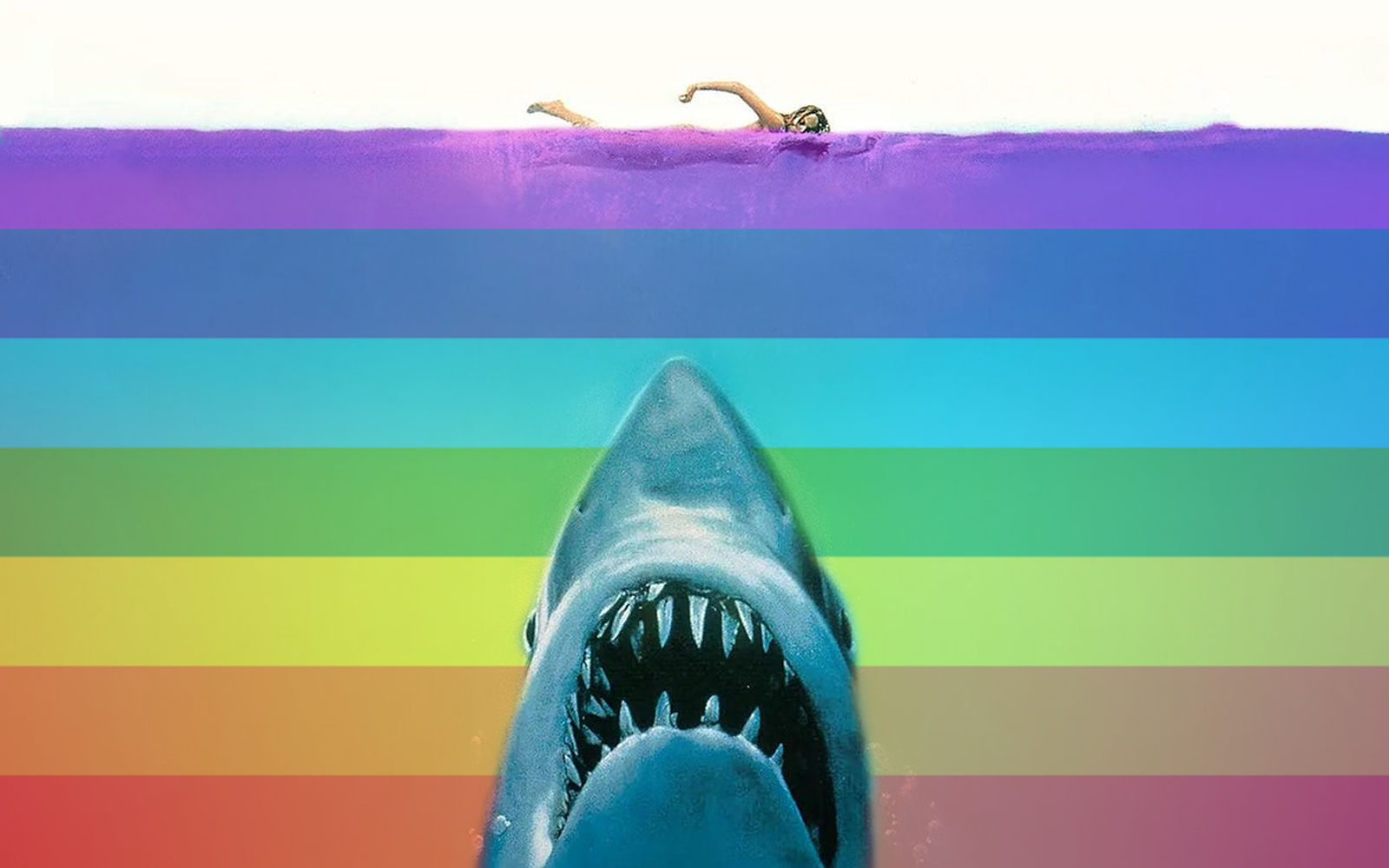
In 2021, I joined comedians Matthew Schott and Chris Okawa on their podcast, The Adaptation Game. I was tasked to conceive my dream movie remake. I chose Jaws, and I reassigned the roles of Scheider, Shaw, and Dreyfus to actresses Kirsten Dunst, Lea DeLaria, and Tessa Thompson, respectively. I also developed a romantic storyline between Quint (DeLaria) and Hooper (Thompson). I believed this casting to be a pipe dream. However, after reading Jen Corrigan’s piece “Three Men on a Boat” in the groundbreaking essay compilation It Came from the Closet, and seeing The Shark is Broken on Broadway, I think we may be approaching a time when a queer remake is entirely possible. While Jaws is subtextually queer to some viewers, overt queerness could enliven the story for the millennium. For too long, horror fans have been dissatisfied with stale remakes of iconic horror films; we’re looking at you Friday the 13th (2009) and A Nightmare on Elm Street (2010). It is time for a fresh approach.
We Deserve a Queer Remake of Jaws.
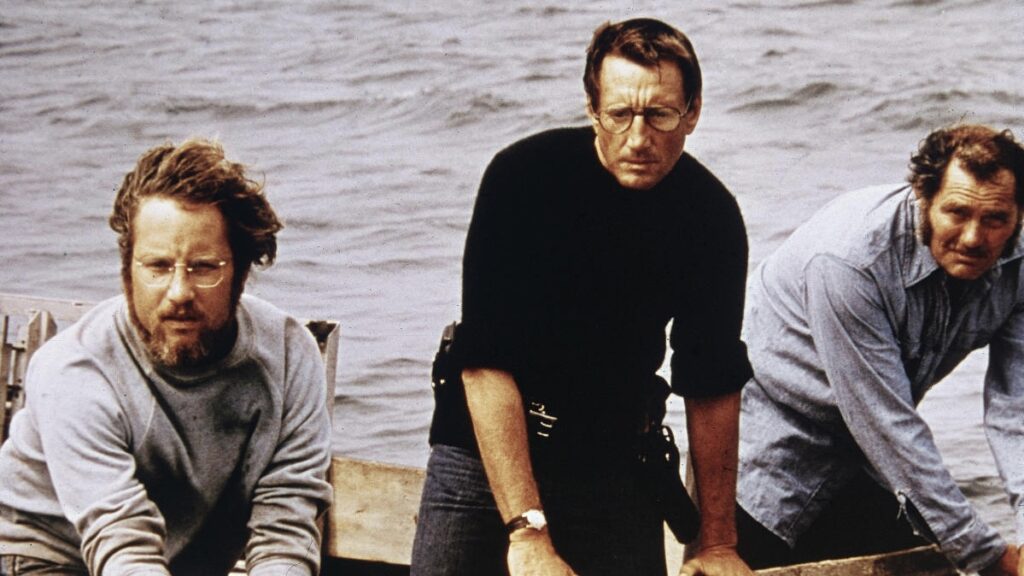
On the surface, Jaws is a straightforward story of three men on a shark-hunting expedition. Subtextually, this story is brimming with male intimacy and vulnerability. The trio face their fears, talk about past trauma, and share constricted quarters. The tension built over days at sea, though thick, is often eased by moments of levity through touch, song, jests, and storytelling. The cast dynamic is fostered by genuine off-screen admiration and frustration for each other as people and actors, pushing themselves and their fellow actors to go further and do better.
Jaws does pass the Bechdel test… once. Aside from a brief geographic conversation between wives, Jaws is homosocial and guided by men and their respective traumas and egos. “In the context of Jaws,” advocates author Jen Corrigan, “homoeroticism can flourish because women are taken out of the equation, but it’s not positioned as a reaction to the lack of women present.” Women are mentioned during the film’s second half, but merely as wives and past lovers. In a film centered around men, it is no wonder, then, that myself and other fans sense something queer is afoot, and maybe it’s time for Jaws to be loud and proud.

Male Intimacy in Jaws (1975)
Heather O. Petrocelli surveyed 3,774 queer horror fans for her new book Queer for Fear: Horror Film and the Queer Spectator (2023). Jaws did not appear in the top 25 favorites list among participants. However, Petrocelli reveals the adoration for haunting/paranormal films by queer viewers (91.6%), as well as monster movies (86%). “To be queer is to be haunted,” asserts Petrocelli. Stories of hauntings resonate with queer viewers, for we know what it is like to hide or be hidden away for our queerness. Who aboard the Orca isn’t haunted by something from their past?
While in Amity and aboard the Orca, Quint, Hooper, and Brody discuss and face their myriad fears: drowning, shark attacks, being underestimated, losing communication with loved ones, and, of course, the erratic behavior of one of their crewmembers. Corrigan finds tenderness in their interactions and sees them as quite queer, especially when things get physical. “My queer reading stems from two aspects of covert communication,” states Corrigan, “the gaze and innocuous touch… Historically, queer interactions were dangerous, and, really, still are. The looks and touches between the men signal intimacy that is easy to overlook…” She then points to an early scene, when Quint asks to see Hooper’s hands. “Touching with hands has a significance in queer intimacy. It is a touch that is both erotic and personal yet can easily be perceived as casual… [Quint] takes Hooper’s hands in his and pulls Hooper toward him as if they are about to embrace…” The intimate moment abruptly turns sour, as Quint cheekily proclaims Hooper has “city hands,” used to handling money. Quint seems to relish intimidating and teasing Hooper. The two dominating personalities clash, but there is a twinkle there, an ineffable connection between the two men and characters that makes them captivating to watch. A romantic storyline does not seem too implausible in any adaptation (please, no more sequels!).
The class difference between Quint and Hooper is a driving force for conflict. As extrapolated by The Shark is Broken, it is the acting methods of Shaw and Dreyfus that cause them to bicker off-screen. In the play, this resulted in a complicated yet sweet relationship between the actors, but not one without its blowups.
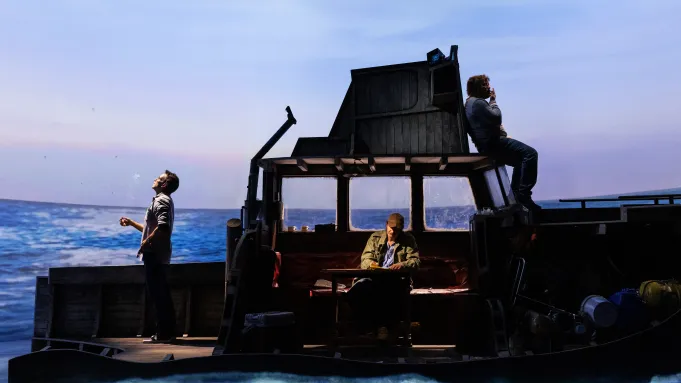
The Shark is Broken (2022)
Written by Ian Shaw and Joseph Nixon, and based on Shaw’s father’s drinking journals he kept while on set, The Shark is Broken is about the downtime between Robert Shaw (Ian Shaw), Richard Dreyfus (Alex Brightman), and Roy Scheider (Colin Donnell) as they wait for the shark to be, well, not broken during the approximately five-month shoot. Most Jaws fans know about the real-life tension between Shaw and Dreyfus, and how this tension fueled Quint and Hooper’s on-screen animosity. Shaw was a traditional theater actor, eventually moving into television and film. Dreyfus, who also found himself in theater and television, was on a quest for Hollywood stardom and fame. Though the two men clashed, often due to either Dreyfus’ ego or Shaw’s addiction, Dreyfus pined for Shaw’s approval and blessing as an actor. The Shark is Broken had a playful monotony that lent itself to both casual and intense conversations. There are tears, embraces, emotional and mental breakdowns, and painful revelations about alcoholism. And, in his downtime, Brody stripped down to a tight Speedo to sunbathe! While these moments were left off-screen, they allow audiences a glimpse at the type of intimacy that fostered the amazing chemistry between the three Jaws stars.
So, where do we go from here? Why make the subtext ‘text?’ I ask, why not? Recent sequels, including those of the Scream franchise, have been infused with new queer characters and/or plot points to much success. Hellraiser, the 2022 remake, was applauded for casting the talented Jamie Clayton as Hellpriest/Pinhead, which is more aligned with Clive Barker’s original vision from “The Hellbound Heart.” Perhaps Jaws is too iconic to tinker with. But, Queer horror is having a big moment, and remakes have the power to boldly go where they were unable to go before.
Sources:
Corrigan, Jen. “Three Men on a Boat.” Essay. In It Came from the Closet: Queer Reflections on Horror, 95–104. New York: The Feminist Press, 2022.
Green, Jesse. “Review: A Bloodless Postscript to ‘Jaws’ in ‘the Shark Is Broken.’” The New York Times, August 11, 2023.
Petrocelli, Heather O. Queer For Fear: Horror Film and the Queer Spectator. Cardiff: University of Wales Press, 2023.


Like many queer people, horror fans, and queer horror fans, I love The Rocky Horror Picture Show. The transgressive 1975 cult musical is so perfect that it feels like it couldn’t possibly exist. And yet it does, as it has for half a century. The cult that has grown up around it via midnight screenings and shadow casts has saved many lives. It has taught queer people and weirdos that there is a place for them. That is a beautiful and important thing. I am in no way denigrating the ways that the movie and the community around it have changed the world. But y’all, I have a bone to pick.

It’s Time to Rethink The Rocky Horror Picture Show Callbacks
A major part of the midnight screening tradition is to yell jokes at the screen during Rocky Horror. Some of these jokes are great, and some of them are not. Many of them are crude or offensive, but (for the most part) wielded lovingly by an inclusive community. I could write separate essays, both positive and negative, about a lot of different callback lines. But what really gets my goat is a specific running gag.
While callback scripts change over time and vary regionally, the specific lines I’m pointing to are foundational and consistently included. I learned them when I was first getting into Rocky Horror in the late 2000s. So did my dad when he first got into it in the 1980s. And all of them can be found in the crowdsourced Ultimate RHPS Participation Script. Here’s what I’m talking about:
During “Science Fiction, Double Feature”:
“And I really got hot when I saw Janette Scott fight a Triffid that spits poison and kills.”
“What the fuck is a Triffid?”
During “Sweet Transvestite”:
“We could take in an old Steve Reeves movie.”
“Who the fuck is Steve Reeves?”
During “Don’t Dream It, Be It”:
[The “An RKO Radio Picture” logo appears]
“What the fuck is an RKO?”
“What the fuck is a radio picture?”
Look, I’m not an humorless clod. I get that several of these callback lines are setups to punchlines. There’s also a broader context around their placement in those scenes.
However, at their core, they still fly in the face of the whole point of this exercise. It’s frustrating to see the RHPS community consistently and happily enforcing willful ignorance about the movie we supposedly love.

These Callbacks Ignore the Fundamentals of Rocky Horror
Every joke relies on a premise. And the premise for these particular callbacks is actively harmful to one’s media literacy.
The joke “what the fuck is a [blank]?” relies on two core understandings. First, it implies that it would be ridiculous to know what the selected thing is. Second, because of this, it is therefore similarly ridiculous that the movie is referencing that thing in the first place. The whole idea behind these jokes is that Rocky Horror is a bad movie vomiting up nonsense for no reason. However, that couldn’t possibly be further from the truth.
The Sci-Fi and Horror Movie References Behind Rocky Horror
These callbacks ignore the fact that the movie is teaching us exactly how to understand what it’s doing. “Science Fiction, Double Feature” is a paean to gloriously campy sci-fi B-movies, especially those from the 1950s and 1960s. 1963’s The Day of the Triffids, about plants that spit poison and kill, is one of them. And Steve Reeves? He also hails from movies of that vintage, including 1958’s Hercules and 1961’s Duel of the Titans. Not to mention the fact that he’s a bodybuilder, upon whom Rocky’s rockin’ bod is clearly modeled.
Knowing who the fuck Steve Reeves is is fundamental to understanding Dr. Frank-N-Furter’s inspiration for his creation. Knowing what the fuck a Triffid is teaches you the genre that the whole goddamn movie is satirizing. Literally the whole thing that Rocky is doing is applying a queer counterculture lens to classic genre films. In addition to sci-fi, this includes 1930s horror movies, particularly Frankenstein and “old dark house” classics. Which is why the RKO Radio Pictures logo shows up, too. It’s not just random, sloppy nonsense.
How King Kong and RKO Pictures Influenced The Rocky Horror Picture Show
That’s the company that produced 1933’s King Kong, which forms the entire spine of Frankie and Rocky’s final moments. This starts when Frankie asks whatever happened to King Kong star Fay Wray. And it builds until a distraught Rocky climbs the RKO tower like Kong climbing the Empire State Building.
Understanding Rocky Horror’s References Makes the Movie Better
It’s completely OK if you don’t know all this going in. You don’t need to be a film scholar to attend a midnight screening. But if Rocky Horror presents you with information you don’t understand, look it up. It will improve your appreciation of the movie tenfold. An unwillingness to learn what the fuck these things are is a deliberate refusal to meet the movie halfway.
Rocky is extending us an offer to understand and accept it on its own terms, and we’re saying no. Doesn’t that fly in the face of what the whole community around the movie claims to stand for?


Stop me if you’ve heard this one before: you walk into a theater. You sit down to watch a movie. One or more people in the audience have absolutely atrocious horror movie etiquette and distract you from said movie. You either buckle and try to get a refund, tell them to quit it to varying degrees of success, or tough it out and endure the slings and arrows of full brightness phone screens and full volume patrons. No matter which way you go, the screening feels tainted by bad vibes.
The Lose-Lose Situation of a Bad Theater Audience
If you’re a fan of going to the movies, this has probably happened to you more than once this year. It certainly has for me, since a good chunk of the theatrical releases I’ve seen for my reviews on Horror Press have been interrupted by some kind of bad audience experience. Crawl through the dredge and slime of social media and you’ll see plenty of posts talking about bizarre experiences coexisting with the humans of the cinema. People talking to themselves and trying to riff on the movie, people talking to someone they came with the entire time, people on their phones playing videos at full volume.
And while the occasional person can be talked to and reasoned with, the vast majority seem to take any intervention of them scrolling through DoorDash to put in a grocery order as an affront to their existence. A face-off with one of these people gets mildly distracting to everybody else at best, and loud and argumentative at worst. It certainly feels like a lose-lose situation, whether it’s you or the usher you call over stopping the disruption.
Why Are Horror Movie Audiences Worse Than Other Moviegoers?
As you might have guessed from the much more informal formatting of this editorial, this is something I’ve been thinking about a lot lately. Part of it was spurred on by a great episode of the Horror Press Podcast (hosted by the ever-lovely Brendan, Eli, and James-Michael, shoutout to my favorite podcast hosts). I’m talking about “Episode 50: Bad Theaters & Great Movies”. If you haven’t listened to it, you should, it’s a great little highlight of terrible theater going experiences our intrepid hosts have had, as well as listener and social media follower’s experiences.
The discussion has sort of just been rattling around in my brain since last year when the HPP gang released that episode. And consequently, in the past year, I’ve also noticed a really strange trend. That more often than not, horror movie audiences tend to be the worst among all genres for this phenomenon. And this isn’t a survivorship bias, warplane diagram moment where I’m only accounting for that genre. Beyond what I see for reviews, I go to the theater fairly frequently for a grab bag of movies across all genres and budgets; the vast majority of the films I watch, as surprising as it may be, are not horror. And while those movies aren’t unblemished by annoying seat neighbors and getting flash-banged by someone’s Facebook feed, it’s way less common to be disturbed among non-horror screenings.
Bad Horror Movie Theater Experiences: From Obsession to Longlegs
Obsession, a movie I absolutely adored, was one I had to leave early on my first watch and reschedule because of a particularly obnoxious group of people. A group that, perhaps magically compelled by a One Wish Willow, could not stop audibly reacting to every single thing that happened in the film. And I’m not talking about teenagers; I’m talking about grown adults. I knew around the time Nikki showed up at Bear’s door, her eyes aglow, that this was too much of a banger to waste on a crowd that bad. I packed up and left.
When I saw the film for a third time, it happened again. Go through any platform of your choice, TikTok or Bluesky or Twitter, and you’ll see a number of posts describing near identical experiences. Bad moviegoers flocked to Obsession, and they flock to a lot of horror movies in particular.
It’s Starting to Feel Undeniable
Buddy, a movie I quite enjoyed despite its flaws, had someone in the row ahead of me full on guffawing at every single thing that happened. No joke, full on DeNiro in Cape Fear booming laughter. A similar crowd for Longlegs that erred towards loud laughing made that movie a rough watch also, killing one of the film’s darkest moments for me. Backrooms, Abigail, Black Phone 2, more casualties of bad crowds that didn’t know how not to comment on the film.
And as a last-minute addition to this non-exhaustive list, I recently saw Primetime. It was an incredible film that had very big horror-thriller vibes, courtesy of Lance Oppenheim’s directing and David Bolen’s insane cinematography. If only it didn’t have a woman full on cheering in the front rows throughout the runtime like it was a Marvel movie. I was genuinely and truly flabbergasted when, as Chris Hansen had a mental breakdown, went catatonic, and was shouted down to by a television producer, she broke into a fit of clapping and said “that’s what I’m talking about!”.
Has Movie Theater Etiquette Gotten Worse Since the Pandemic?
Now, what is the source of all this, of this uptick specifically with horror movies? There’s a myriad of theories as to why audiences have gotten worse over the past few years. The COVID-19 pandemic and its social and psychological repercussions is a common point of contention among most of the people I’ve talked to about this. The logic goes that lockdown and the moratorium on going to theatres killed everyone’s idea of theater (and concert, and general public space) etiquette. The muscle of restraint in a public space wasn’t used, and consequently atrophied. This then resulted in their return basically as blank slates. They have no memory of the before times when cave mother Nicole Kidman would use fire and shadow puppets to tell stories of heartbreak feeling good, or however movie projection works.
But I’ve had plenty of good, even great audiences as well post 2020 that have enriched the films for me. Those people were in the same boat, but they had restraint and they only reacted when it felt right. So, I don’t know if I can fully hoist their bad behavior onto that. Certainly, there’s a correlation, but causation feels suspect.
Social media induced anhedonia is another popular culprit. A simple inability to get the same level of joy out of a feature length film as one would from their carefully curated dopamine IV drips. Why concentrate, where is the infinite scrolling gratification? I think we’re getting closer with this, especially with the number of bold-faced phone users who plague theaters. But it still doesn’t account for people who don’t use their phones but can’t seem to stop talking.
“It’s always been this bad,” says others. It’s simply frequency bias and being able to commiserate with everyone else on the internet that makes it feel like it’s gotten worse or more common. And maybe this is true. Human memory is a cruel and fickle mistress, prone to rose-colored tints and editing details to fit your thinking. But it doesn’t answer the question: why horror? Why does horror in particular have such bad audiences?
And then I saw Hope.
Why Horror Movies Make Audiences React So Loudly
Na Hong-jin’s horror sci-fi blockbuster is a weird film. Being the most expensive movie in South Korean film history, Hope is pure liquid spectacle injected through your retinas, and it’s borderline impossible to pin down. It seems it only exists as unfettered visual and emotional stimuli, and I don’t even know if a review could capture how bold and bizarre and captivating a movie it is.
But when I went to go see it, I had the privilege of sitting in the same row as an older couple. And the wife in this duo jumped and cried out, at not just every single jump scare, but every single moment one of the alien creatures even showed up. Whenever anything emotionally significant happened, like clockwork, she panicked. By all means, I should have been annoyed.
And you know what? I didn’t hate it.
I think there was a predictability that became sort of enjoyable, knowing there was going to be a response from her. The film was designed to be a pressure cooker of emotional stimuli, and this person was in the center of it. And at that moment, it demystified a lot of that terrible theater behavior for me in a way. The vast majority of these odd interruptions to the viewing experience stem from one thing: an inability to regulate emotions.
Not to play armchair psychologist (I am, I will), but the pattern feels clear. The loud uncomfortable laughs, the self-soothing commentary, the self-distraction. These interruptions are all different forms of the same inability to control emotions. Confronted with the macabre, the disgusting, the disquieting, some people don’t know how else to react. If the old adage is true that we love horror movies because they allow us to safely engage with fear, then why should we be surprised that some people struggle to handle even that safe fright? When you go into films that belong to the most emotionally evocative genre, why should you not expect people to react in a louder way than usual?
The Psychology Behind Disruptive Horror Movie Audiences
This isn’t to excuse everybody who acts out of turn at the movies as just having “big feelings” they’re struggling with. The guy who is talking loudly to his friends during the movie is definitely just being inconsiderate and begging for attention in a quiet moment. The dude who takes off his shoes is still gross, and I don’t understand him at all. But for some of the people you’re sharing the theater with, the horror movie isn’t just a fun, momentary bit of catharsis. A screening can accidentally become a cross section where you get to see how a person struggles with their emotions writ large.
I don’t need to tell you we’re living in stressful, difficult times. The world is bearing down on you and everybody you know. And as we become more hyper-vigilant and are constantly irritated and stimulated by the various mechanisms of a strained and strange society, we’re seeing (and are going to be seeing much more of) these moments of emotional dysregulation pop up more and more. People have no third spaces. The vast majority of them don’t have good ways to vent and process and manage their emotions. And it spills out at the worst of times. Horror movies may just tend to amplify that because of how hard those emotional barbs can sting, because of the reactions they can evoke.
So, what may just be a normal night out turns into a sort of social pressure valve to feel in a public space. And it isn’t fair to anybody who wanted to just experience the film, and I wouldn’t say it’s acceptable to foist those problems onto a crowd because you’re going through it. But it feels like a consequence of some societal ills that are much bigger than people just being annoying for the sake of being annoying. It feels like even these small moments of frustration are a sign of the times in their own right.
Can Fans Fix Bad Horror Movie Theater Etiquette?
I suppose there isn’t a nice, neat way to wrap this up. There is no clean solution. But maybe this can serve as a reminder to myself, and to anybody else reading this, that some of your fellow horror fans might just be going through it. Maybe it’s just happening to leak out and leach into our theatergoing experiences at a bad time, for both us and them. And maybe all we can do for them, the ones who struggle to hold in the shrieks and the laughs and the weird noises, is to show some grace. And hope that they can find a better way to deal with those feelings down the line.
If there is no fixing it, maybe the only thing we can do is learn to accept the broken silence and let the moment pass.
Well.
Except when a person tries to take a phone call or is on TikTok after the previews are up. Ostracize that person, you do have a duty to show them no grace and tell them to get off their phone. Sic ‘em, horror fans. And happy watching.
