
With legendary queens popping up more frequently in fright films and fabulous monsters routinely competing for a crown on one of horror’s biggest streaming platforms, there’s invariably always some grumpy naysayer who insists on asking – “What’s drag have to do with horror?”
Often presented in bad faith, this question tends to neglect that the two art forms are, in many ways, deeply linked.
Exploring the Connection Between Horror and Drag
By their most basic definitions, horror and drag are mediums that utilize a sense of heightened reality to critique, expose, and lambast the world around us. As such, drag artists have long leaned into the fantastic lens that fright provides, and there’s a rich history of the two intermingling. From legendary “male actress” Charles Pierce utilizing recreations of Bette Davis’s Baby Jane in his act to USA Up All Night hosting drag-skewed genre films, the comingling of crafts is not only time-honored, but crucial.
…and while the symbiosis between drag and horror can be traced back to a time that predates the moving picture, the modern era owes a debt to one particular troupe of performers whose gender-skewing revolution changed the face of contemporary performance forever.
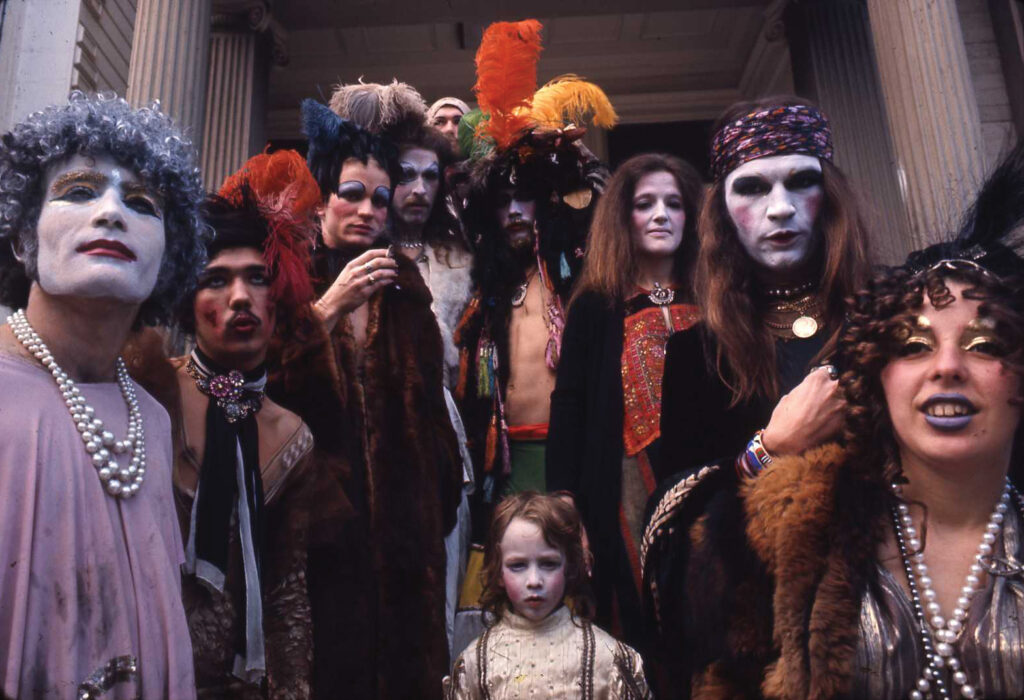
Formed in 1969, The Cockettes were a San Francisco-based avant-garde theater troupe whose penchant for psychedelic satire quickly garnered them a cult following that spread far past their Bay Area surroundings. Founded by drag icon Hibiscus, the group consisted of members from across the gender spectrum, and would eventually expand to include the likes of film superstar Divine and disco legend Sylvester.


PALACE MARQUEE: Screen Shot from Les Ghouls (1971) a short film by Scott Runyon & Syd Dutton”
An Influential Group With Punk Roots
Born out of the burgeoning counter-culture scene of Haight-Asbury, The Cockettes’ work sought to critique and satirize the cultural constructs of the world around them.
“We were just kids…like The Little Rascals in drag doing Busby Berkeley on acid, out to truck our fantasies on stage for the world to see,” says Rumi Missabu, one of the founding and core members of The Cockettes.
Intentionally or not, through expressing those fantasies, The Cockettes created a movement, the tendrils of which can still be seen today in the likes of The Boulet Brothers’ Dragula and the celebrated stage shows of Peaches Christ.
…and while the punk rock ethos of this group would be more than enough to mark their influence on the drag monsters that would follow, The Cockettes’ own forays into fright have also left an indelible mark on queer history.
Though not all of The Cockettes’ original stage shows dabbled in the macabre, one of the most storied (thanks in large part to being preserved in the documentary The Cockettes in the Palace) is the October 1970 production of Les Ghouls.


LES GHOULS DRAWING ADVERT: Steven Arnold, The Rumi Missabu Collection
Mick Jagger and Halloween
Part of a series of shows (billed as “Nocturnal Dreams”) at the Palace Theater, Les Ghouls was an original Halloween production that encompassed dancing tombstones, a parody of 1935’s Bride of Frankenstein, and a show-stopping “Mick Jagger”-fueled finale. Running from October 29th through the 31st of 1970, Les Ghouls was accompanied each night by a screening of George A. Romero’s Night of the Living Dead (itself barely two years old at this point in time) and was admittedly an ever-changing beast thanks to cast extravagance, drug-use, and more.
“To describe the Cockettes’ Halloween extravaganza Les Ghouls is to launch into a catalog of adjectives, none of which would be accurate in of itself, and all of which would only confuse,” says Rumi Missabu.
To be sure, the amorphous nature of the production has led to certain aspects of the show to pass into drag legend, with varying tidbits popping up in a multitude of places (for example, the Noe Hill website suggests that in at least one performance Sylvester played “The Queen of Mars”) and each remembrance juicier than the last.
“With Halloween weekend looming, I jumped right back in the mud puddle declaring to close the show as Mick Jagger,” Missabu says, speaking on the show’s changing aspects. “Our set list varied from night-to-night and I remember covering ‘Little Queenie,’ ‘Shake a Tail Feather,’ and ‘Honkytonk Woman.’”
Though it may seem chaotic to the outsider, it’s this frenetic energy that also gave the Cockettes their edge and helped set the mold for the generations of punk rock, off-the-cuff performers that would follow.


RUMI AS MICK: David Wise. The Rumi Missabu Collection
The Brides of Frankenstein
In her unpublished autobiography, Cockette member Tahara remembers that Les Ghouls had multiple performers playing the Bride of Frankenstein not because of an artistic choice, but simply because they all wanted to do so. While this definitely did not go off without a hitch (there was one incident where one of the “Brides,” played by Goldie Glitters, was locked in a closet and subsequently had an epileptic seizure on stage ), this freewheeling experimentation was a hallmark of The Cockettes’ oeuvre.
Perhaps more importantly, it was also a crucial aspect of the troupe’s bond with the audience.
“When the doors [would] finally open, the crush of bodies that ensued brought to mind the stampede of pushing, shoving humanity that ends Nathanael West’s The Day of the Locust,” says Rumi Missabu about the audience’s fervor at Les Ghouls and other shows. “It’s an audience that has been coached in manner by their idols- The Cockettes…which means they’re straight out of Salvador Dali’s imagination or Antonin Artaud’s madness or Charles Baudelaire’s hash dreams – we were madcap chefs cooking up a storm and the ingredients were magic and tribal anarchy. No one really cared if we could sing or dance; the fact that we dared to assume as much was enough for both ourselves and our audience.”
The Cockettes’ Influence on Modern Queer Horror
By bringing the audience into their domain, the Cockettes could curate a dream or a nightmare and use either to point out the absurdity of the world outside. Their engagement with zombies, monsters, and yes, even Mick Jagger, was a critique of the establishment and a radical exultation of otherness. Much like the Bride of Frankenstein that they were celebrating (and several of them wanted to be) in Les Ghouls, The Cockettes did not ask to be brought into this world, but refused to accept what was given to them merely because it was there.
The legacy of Les Ghouls and The Cockettes continues to be seen in the modern landscape (cult impresario Peaches Christ has referenced them as an influence on her own Midnight Mass), and their radical use of heightened persona is reflected as much in horror as in drag circles (the outrageous works of Troma come to mind).


Halloween Shows Were Just the Beginning
What’s more, their storied Halloween shows were not The Cockettes’ only engagement with the dark lens of the fantastic. The troupe would also appear in the 1971 feature film Luminous Procuress, which centered around a surreal landscape that dealt with bizarre, dreamlike, and horror-infused imagery. In addition to the historical significance of the group’s participation in the film, the cult prestige of Luminous Procuress further cemented The Cockettes jubilant connection to surrealism and otherness.
Later iterations of the troupe would go-on to mount productions of The Masque of the Red Death and upon Divine’s inclusion, do a show that would see the John Waters superstar dressed up as a giant lobster.
Through balancing the strange and absurd with a sense of whimsy, the Cockettes revealed that the horrors of the outside world could be cajoled and critiqued. With glitter and wild abandon, they showed that if we were able to laugh at our fears, we may also be able to conquer them.
…and while it is true that The Cockettes may not have engaged in the gory, blood and guts imagery utilized by later horror intersecting drag artists, it cannot be denied that they laid the foundation to boldly use otherness to fight back and/or simply be.
So, what does drag have to do with horror? The easy answer would be everything, but the correct one is that it depends on how radical you’re willing to become.