


It’s terrifying to imagine living in a body that doesn’t feel quite right. The idea of becoming a stranger to yourself, the unwilling pilot of a vessel whose creation you had no say in, isn’t so out of place for a horror movie. Unfortunately, it’s all too real for many trans people. Manga is one of the unsung mediums for dysphoric body horror. The macabre yet beautiful art of manga allows for visceral interpretations of gender dysphoria. Despite Japan’s complicated relationship with transgender issues, artists from the archipelago have given readers some of the most compelling depictions of dysphoria through body horror.


The Mundane Horror of To Strip The Flesh
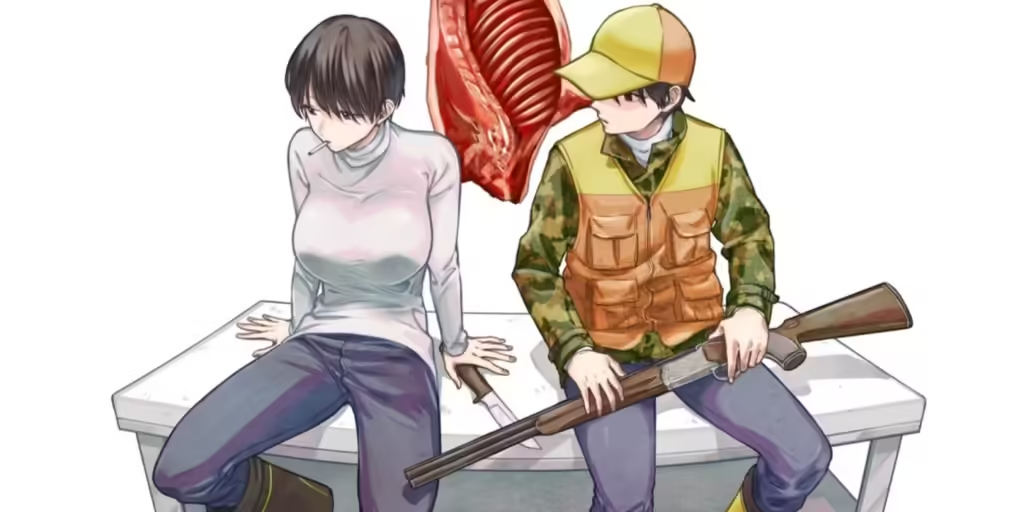
Oto Toda’s To Strip The Flesh (2019) follows Ogawa Chiaki, a pre-op transgender man saving up for his eventual gender-affirming surgery through live-streaming.
The content of these live streams depicts Chiaki expertly butchering fresh game from his father, a professional hunter.
Unfortunately, the high viewership of Chiaki’s livestream comes from his body. Chiaki’s large breasts, curvy hips, and shapely glutes meant more donations, much to his dismay.
Meat is a constant visual motif in To Strip The Flesh. Chiaki separates himself from his body by imagining it as meat. To Strip The Flesh’s title page even depicts Chiaki hung up on hooks by his ankles, like a freshly killed deer. However, Chiaki’s face betrays no fear in this horrifying scenario.
Instead, his face is blank.
Chiaki’s body signals to the world that Chiaki isn’t a man but a woman. Worse, a woman to be objectified, whose only purpose is to arouse men. In a way, Chiaki sees his body as no different from prime cuts at the butcher’s shop. However, instead of hunger, Chiaki’s body satisfies men’s libido.
That alone paints a bleak picture of Chiaki’s life. On top of his dysphoria, Chiaki must rely on his body’s sexuality to finance his gender-affirming surgery. Although Chiaki wanted to be a hunter like his father, the latter insisted Chiaki become a beautiful bride, as his son’s late mother wished.
After his father reveals he has cancer, Chiaki chooses to delay his plans for surgery. Though he hates being a daughter, it’s the daughter that the father loved, not the son. The situation worsens his already fragile mental health, and so he starts to dream.
Chiaki lies naked on the table where he butchers meat. His father approaches the table silently. With gentle hands and a sharp knife, Chiaki’s father cuts away his breasts and takes out his uterus. With all signs of his feminity stripped away, Chiaki smiles and tells his father they can finally hunt together.
All of this happens so matter-of-factly that you almost forget the severity of the scene. A father grabs his son’s breasts and ovaries, but there’s no sexual edge to it. The dream makes it clear Chiaki and his father don’t see these parts as anything but meat. In Chiaki’s ideal world, the person he loves most could cut away his feminine features, and just like that, all would be well.
Reality isn’t so simple.
Gender-affirming surgery helps significantly with gender dysphoria, but it’s far from simple. Surgery is expensive. Finding safe hospitals that even allow the surgery is a nightmare, especially in Japan. To top it all off, it could be life-threatening. There is no fairytale solution to gender dysphoria.
It would be great if our bodies could be so malleable, to shape it however we want. But bodies are fragile, gross, and surprisingly weak. Chiaki knows that yet the anguish of dysphoria far outweighs any risk the gender-affirming surgery may have.
To Strip The Flesh masterfully portrays the existential dread of the transgender experience through a clinical yet surprisingly emotional lens.


Fear and Loathing in Fire Punch
While To Strip The Flesh tackles the mundane horror of dysphoria, the following manga I will discuss does not. Honestly, it’s so off-the-wall that it’s borderline exploitation if not for the heart instilled in it by the author.
Violence doesn’t even begin to describe the post-apocalyptic world of Tatsuki Fujimoto’s Fire Punch (2016). Society has completely broken down after an ice witch cursed the planet into a frozen hellscape. The story follows Agni, a perpetually burning young man on a quest to avenge his dead sister.
Along the way, he meets Togata, a hypercompetent movie buff who constantly references films from before the end times. Togata also reveals he’s lived in this hellscape for over 300 years thanks to his potent regeneration powers. As one of the few friendly faces Agni meets, he starts to see Togata as a big sister.
At first, Togata acts like a comedic sociopath, obsessed with the idea of the “perfect action movie.” Not only that, Togata’s humor is often crude, with constant quips about penises unprompted. The black comedy of Fire Punch brings to mind campy horror classics like Evil Dead 2 and The Texas Chainsaw Massacre 2, where death is just another punchline.
While highly entertaining, the story takes a turn after they encounter a villain capable of reading minds. The telepath cruelly outs Togata as a transgender man, much to Agni’s shock. Suddenly, everything shifts into perspective. The penis jokes, the obsession with hypermasculine movies, and the explosive violence were a facade.
The real Togata hated himself. His regeneration meant that no matter how many surgeries he took, his body would regenerate into a biological woman. Togata had to live in a body he hated for 300 years, incapable of changing it meaningfully. No matter how much he tried to rip himself apart.
After 300 years of constant death, Togata has forgotten who he was. All that’s left is the pain of knowing who he could never be. It’s a brutal form of fictional dysphoria, impossible to overcome on a physical level.
Fire Punch took a comedic character and turned him into a dysphoric tragedy. You don’t need regeneration to feel stuck in the wrong body. People who can’t afford gender-affirming surgery or have existing medical issues that make surgery dangerous already suffer the same way. Togata’s situation may be over-the-top, but his feelings are all-too-real.
Final Thoughts
I’ve only scratched the surface of queer body horror in manga in this article. Other works like Level E and Inside Mari also tackle the concept in visceral ways that depict dysphoria in uncomfortable ways. By evoking the powerful feelings of dysphoria through art, readers can hopefully get a dose of what many trans people experience daily.